BadAss Backlinks · Real Estate SEO · Updated October 2026
Real Estate Link Building: Complete Guide
Real estate link building is earning backlinks from local news, community organisations, property publications and partner businesses to an agent or brokerage website. Those links help an agent outrank portals for neighbourhood and city searches.
TL;DR
- What it is: earning local, property and community links to neighbourhood, agent and service pages.
- Why: 46% of buyers start online and 52% found their home online (NAR 2025).
- How to win: out-local the portals with neighbourhood guides, market data and community links.
- Avoid: link exchanges, link farms and pointing links at duplicate IDX listings.
- Cost: roughly $500 to $1,500 a month for agents, $1,500 to $5,000 for brokerages.
On this page
Free link audit
What do you need?
Local authority for your name
- Local and property publishers
- Data-led PR for agents
- Specs guaranteed or replaced
Guest posts from $85 and niche edits from $69 per link. Monthly plans optional.
1,200+ links delivered · 95% client retention
Get a free agent link audit
Written by Paul with input from BadAss Backlinks founder SVS, based on our property campaigns and a review of the top 10 Google results for “real estate link building” in October 2026.
The direct answer
What is real estate link building?
Real estate link building is earning links from local, property and community websites to a brokerage, agent, developer or property business’s neighbourhood, listing, service and resource pages, so it ranks for searches like “homes for sale in [neighbourhood]” or “best realtor in [city]”. Because big portals dominate generic property searches, the winning strategy is hyperlocal: become the most linked-to authority on specific places and topics.
Home buyers live online. The National Association of Realtors 2025 Profile of Home Buyers and Sellers found 46% of buyers took their first step by looking online (30% of first-time buyers, 50% of repeat buyers), 52% found the home they bought on the internet, 70% used a mobile device in their search, and 85% bought through an agent. The median search lasted 10 weeks. That is ten weeks of searches about neighbourhoods, schools, prices, mortgages and agents, and every one is a chance to be found.
Most published guides on this topic recycle the same generic tactics, and at least one ranking guide still recommends link exchanges, which Google’s spam policy names as link spam when excessive. This guide is built for 2026: how to compete with portals, what links real estate businesses can realistically earn by segment, local data assets, the IDX duplicate content problem, costs and timelines.
Business case
Why link building matters for real estate websites
Portals such as Zillow, Realtor.com and Rightmove hold enormous link profiles, so independent agents and brokerages win by building concentrated authority on local pages the portals cover thinly.
You cannot outspend the portals, but you can out-local them
Portals rank for “[city] homes for sale” with millions of links and listing pages. They are far weaker on “living in [neighbourhood]”, “[suburb] school catchment guide”, “is [neighbourhood] a good place to live” or “[development] review”. These searches come from serious buyers and sellers, and the pages that win them are deeply local and well linked from local sources.
Real estate is a YMYL purchase
Buying a home is the largest financial decision most people make, so it falls under the “Your Money or Your Life” category in Google’s Search Quality Rater Guidelines. Links from credible local institutions, news and property publications are strong trust signals.
Links feed the map pack and AI answers
Google’s local ranking help page says prominence is based on information from across the web, such as links, articles and directories. And when buyers ask an assistant “who are the best agents in [city]”, the answer is shaped by brand mentions; Ahrefs found branded web mentions correlate most with AI Overview visibility.
Segments
Real estate link building by business type
Agents need local authority, brokerages need scale across neighbourhoods, developers need project and PR coverage, property managers need landlord and investor links, and proptech companies need SaaS-style tactics.
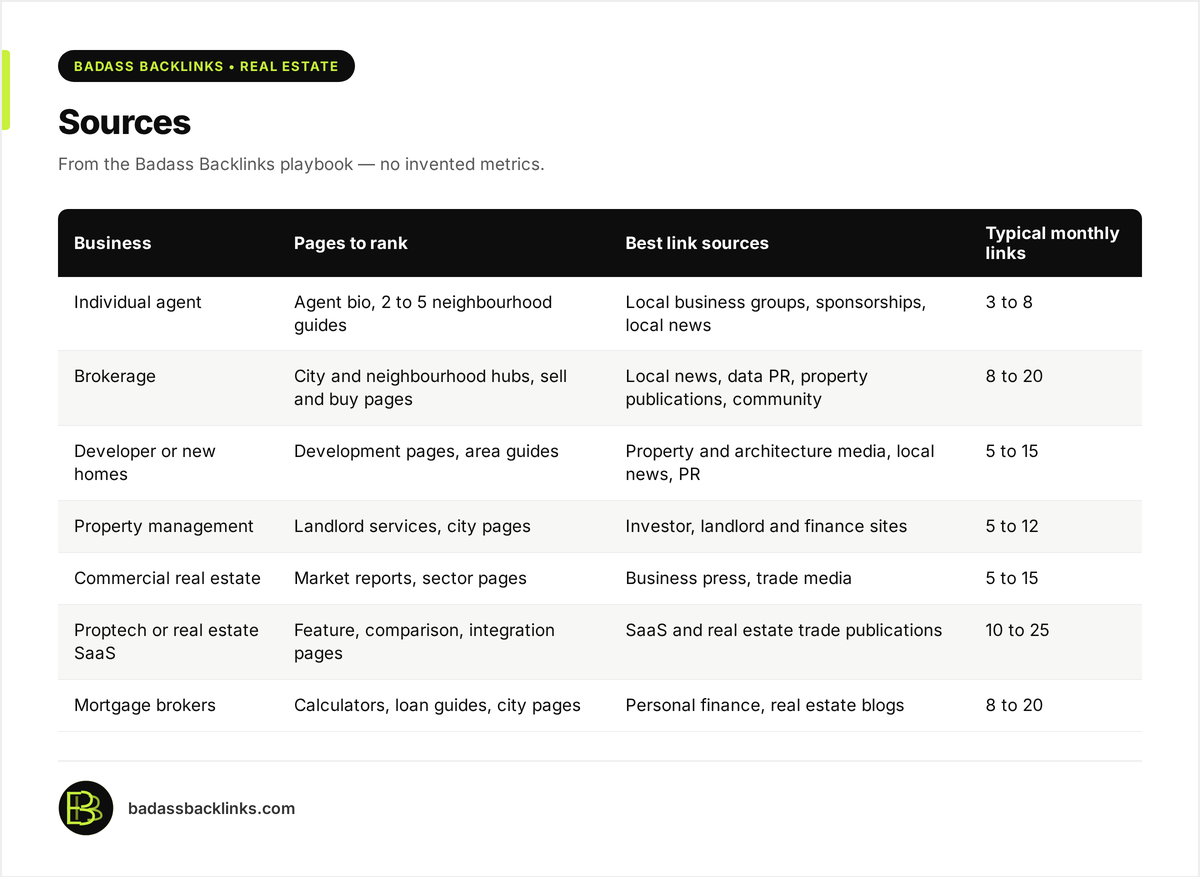
| Business | Pages to rank | Best link sources | Typical monthly links |
|---|---|---|---|
| Individual agent | Agent bio, 2 to 5 neighbourhood guides | Local business groups, sponsorships, local news | 3 to 8 |
| Brokerage | City and neighbourhood hubs, sell and buy pages | Local news, data PR, property publications, community | 8 to 20 |
| Developer or new homes | Development pages, area guides | Property and architecture media, local news, PR | 5 to 15 |
| Property management | Landlord services, city pages | Investor, landlord and finance sites | 5 to 12 |
| Commercial real estate | Market reports, sector pages | Business press, trade media | 5 to 15 |
| Proptech or real estate SaaS | Feature, comparison, integration pages | SaaS and real estate trade publications | 10 to 25 |
| Mortgage brokers | Calculators, loan guides, city pages | Personal finance, real estate blogs | 8 to 20 |
Mortgage and lending pages cross into finance compliance; see our finance link building guide. Proptech companies should also read our SaaS link building guide.
Tactics
13 real estate link building tactics that work
The strongest real estate tactics are local market data reports, neighbourhood guides, local sponsorships and events, expert commentary for local media, relocation content, and partnerships with businesses that serve movers.
1. Monthly or quarterly local market reports
Median prices, days on market, inventory and price changes for your city or neighbourhoods, published on a consistent schedule. Local journalists and bloggers need these numbers and will cite the agency that publishes them reliably. Use MLS or public records data you are allowed to publish, and show your method.
2. Neighbourhood guides that are genuinely better
Real photos, commute times, schools, parks, price ranges, local businesses and honest pros and cons. Local businesses featured in a guide often link to it; relocation blogs cite it.
3. Local sponsorships
Youth sports, school fundraisers, charity events and festivals usually credit sponsors with links. Choose ones your clients care about; the community goodwill matters as much as the link.
4. Expert commentary for local and national media
Reporters covering interest rates, housing supply or local development need fast, specific quotes. Agents who respond quickly become go-to sources.
5. Relocation content
“Moving to [city]” guides attract links from employers, universities, relocation companies and expat sites.
6. Partner businesses that serve movers
Mortgage brokers, inspectors, movers, interior designers, stagers and solicitors or conveyancers. Co-create resources (a home buying checklist, a moving timeline) rather than swapping links, which Google treats as spam when excessive.
7. Guest articles on property and finance publications
Practical advice on buying, selling, investing or renting in your market for property, personal finance and lifestyle publications.
8. Niche edits on local and property guides
Adding a relevant link to an existing, ranking guide about your area shows impact quickly.
9. Local business directories and associations
Chambers of commerce, local business associations, your real estate board and brokerage profile pages. Keep NAP data identical.
10. University and employer housing pages
Universities and large employers maintain housing and relocation resources and link to useful local guides.
11. Development and project PR
New developments, regeneration projects and award-winning designs attract architecture, design and local news coverage.
12. Tools and calculators
Affordability, stamp duty or transfer tax, rent vs buy and commute calculators earn links from finance and property blogs.
13. Unlinked mentions and reviews
Agents mentioned in local news, award lists or podcasts without a link are easy wins.
Free, no obligation
See where competing agents get their links
We compare your site with the top agents and brokerages in your market and list the local links, citations and media mentions you are missing.
Get a free real estate link auditPR
Digital PR for real estate: turning local knowledge into coverage
Real estate digital PR works when you give journalists a timely, local, data-backed story they could not easily produce themselves, plus a quotable expert.
Housing is one of the most covered topics in local and national news. Interest rate moves, affordability, rents, new developments, school catchments and seasonal market shifts all generate stories, and every one needs a local angle and an expert. Agents and brokerages have both. The gap is usually process: nobody is watching the news cycle, preparing data, or responding to journalist requests within hours.
Story angles that work
- Affordability: how many years of median income it takes to buy in each neighbourhood.
- Price gaps: the premium buyers pay to live near top-rated schools or transit stations.
- Seasonality: the best and worst months to list in your city, from your own sales data.
- Generational trends: where first-time buyers are actually buying.
- Reactive commentary: what a rate decision means for local buyers this week.
- Quirky local data: the streets with the most price growth, the oldest housing stock, the most pet-friendly areas.
How to run it
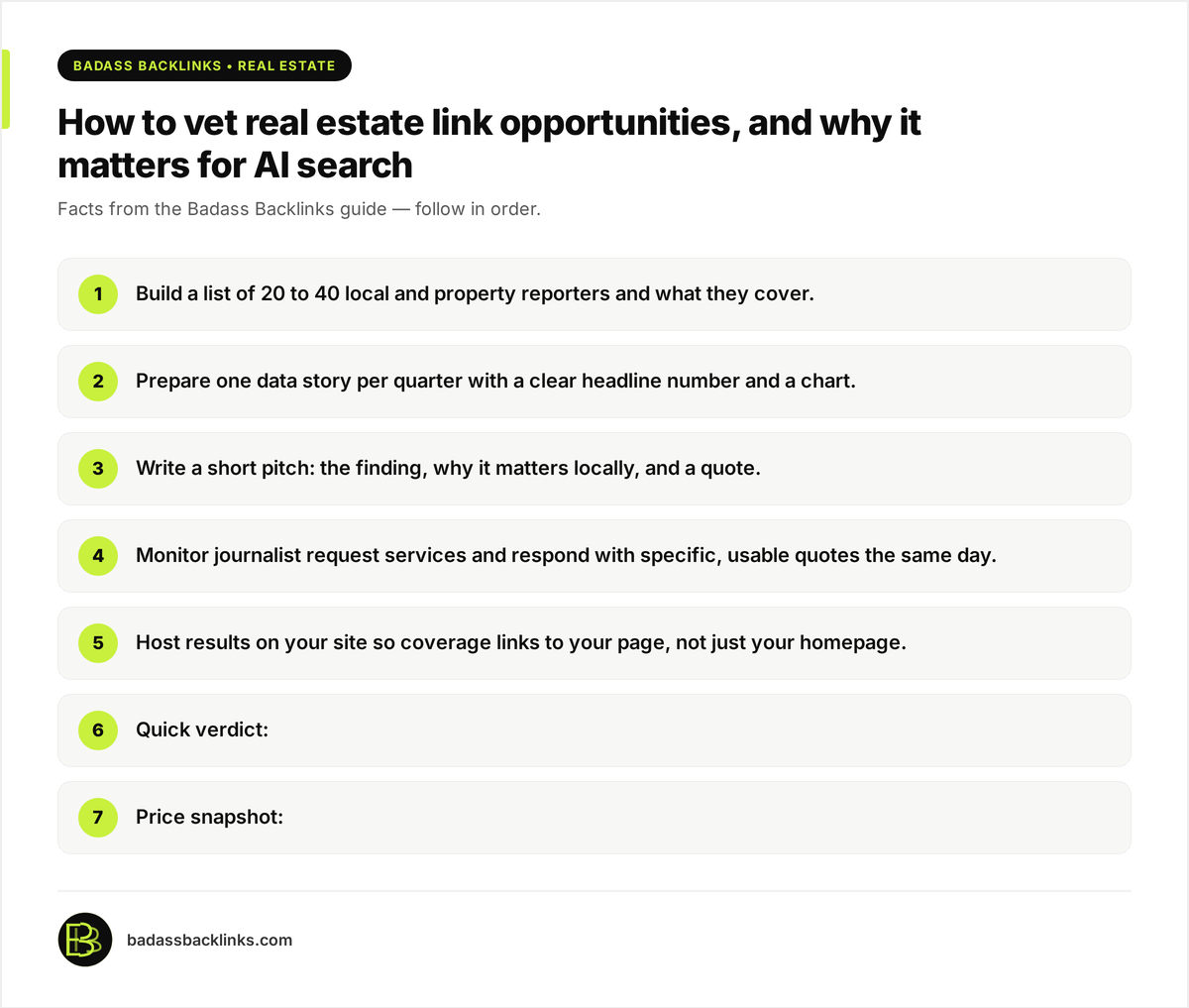
- Build a list of 20 to 40 local and property reporters and what they cover.
- Prepare one data story per quarter with a clear headline number and a chart.
- Write a short pitch: the finding, why it matters locally, and a quote.
- Monitor journalist request services and respond with specific, usable quotes the same day.
- Host results on your site so coverage links to your page, not just your homepage.
One well-placed local news link can lift neighbourhood pages more than a dozen generic guest posts, and it generates the branded mentions that matter for AI search. For campaigns run end to end, see our digital PR service.
Assets
Hyperlocal data assets: the real estate link magnet
Original local data is the single most reliable way for a real estate business to earn press links, because local reporters need numbers and portals rarely produce hyperlocal stories.
| Asset | Data needed | Who links |
|---|---|---|
| Neighbourhood price index | Sales prices by area over time | Local news, bloggers |
| Most affordable neighbourhoods list | Prices plus incomes | Local and national media |
| Rent vs buy by area | Rents, prices, mortgage rates | Personal finance sites |
| School catchment price premium | Prices near schools | Parents’ blogs, local news |
| Commute and transit map | Commute times | Relocation sites, employers |
| New development tracker | Planning and permits data | Local news, community groups |
Publish each asset on your site with a short summary, a chart, a clear method, the date and a contact for journalists. Pitch it to two or three local reporters with a specific story angle. Update it on a schedule so it keeps earning links.
Content
The neighbourhood guide blueprint that earns links
A link-worthy neighbourhood guide answers every question a buyer has about living there, with original photos, current numbers and honest trade-offs, and is clearly better than the portal’s area page.
Most agent sites publish neighbourhood pages that are a paragraph of generic copy and a listings widget. They do not rank and nobody links to them. Local bloggers, relocation sites, employers and journalists link to guides that save them research. Use this structure:
- Quick verdict: two or three sentences on who the area suits and who it does not.
- Price snapshot: median sale price, typical price range by property type, and rent ranges, with a date and source.
- Schools and childcare: catchments and how they affect prices, linking to official school data.
- Getting around: commute times to main employment centres at rush hour, transit options, walkability.
- Daily life: independent shops, parks, gyms, restaurants and community events, named and photographed.
- Safety and noise: link to official crime data rather than opinions.
- Future changes: planned developments, transport projects and zoning changes.
- Pros and cons: a short honest list.
- Local expert: the agent’s experience in the area, recent activity where permitted, and contact.
- FAQ: the questions you hear from clients every week.
Then promote it: tell every business you featured, share it with local community groups, offer it to relocation services and HR teams at large local employers, and update it at least twice a year. A handful of strong guides, each with real local links, usually outperforms dozens of thin ones.
Seller-focused content earns links too
Sellers search for “how much is my home worth in [area]”, “best time to sell in [city]” and “cost of selling a house in [state]”. Content that answers these with real local numbers (typical fees, transfer taxes, days on market by season) gets cited by personal finance writers and local media, and it targets the clients who generate listings.
Quality
How to vet real estate link opportunities, and why it matters for AI search
A good real estate link comes from a site with real local or property readers, steady organic traffic, topical relevance and editorial standards; most “real estate guest post” lists fail at least one of these.
- Audience location: traffic should come mainly from the country, and ideally the region, you serve.
- Traffic trend: stable or rising over 12 months. Sites that collapsed after a core update are a risk.
- Topic: property, local life, personal finance, home and design, relocation. Not everything at once.
- Outbound links: recent posts should not be stuffed with unrelated commercial links.
- Editorial signals: named authors, edits, rejections. If anything is accepted, the link is worth little.
Being recommended by AI assistants
Buyers increasingly ask assistants “who are the best agents in [area]” or “which neighbourhoods in [city] are good for families”. Answers draw on local news, guides, review platforms and directories. Ahrefs’ research found branded web mentions correlate more strongly with AI Overview visibility than backlinks alone. Make sure your agency is named, with its area and specialism, on local news, community sites and property publications, and keep review profiles active. The same work that earns local links builds that footprint.
Doing it yourself vs hiring help
Agents have advantages agencies cannot buy: relationships with local businesses, community roles and genuine market knowledge. The best results usually come from combining the two. Agents supply local access, quotes and data; a link building partner handles research, writing, outreach and reporting so the work happens every month rather than when things are quiet. If you work with an agency, insist on local and property-relevant placements only, and get the traffic and topic of every site in writing.
Foundations
Fix IDX duplicate content and internal links before building links
Most real estate sites use IDX listing feeds that duplicate the same content found on hundreds of other sites, so links should point at your unique pages, not at syndicated listings.
IDX feeds are useful for visitors but give Google little reason to rank your version of a listing over the portal’s. Build unique neighbourhood, guide and service pages, then link from them to relevant listing searches. Point backlinks at the unique pages, and use internal links to pass authority where you need it.
- Create one unique hub page per city and per priority neighbourhood.
- Make agent bio pages substantial: experience, areas, recent transactions where allowed, reviews.
- Interlink neighbourhood guides, market reports and service pages logically.
- Check that listing pages do not create thousands of thin, indexable duplicates.
- Keep page speed and mobile usability strong; NAR found 70% of buyers used a mobile device in their search.
Local playbook
Earning community links the right way, plus commercial real estate
Community links (sponsorships, charities, schools, clubs and local business groups) are the backbone of real estate link building because they are local, relevant and hard for portals or out-of-town competitors to copy. Choose them for genuine community value first; the link is a bonus.
How to choose sponsorships and partnerships
- Relevance to your clients: youth sports, school fundraisers, neighbourhood associations, farmers markets and local arts events reach families and homeowners in your patch.
- A real web presence: check that the organisation has a sponsor or partner page that is indexed and kept up to date.
- Lasting value: annual sponsorships keep your name on the page year after year and build a relationship rather than a one-off link.
- Coverage potential: events that local news covers can earn a second link from the article.
- Fit with your brand: sponsor things you would be proud to talk about on your own site and social channels.
Google’s guidance on qualifying outbound links says links that are part of sponsorships or paid arrangements should be marked sponsored. Many community sites will add the attribute, and that is fine: the value of these links lies in local relevance, brand mentions and referral visitors, not only in ranking credit. Google’s local ranking guidance points to information about a business from across the web, including links, articles and directories, as part of prominence.
Turn involvement into content
Write about what you sponsor: a recap of the charity run, an interview with the youth league coach, a guide to the farmers market vendors. Share it with the organisation, which often links to it, and use it in neighbourhood guides. This gives your community work a second life as linkable, locally relevant content.
Reviews and links work together
Google’s local ranking guidance also says review count and review score factor into local ranking. Agents who ask every closed client for a review, respond to reviews professionally and earn local links tend to strengthen map pack visibility faster than agents who do only one of the three. Link your best reviews and testimonials pages from neighbourhood guides where your rules on testimonials allow, and make sure your Google Business Profile links to the most relevant location page rather than the homepage.
Commercial real estate
Commercial brokers, investors and developers serve a business audience, so the link sources shift. Business journals, trade publications covering office, retail, industrial and multifamily property, economic development agencies, chambers of commerce and local business news are the core targets. The most effective assets are quarterly market reports by sector (vacancy, absorption and rents), development pipeline trackers and analysis of major leasing or investment deals. Business reporters cite these reports, and economic development sites link to them as resources for companies considering a move. Expert commentary on interest rates, office demand and local projects completes the mix. Because deal sizes are large, even a modest increase in qualified enquiries from search can justify a sustained programme.
Budget
How much does real estate link building cost?
Individual agents typically spend $500 to $1,500 a month, brokerages $1,500 to $5,000, and developers or proptech companies more depending on PR needs.
Across niches, PressWhizz’s 22,703-order dataset puts the average placement at $161.25 and the median at $112, while Ahrefs’ outreach test found sites quoted an average of $361.44 for a link insertion. Local links from sponsorships and community work often cost less in money and more in time.
| Business | Monthly budget | Time to see movement |
|---|---|---|
| Individual agent | $500 to $1,500 | 3 to 6 months |
| Brokerage | $1,500 to $5,000 | 4 to 9 months |
| Developer, proptech, CRE | $2,500 to $8,000+ | 4 to 12 months |
These ranges come from our campaigns and are planning figures, not quotes. See our real estate backlink packages and pricing page.
Estimate your real estate link budget
Estimated monthly investment:
Uses $150 to $500 per real estate editorial or local link. Sponsorships and data PR campaigns are priced separately.
Get an exact quoteExecution
Anchor text and a 90-day plan for real estate
Lead with your brokerage or agent name, use neighbourhood and service phrases naturally, and follow a 90-day plan that fixes foundations, publishes one data asset and earns steady local links.
| Anchor type | Example | Suggested share |
|---|---|---|
| Brokerage or agent name | Harbor Homes Realty | 35% to 50% |
| Naked URL | harborhomes.com | 10% to 15% |
| Natural | this neighbourhood guide | 15% to 25% |
| Partial match | Westside homes guide from Harbor Homes | 10% to 15% |
| Exact match | Westside realtor | Under 5% |
These shares are planning guidance from our campaigns, not a Google rule; compare against the top local competitors.
Days 1 to 30
- Audit your links, citations and Google Business Profile.
- Fix NAP inconsistencies and claim board, chamber and portal profiles.
- Pick three priority neighbourhoods and one service page.
- Rebuild those pages using the guide blueprint above.
Days 31 to 60
- Publish your first local market report.
- Pitch it to two or three local reporters and community newsletters.
- Secure two or three sponsorships or community partnerships.
- Start guest posts on property and personal finance publications.
Days 61 to 90
- Add niche edits on ranking local guides.
- Reach out to employers and universities with your relocation content.
- Report rankings, map pack visibility, calls and valuation requests.
- Schedule the next report so journalists know when to expect it.
Risk
Real estate link building mistakes to avoid
The most damaging real estate link building mistakes are chasing national links with no local relevance, buying directory bundles and pointing every link at the homepage. Each mistake below has a fix.
- Link exchanges with other agents. Excessive exchanges are named in Google’s spam policies.
- Buying general “real estate guest posts” from link farms. Many sell to any niche and lose traffic after updates.
- Sending links to IDX listing pages. They are temporary and duplicated.
- Thin neighbourhood pages. A paragraph and a listing widget will not earn or hold links.
- Ignoring local signals. Inconsistent NAP data and no local links hold back map pack rankings.
- Exact-match anchors. “Best realtor in Austin” repeated across links is a footprint.
- Stopping market reports. Consistency is what makes journalists rely on you.
Related reading: real estate backlinks explained, guest posting sites by niche and link building costs.
Markets
Real estate link building outside the US
The same principles apply in the UK, Canada and Australia, but the portals, data sources and local publications differ, so link targets must be market-specific.
| Market | Dominant portals | Useful local data | Typical link sources |
|---|---|---|---|
| United States | Zillow, Realtor.com, Redfin | MLS data, county records | Local news, real estate boards, relocation sites |
| United Kingdom | Rightmove, Zoopla, OnTheMarket | HM Land Registry price paid data | Local press, property and finance publications, community groups |
| Canada | Realtor.ca and regional boards | Board market statistics | City news, immigration and relocation resources |
| Australia | realestate.com.au, Domain | State valuer and sales data | Local news, property investor media, community clubs |
For each market, use official open data where licensing allows, follow local advertising rules for property marketing, and target publications that local buyers actually read. A UK estate agent gains little from US real estate blogs, however high their domain rating.
How to measure success
- Valuation requests, buyer enquiries and calls from organic search and the map pack.
- Rankings for priority neighbourhood, service and agent name queries.
- Map pack visibility across a grid of your service area.
- Referring domains to neighbourhood hubs compared with local competitors.
- Mentions in local media and AI answers for “best agent in [area]” style prompts.
Real estate SEO rewards consistency. The agents and brokerages that dominate local search usually did not do anything clever; they published useful local content for years, supported their community, and kept earning links month after month while competitors started and stopped.
Expert insight
Expert insight on real estate link building
The quotes below are verbatim public statements, linked to the original source. We have not interviewed these people; the case study figures are our own client results.
“Google uses links as a signal when determining the relevancy of pages and to find new pages to crawl.”
Google Search Central, Link best practices for Google
“Google’s automated ranking systems are designed to prioritize helpful, reliable information that’s created to benefit people, and not content that’s created to manipulate search engine rankings.”
Google Search Central, Creating helpful, reliable, people-first content
From our case study data
Home service brand case study: A 90-day local campaign built 84 links, lifted organic traffic from 3,100 to 9,680 visits a month and grew page-1 keywords from 7 to 26. Read the full case study
Conclusion
The bottom line on real estate link building
Real estate link building works best when it is local: neighbourhood content, community partners and local press. Build those links steadily and real estate link building lets an agent compete where portals are weakest.
Quick answers
Quick answers about real estate link building
Short, direct answers to the questions people ask search engines and AI assistants about real estate link building.
How do real estate agents get backlinks?
Real estate agents get backlinks from local news, sponsorships, community groups, neighbourhood guides, market reports and partner businesses such as mortgage brokers and movers.
Can a local agent outrank Zillow?
A local agent rarely outranks portals on broad city terms, but can win neighbourhood, school-district and long-tail searches with local links and content.
What content earns links for a real estate website?
Local market reports, neighbourhood guides and data on prices or rents earn the most links for real estate websites.
How much does real estate link building cost?
Real estate link building costs depend on the market and link type; the cost section on this page lists published ranges.
Are real estate directories worth it?
Major real estate directories help citations and trust, but most low-quality directories add nothing.
How long does real estate link building take?
Local real estate link building usually shows ranking movement after a few months, and our home service case study grew page-1 keywords from 7 to 26 in 90 days.
Questions
Frequently asked questions
What is real estate link building?
Earning links from local, property and community websites to a real estate business’s neighbourhood, agent, service and resource pages to improve rankings and local visibility.
How can a small agent compete with Zillow?
Focus on hyperlocal pages portals cover thinly, such as detailed neighbourhood guides, local market reports and relocation content, and earn local links to them.
Are link exchanges with other agents safe?
Occasional natural cross-links are fine, but Google lists excessive link exchanges as link spam. Co-create resources with partners instead.
What are the best backlinks for realtors?
Local news, chambers of commerce, sponsorships, real estate boards, property and personal finance publications, relocation resources and universities.
How much does real estate link building cost?
Individual agents usually spend $500 to $1,500 a month; brokerages $1,500 to $5,000; developers and proptech more.
How long until links improve rankings?
Most real estate sites see movement in three to six months for neighbourhood terms, longer for city-wide terms.
Does digital PR work for local agents?
Yes. Local reporters regularly need housing data and quotes. Publishing a consistent market report and responding quickly to journalist requests is one of the best ways for agents to earn high-authority links.
Should I build links to listing pages?
Rarely. Listings are temporary and often duplicated across IDX sites. Build links to unique neighbourhood and service pages.
Do backlinks help the Google map pack?
Yes. Google says prominence draws on links, articles and directories from across the web, alongside reviews.
Should real estate sponsorship links be marked sponsored?
Google asks for paid or sponsorship links to be qualified with rel=”sponsored”. Many community sites do this. The links still provide local relevance, brand mentions and referral visits, which support local prominence.
What content earns the most links for estate agents?
Consistent local market reports, detailed neighbourhood guides, relocation guides and data stories about affordability or school catchment prices. These give journalists, bloggers and employers a reason to cite you.
How many links does a real estate website need?
Enough to match the local competitors outranking you for each neighbourhood or city term. Individual agents often need only a few strong local links a month; brokerages covering many areas need more. Benchmark the top five local competitors first.
Do links from other countries help a local agent?
Rarely. Links from publications serving your own market and region are far more relevant. A UK estate agent gains little from US real estate blogs, whatever their authority.
Is link building worth it for a solo agent?
Usually, if it is focused. A solo agent who owns a few neighbourhoods can win local searches with a handful of strong guides, steady community links and consistent reviews, without competing for city-wide terms dominated by portals.
References
Sources
Every statistic on this page links back to the original publisher below. Figures were checked on 24 October 2026.
- National Association of Realtors, 2025 Profile of Home Buyers and Sellers (highlights): 46% of buyers’ first step was looking online for properties; 52% found the home they bought online; median search 10 weeks. www.nar.realtor/sites/default/files/2025-11/2025-profile-of-home-buyers-and-sellers-highli
- Google Search Quality Rater Guidelines: Defines YMYL topics, including financial and legal topics, and applies the highest Page Quality standards to them. static.googleusercontent.com/media/guidelines.raterhub.com/en/en/searchqualityevaluatorgui
- Ahrefs, AI Overview brand visibility factors (75K brands): Branded web mentions had a 0.664 correlation with AI Overview visibility, branded anchors 0.527, backlinks 0.218. ahrefs.com/blog/ai-overview-brand-correlation
- Google Search Central, Spam policies for Google web search: Defines link spam, including buying or selling links that pass ranking credit, excessive link exchanges and large-scale guest posting campaigns with keyword-rich anchors. developers.google.com/search/docs/essentials/spam-policies
- PressWhizz, Link Building Pricing Report 2026: 22,703 completed placements worth $3.66M; average $161.25, median $112; casino $252, sports $246 and finance $221 among the most expensive niches. presswhizz.com/case-studies/link-building-pricing-report
- Ahrefs, Should You Buy Backlinks: Average quoted price for a paid link insertion $361.44 (450 sites, nine niches); paid guest posts $77.80; only 12.6% of sites agreed to sell; cites Authority Hacker’s $83 average. ahrefs.com/blog/buy-backlinks
- Google Business Profile Help: local ranking: Relevance, distance and prominence; prominence uses links, articles, directories and reviews.. support.google.com/business/answer/7091