BadAss Backlinks · Link Building Guide · Updated October 2026
Guest Posting in 2026: The Complete Playbook (Outreach to Published)
Guest posting is writing an article for another website in exchange for exposure and, usually, a backlink. Guest posting still works in 2026 when the site is relevant, the article is genuinely useful and the link is not bought purely for rankings.
TL;DR
- Google does not ban guest posting. It targets guest posts written at scale with keyword-rich links.
- BuzzStream analysed about 257,000 guest post sites: 96.2% were low quality and 39.6% had zero organic traffic.
- Average guest post prices: $461 through vendors and $295 direct in BuzzStream data; $77.80 in Ahrefs outreach tests.
- Use a seven-point filter before you pay or pitch anyone, and keep anchors branded or descriptive.
On this page
Guest posts that count
What do you need?
We place guest posts on real sites with real traffic, vetted against the filter in this guide.
- Sites vetted for real traffic
- Editorial content written by specialists
- Branded and descriptive anchors
Guest posts from $85 and niche edits from $69 per link. Monthly plans optional.
See guest posting service
Guest posting has been declared dead roughly every year since 2014. It is still one of the most common ways SEO teams earn links, because it is one of the few tactics where you control the topic, the timing and the target page. What has died is the version where you buy a post on a site nobody reads and stuff it with your money keyword.
This playbook takes one guest post from outreach to published: the rules and market data you need first, then eight steps covering prospecting, vetting, pitching, follow-up, writing, approval, publication and verification. If you would rather outsource the whole thing, our guest posting service uses exactly the filter below.
Overview
The guest posting playbook at a glance
This playbook runs one guest post from first search to a verified, indexed link. Each step below has a clear output, so you can see where a campaign is stuck. Before step one, two pieces of context: what Google allows, and what the market looks like.
Most guest posting campaigns fail between steps 3 and 6: pitches go unanswered, accepted drafts stall in editing, or a post goes live with the link removed. The steps on follow-up, approval and verification are where this playbook differs from a list of tips.
Definition
What is guest posting for SEO?
An SEO guest post is an article you write for another website, published under your name or brand, that includes a link back to your site. The host gets free content. You get exposure to their audience and, if the link is followed, a backlink that can pass ranking signals.
The backlink is where guest posting gets complicated. A guest post is legitimate content marketing when the article is useful to the host’s readers and the link is there because it helps them. It becomes link spam when the article exists only to carry the link. Google draws the line in its Google Search Central: “large-scale article campaigns or guest posting campaigns with keyword-rich anchor text links” are listed as a link scheme.
So the question is never “is guest posting allowed?” It is “would this post exist if links did not pass PageRank?” If the answer is yes, you are fine. If not, you are probably wasting money, because the link is likely to be ignored.
Reader poll
Your vote is saved in this browser only. No live tally is stored on a server, so results show votes cast on this device.
Before you start
Before you start: what Google says about guest posting
Google has addressed guest posting directly several times. Three statements matter.
The 2017 reminder
In Google Search Central Blog, Google said it had seen “an increase in spammy links contained in articles referred to as contributor posts, guest posts, partner posts, or syndicated posts.” The warning signs it listed were stuffing keyword-rich links into articles, publishing the same articles across many sites, using writers with no knowledge of the topic, and using the same or similar content across articles. Note what is not on that list: writing a genuinely useful article for a relevant site.
Link attributes
Google’s Google Search Central page says sponsored or paid links should use rel="sponsored". If you pay for placement, Google expects the link to be qualified. Many publishers ignore this, which is exactly why Google’s systems try to identify and discount paid placements algorithmically.
Site reputation abuse
In March 2024 Google introduced a Google policy covering site reputation abuse: third-party content published on a strong site mainly to exploit that site’s ranking signals. Enforcement began in May 2024, starting with manual actions. Google’s SearchLiaison account confirmed the timing publicly.
@thatkatieberry It’ll be starting later today. While the policy began yesterday, the enforcement is really kicking off today.
Google SearchLiaison (@searchliaison) May 6, 2024
@rustybrick @glenngabe @LauraChiocciora Not sure if you’re still online, Barry — but we’re only doing manual actions right now. The algorithmic component will indeed come, as we’ve said, but that’s not live yet.
Google SearchLiaison (@searchliaison) May 7, 2024
Site reputation abuse mainly hit coupon, review and affiliate sections hosted on news sites, not individual guest posts. The lesson for guest posting is the same though: third-party content that has nothing to do with the host’s audience is now a policy target, not just a quality problem.
Before you start
Before you start: the guest post market in numbers
The biggest public dataset on guest post sites comes from BuzzStream. Its BuzzStream study analysed about 257,000 sites offering guest posts and found the market is mostly junk.
Average guest post price by source (USD)
Sources: BuzzStream guest post cost study; PressWhizz 2026 pricing report (22,703 placements); Ahrefs outreach experiment.Prices vary by method. The Ahrefs Ahrefs experiment found an average paid guest post quote of $77.80, while link insertions averaged $361.44, and only 12.6% of contacted sites agreed to sell at all. PressWhizz data from 22,703 completed placements puts the average at $161.25 and the median at $112. And practitioners expect more: the Editorial.Link survey of 518 SEOs found the average acceptable price for one high-quality link was $508.95, with 80.9% expecting costs to rise.
The gap between $78 and $500 is the gap between “a site that will publish anything” and “a site with editors and readers.” You usually get what the price suggests.
Step 1
Step 1: Find guest post sites worth pitching
The best guest post targets are rarely on vendor lists. They are sites your audience already reads. Five ways to find them:
| Method | How | What to watch |
|---|---|---|
| Search operators | “write for us” + topic, “guest post guidelines” + topic, “contribute” + topic, intitle:”write for us” | Operator results skew towards sites that advertise for content; vet harder |
| Competitor backlinks | Export referring domains of the three pages outranking you; filter for blog and article URLs with bylines from other companies | Shows which hosts already accept contributors in your niche |
| Author footprints | Search the names of prolific writers in your niche to see where they contribute | Good hosts tend to attract good writers |
| Newsletters and podcasts | Hosts that run newsletters often run contributor programmes | Audience quality is usually higher |
| Partners and customers | Integrations, suppliers and clients with blogs | Natural relevance, easy yes |
Our guide to using Google to find backlink opportunities lists more operators. Whatever the source, every site still goes through the seven-point filter.
Guest posting compared with other tactics
| Tactic | Control over topic and anchor | Typical cost signal | Scales? |
|---|---|---|---|
| Guest posting | High | $78 to $461 average per post in published studies | Yes, with vetting |
| Niche edits | Medium (existing article) | $361.44 average insertion quote in Ahrefs test | Yes, riskier |
| Digital PR | Low (journalist decides) | $300 to $500 most common cost per link (BuzzStream) | Campaign-based |
| Unlinked mentions | Low | Staff time only | Limited by mentions |
Guest posts sit in the middle: more control than digital PR, more editorial context than niche edits. Most balanced campaigns use all three.
Step 2
Step 2: Vet every site with the 7-point filter
Run every site through these seven checks before you pitch or pay. If a site fails two or more, walk away.
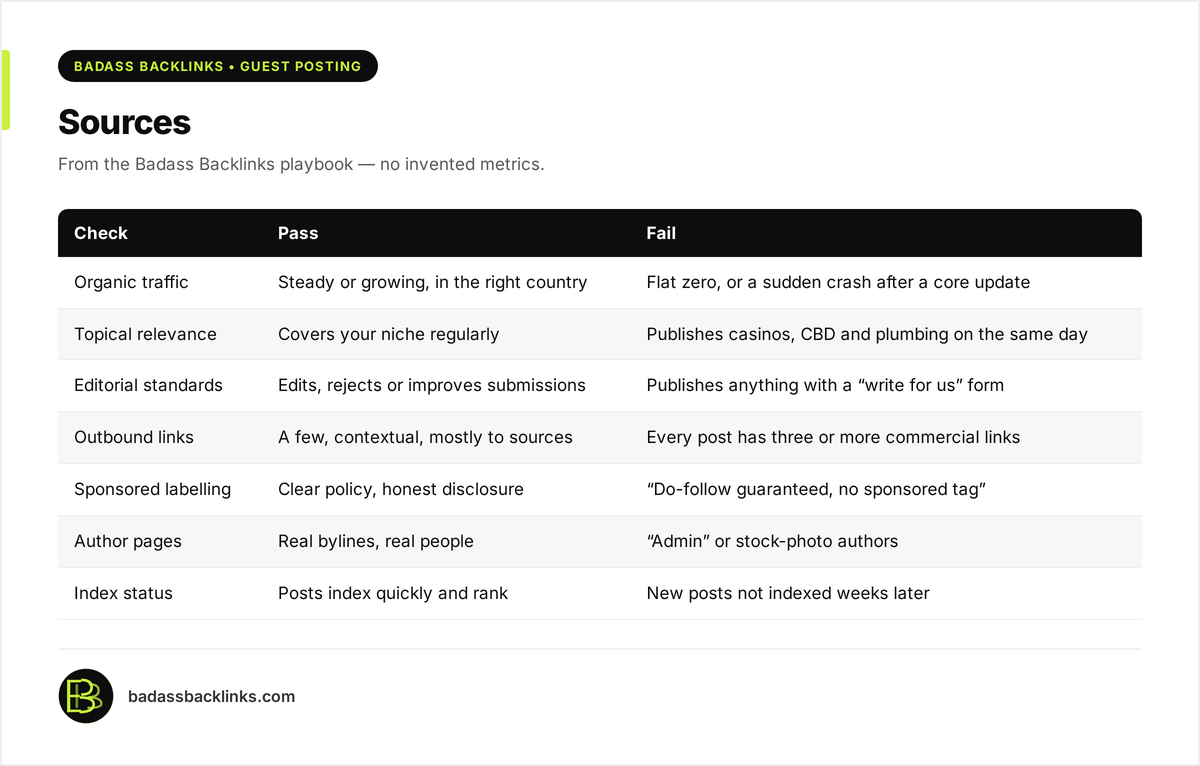
| Check | Pass | Fail |
|---|---|---|
| Organic traffic | Steady or growing, in the right country | Flat zero, or a sudden crash after a core update |
| Topical relevance | Covers your niche regularly | Publishes casinos, CBD and plumbing on the same day |
| Editorial standards | Edits, rejects or improves submissions | Publishes anything with a “write for us” form |
| Outbound links | A few, contextual, mostly to sources | Every post has three or more commercial links |
| Sponsored labelling | Clear policy, honest disclosure | “Do-follow guaranteed, no sponsored tag” |
| Author pages | Real bylines, real people | “Admin” or stock-photo authors |
| Index status | Posts index quickly and rank | New posts not indexed weeks later |
If you are comparing vendors, our reviews of the best guest posting services apply the same checks. Niche lists such as SaaS guest post sites and finance guest post sites are a starting point, not a shortlist; vet every one.
Guest posts done properly
Want guest posts on sites people actually read?
We vet every site against the seven checks above, write specialist content and place it with natural anchors. Every site meets the DR, traffic and niche you ordered, or we replace it.
See our guest posting serviceStep 3
Step 3: Pitch the editor
Editors receive a lot of pitches. The Muck Rack survey of 1,515 journalists found 86% disregard pitches that are not relevant to their beat. Blog editors behave similarly. A good guest post pitch is short and specific.
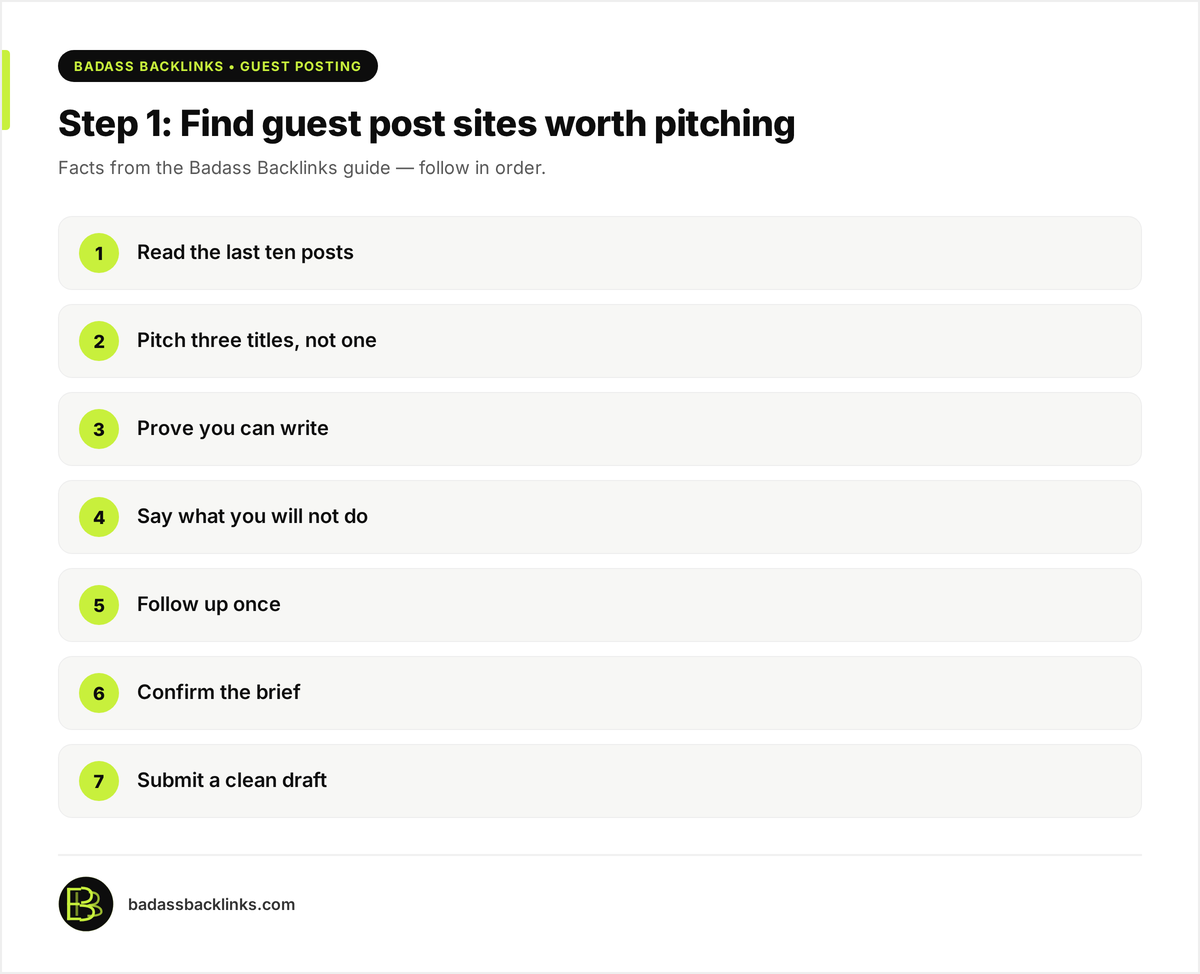
- Read the last ten posts. Find a gap: a topic they have not covered, or covered thinly.
- Pitch three titles, not one. Each with a one-line angle that shows you understand their reader.
- Prove you can write. Link to one or two published pieces, not your service page.
- Say what you will not do. No promotional copy, no keyword stuffing. Editors are relieved to read it.
- Follow up once. A week later, briefly.
Example pitch
Step 4
Step 4: Follow up without burning the contact
Editors are busy, and many good pitches are simply missed. A short, polite follow-up is normal. Our process:
| When | What to send | Rule |
|---|---|---|
| Day 0 | Original pitch with 2 or 3 headline ideas | One editor, one personalised email |
| About 5 business days later | One-line follow-up in the same thread | Add a new angle or a relevant recent post |
| About 10 business days later | Final note offering to withdraw the ideas | Then stop and mark the site |
| Any reply | Answer within one working day | Speed wins assignments |
These timings are our working practice, not an industry standard. Never follow up more than twice, never switch to a second editor at the same site without being asked, and keep a simple tracker with site, contact, date, status and next action. A tracker turns outreach from guesswork into a pipeline you can measure.
Step 5
Step 5: Write the post and place the link
Write the post to be the best article on the host site that month. That is the standard that gets you invited back and keeps the link alive.
- Match the host’s format. Length, tone, heading style, image use.
- Bring something original. A data point, a worked example, a screenshot from your own work.
- Link out to sources. Two or three authoritative citations make the post look editorial, because it is.
- Place your link where it helps. In the body, pointing to a page that expands on the point. Not in the first sentence, not in the bio only.
- Use a branded or descriptive anchor. See below.
Anchors in guest posts
Guest posts are the one tactic where you choose the anchor, which is why they are the one Google watches most closely for anchor manipulation. The Ahrefs study found the median exact-match share among top-20 pages was 0%. We default to branded anchors, naked URLs and descriptive partial phrases, and never repeat the same commercial anchor across hosts.
Step 6
Step 6: From acceptance to approval
An acceptance is not a link. Between “yes” and “published” there are usually three stages: the brief, the draft and the edit.
- Confirm the brief. Agree the title, angle, word count, deadline, image rules and link policy in writing before you write.
- Submit a clean draft. Use the host’s format (Google Doc or CMS draft), include sources and suggested images with credits.
- Handle edits fast. Accept style changes without argument. If the editor removes your link, ask once whether a different, more useful page would fit.
- Agree the publish date. Ask when it is scheduled and whether you can share it on publication.
- Do not pay for editorial acceptance. If money changes hands, the link should be rel=”sponsored”.
Treat the editor as a long-term contact. A smooth first post is how you get a second invitation, and repeat contributors are the most efficient guest posts in any campaign.
Step 7
Step 7: Publish a post that works, not one that gets ignored
A guest post works when it answers a real reader question better than the host site’s existing posts, links naturally and gets promoted after publication.
Guest posts that still work
- Relevant site with real organic traffic
- Article written for that site’s readers
- One contextual link to a useful page
- Branded or descriptive anchor
- Byline from a real person with expertise
Guest posts that get ignored
- Sites selling posts on every topic
- Spun or AI-padded articles
- Multiple commercial links per post
- Exact-match anchors, repeated across sites
- Posts hidden from the homepage and category pages
The BuzzStream roundup found 61% of organisations manage link building fully in-house and only 30% of teams using external link builders are fully confident in their results. Confidence is low because so many placements go on sites from the 96.2% bucket. The answer is fewer, better placements, measured properly.
Step 8
Step 8: Verify, index and promote
Once the post is live, verify it before you call it done.
| Check | How | Why |
|---|---|---|
| Link present and correct | View source or a link checker | Links are sometimes changed in final edit |
| Attributes | Check rel values | Know whether it is followed, nofollow or sponsored |
| Indexed | Google Search Console URL Inspection on your own page; site: search for the host page | An unindexed page passes nothing |
| Shows in your Links report | Google Search Console Links report, after it is crawled | Confirms Google has seen the link |
| Still live | Re-check monthly | Pages move and links disappear |
Then promote the post: share it, link to it from your own author page where it fits, and thank the editor. Promotion helps the host, which helps your next pitch.
Reporting
How to measure guest post results
Most guest post reporting stops at “link live.” That is not a result. Track these instead:
| Metric | Where | Why it matters |
|---|---|---|
| Indexed | Google Search, URL Inspection | An unindexed post passes nothing |
| Host traffic trend | Ahrefs or Semrush | A host losing traffic is losing value |
| Target page rankings | Search Console | The real reason you built the link |
| Referral visits | GA4 | Real readers clicking is the best quality signal |
| Link still live at 6 and 12 months | Link monitor | Links rot; you paid for permanence |
Link rot is real. The Ahrefs study found 66.5% of links to 2,062,173 sites created since 2013 had rotted. Check your placements quarterly. We built a free backlink monitoring tool for exactly this.
Avoid
7 guest posting mistakes
The most common guest posting mistakes are buying from marketplace lists without vetting, using the same anchor everywhere, choosing sites by DR alone and writing for the link, not the reader. Each one is explained below with the fix.
- Buying from marketplace lists without vetting. The 96.2% figure is the reason.
- Using the same anchor everywhere. Google named this pattern in 2017.
- Choosing sites by DR alone. DR can be inflated. Traffic and relevance are harder to fake.
- Writing for the link, not the reader. Editors notice. So do readers.
- Linking only to the homepage or only to money pages. Mix in guides and resources.
- Ignoring disclosure. If you paid, Google says the link should be sponsored.
- Not tracking indexation. Many cheap posts never get indexed.
Expert insight
Expert insight on guest posting
The quotes below are verbatim public statements, linked to the original source. We have not interviewed these people; the case study figures are our own client results.
“Link spam is the practice of creating links to or from a site primarily for the purpose of manipulating search rankings.”
Google Search Central, Spam policies for Google web search
“Mark links that are advertisements or paid placements (commonly called paid links) with the sponsored value.”
Google Search Central, Qualify your outbound links
“If AI can write your #SEO content, your edge is the expert, the data and the customer story it can’t.”
Search Engine Land, on X, 17 October 2026
From our case study data
B2B SaaS CRM case study: 128 links took organic traffic from 4,200 to 18,500 visits a month in six months, after a previous vendor had left 41% exact-match anchors. Read the full case study
Conclusion
The bottom line on guest posting
Guest posting earns links and exposure when you write for real audiences on relevant sites. Vet every site, pitch original angles and treat guest posting as content marketing first.
Quick answers
Quick answers about guest posting
Short, direct answers to the questions people ask search engines and AI assistants about guest posting.
Is guest posting still worth it in 2026?
Guest posting is still worth it when the site has real readers in your niche and the post is useful; mass guest posting for links is not.
How do I find guest posting opportunities?
Find guest posting opportunities with search operators such as “write for us” plus your niche, competitor backlink checks and editor relationships.
Do guest post links need to be nofollow?
Guest post links that are paid for should be marked rel=”sponsored” or nofollow under Google’s guidelines.
How long should a guest post be?
A guest post should be as long as the topic needs and match the length of the site’s best existing posts.
What makes an editor accept a guest post pitch?
Editors accept guest post pitches that offer a specific, original angle for their audience and show you read the site.
How many guest posts do I need to rank?
The number of guest posts you need depends on the referring domains of the pages you want to outrank.
Questions
Frequently asked questions
Is guest posting still good for SEO in 2026?
Yes, when the post is genuinely useful to a relevant site’s readers and the link is natural. Google targets large-scale guest posting with keyword-rich anchors, not guest posting itself.
How much does a guest post cost?
Published data ranges widely: BuzzStream found an average of $461 through vendors and $295 direct; Ahrefs outreach tests averaged $77.80; PressWhizz reports a $112 median across 22,703 paid placements.
Are guest post links do-follow?
Many are, but Google asks that paid or sponsored links use rel=”sponsored”. Unpaid editorial guest posts on sites with real standards are the safest kind.
How do I find guest post sites?
Search operators such as “write for us” plus your topic, competitor backlink profiles and niche communities. Then vet every site for traffic, relevance and editorial standards.
How many guest posts do I need?
The number of guest posts you need depends on the competition for your target pages. Compare referring domains to the pages that outrank you, and focus on quality over volume.
Can guest posting get my site penalised?
Manual actions for unnatural links still exist, and Google lists large-scale guest posting with keyword-rich anchors as link spam. More often, low-quality guest post links are simply ignored.
References
Sources
Every statistic on this page links back to the original publisher below. Figures were checked on 24 October 2026.
- Google Search Central, Spam policies for Google web search: Defines link spam, including buying or selling links that pass ranking credit, excessive link exchanges and large-scale guest posting campaigns with keyword-rich anchors. developers.google.com/search/docs/essentials/spam-policies
- Google Search Central Blog, A reminder about links in large-scale article campaigns (2017): Warns against guest posts that stuff keyword-rich links, are published across many sites, or are written by people with no knowledge of the topic. developers.google.com/search/blog/2017/05/a-reminder-about-links-in-large-scale
- Google Search Central, Qualify your outbound links: rel=”sponsored” for paid or sponsored links, rel=”ugc” for user-generated content, rel=”nofollow” otherwise. developers.google.com/search/docs/crawling-indexing/qualify-outbound-links
- Google, March 2024 core update and spam policies: New policies on expired domain abuse, scaled content abuse and site reputation abuse. developers.google.com/search/blog/2024/03/core-update-spam-policies
- BuzzStream, The Cost of Guest Posts, Based on 500k Sites (2026): About 257,000 guest post sites analysed: average vendor price $461, average direct price $295; 96.2% judged low quality; 39.6% had zero organic traffic; only 1.37% high quality; ecommerce niche average $341. www.buzzstream.com/blog/guest-post-costs
- Ahrefs, Should You Buy Backlinks: Average quoted price for a paid link insertion $361.44 (450 sites, nine niches); paid guest posts $77.80; only 12.6% of sites agreed to sell; cites Authority Hacker’s $83 average. ahrefs.com/blog/buy-backlinks
- PressWhizz, Link Building Pricing Report 2026: 22,703 completed placements worth $3.66M; average $161.25, median $112; casino $252, sports $246 and finance $221 among the most expensive niches. presswhizz.com/case-studies/link-building-pricing-report
- Editorial.Link, Link Building Statistics survey: 518 SEO professionals surveyed; $508.95 average acceptable price for one high-quality link; 80.9% expect costs to rise. editorial.link/link-building-statistics
- Ahrefs, Anchor Text study (384,614 pages): 384,614 pages ranking in the top 20 for 19,840 keywords; median share of exact-match anchors was 0% at every position; average Spearman correlation between exact-match anchors and rank 0.1436 (weak); notes most SEOs recommend about 1% to 5% exact match; Penguin affected about 3.1% of queries. ahrefs.com/blog/anchor-text
- Muck Rack, State of Journalism 2025: Survey of 1,515 journalists: 84% say at least some stories originate from pitches; 86% disregard irrelevant pitches; 42% want original data or research; 77% use AI tools. media.muckrack.com/documents/6.9.2025_state_of_journalism.pdf
- Ahrefs, Link Rot Study: 66.5% of links to 2,062,173 sites created since 2013 have rotted; 74.5% of links lost overall. ahrefs.com/blog/link-rot-study
- BuzzStream, 80 Link Building Statistics (2026): 61% of organisations manage link building fully in-house; 30% of teams using external link builders are fully confident in results; 63% want better impact reporting. www.buzzstream.com/blog/link-building-statistics