BadAss Backlinks · Ecommerce SEO · Updated October 2026
How to Get Backlinks for an E-commerce Website (2026 Playbook)
The best way to get backlinks for an e-commerce website is to target gift guides, product roundups, supplier pages, unlinked brand mentions and data-led PR. Point those links at category pages and linkable content, then pass value to products internally.
TL;DR
- Ecommerce backlinks are links to an online store’s product, category and brand pages.
- Category pages are where the revenue is, but they are the hardest to earn links to; Moz found only about 25% of links to category pages used targeted anchors.
- Unlinked brand and product mentions are the fastest win: in our DTC case study, 32 of 55 mentions became links (58%).
- Gift guides, seasonal PR and reviews earn links that ordinary guest posts cannot.
On this page
Ecommerce backlinks
What do you need?
Links to product and category pages.
- Links to category pages
- Gift guide and review placements
- Unlinked mention reclamation
Guest posts from $85 and niche edits from $69 per link. Monthly plans optional.
See ecommerce backlinks
Most online stores have a link problem shaped like a pyramid: plenty of links to the homepage, a few to the blog, almost none to the category and product pages that actually sell. Ecommerce link building is about fixing that shape.
This guide covers the link sources that work for stores, a 7-step playbook and first-hand campaign data. For done-for-you campaigns, see our ecommerce backlinks service.
Definition
What are ecommerce backlinks?
Ecommerce backlinks are links from other websites to an online store’s pages, especially category, collection and product pages, that help those pages rank and bring referral traffic.
The challenge is that publishers naturally link to homepages and articles, not to “/collections/running-shoes”. The Moz found 34.6% of links to category and product pages used targeted anchors, and only about 25% of links to category pages were targeted. Commercial pages need deliberate effort.
Context
Why link building is different in ecommerce
Link building is different in ecommerce because product and category pages rarely earn links on their own, product URLs change, and gifted-product links carry Google spam risk.
Ecommerce is different in three ways. Thousands of pages compete for a limited link budget, so you must prioritise. Products appear in the media constantly, often without a link, which makes reclamation unusually productive. And retail is seasonal: gift guides and holiday stories are planned months in advance.
Platform matters too. Shopify and WooCommerce stores often create duplicate product URLs through collections and filters; make sure links point at the canonical URL.
Reader poll
Your vote is saved in this browser only. No live tally is stored on a server, so results show votes cast on this device.
Link sources
Link sources that only work in ecommerce
Link sources that only work in ecommerce: gift guides, product reviews, comparison shopping and unlinked product mentions.
| Source | Examples | Notes |
|---|---|---|
| Gift guides | Holiday, Mother’s Day and “best gifts for” roundups | Pitch 2 to 4 months ahead |
| Product reviews | Independent review sites and creators | Send product; never require a followed link |
| Comparison shopping | Comparison and deal sites | Visibility; links often nofollow |
| Unlinked product mentions | Press and blogs naming your products | Highest conversion rate |
| Supplier and stockist pages | “Where to buy” and brand partner pages | Natural and relevant |
| Creator collaborations | Collab drops and limited editions | Disclose sponsored relationships |
| Platform ecosystems | Shopify app partner and showcase pages | Occasional, relevant |
Priorities
The best links for ecommerce, in priority order
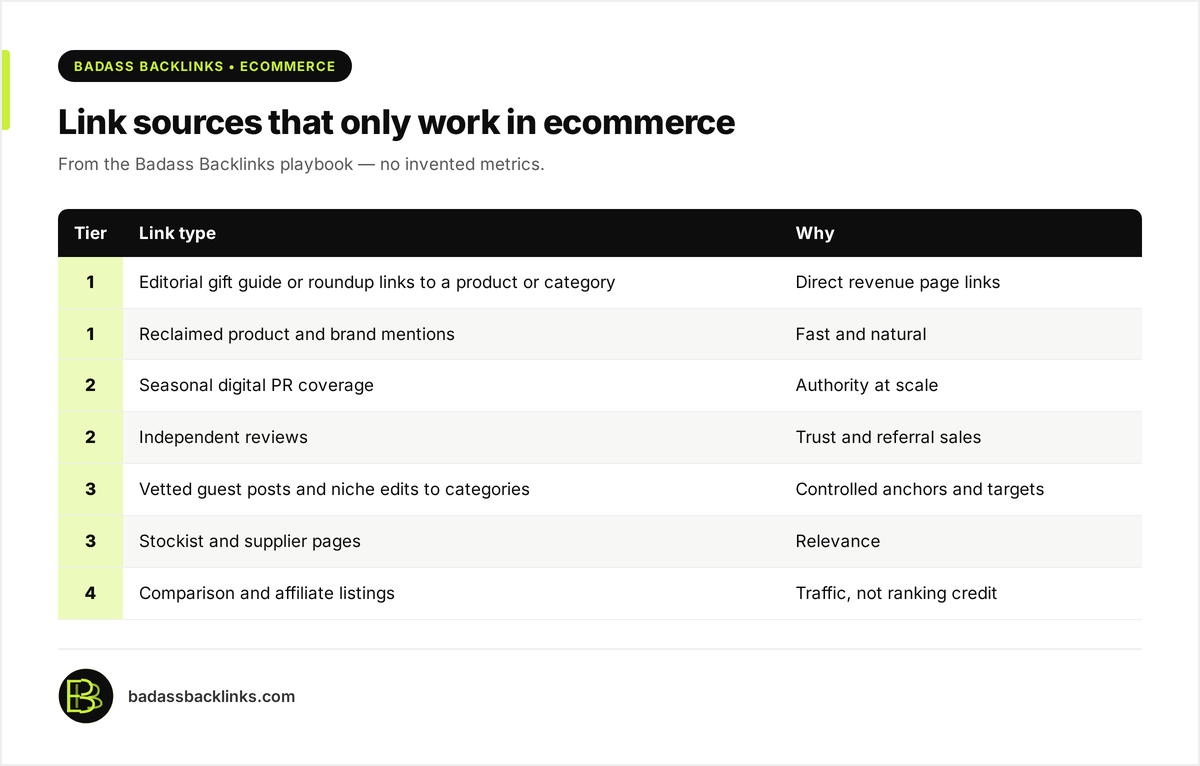
The best links for ecommerce, in priority order: reclaimed product and brand mentions, seasonal digital PR coverage, independent reviews and vetted guest posts and niche edits to categories.
| Tier | Link type | Why |
|---|---|---|
| 1 | Editorial gift guide or roundup links to a product or category | Direct revenue page links |
| 1 | Reclaimed product and brand mentions | Fast and natural |
| 2 | Seasonal digital PR coverage | Authority at scale |
| 2 | Independent reviews | Trust and referral sales |
| 3 | Vetted guest posts and niche edits to categories | Controlled anchors and targets |
| 3 | Stockist and supplier pages | Relevance |
| 4 | Comparison and affiliate listings | Traffic, not ranking credit |
How to
How to get ecommerce backlinks: 7 steps
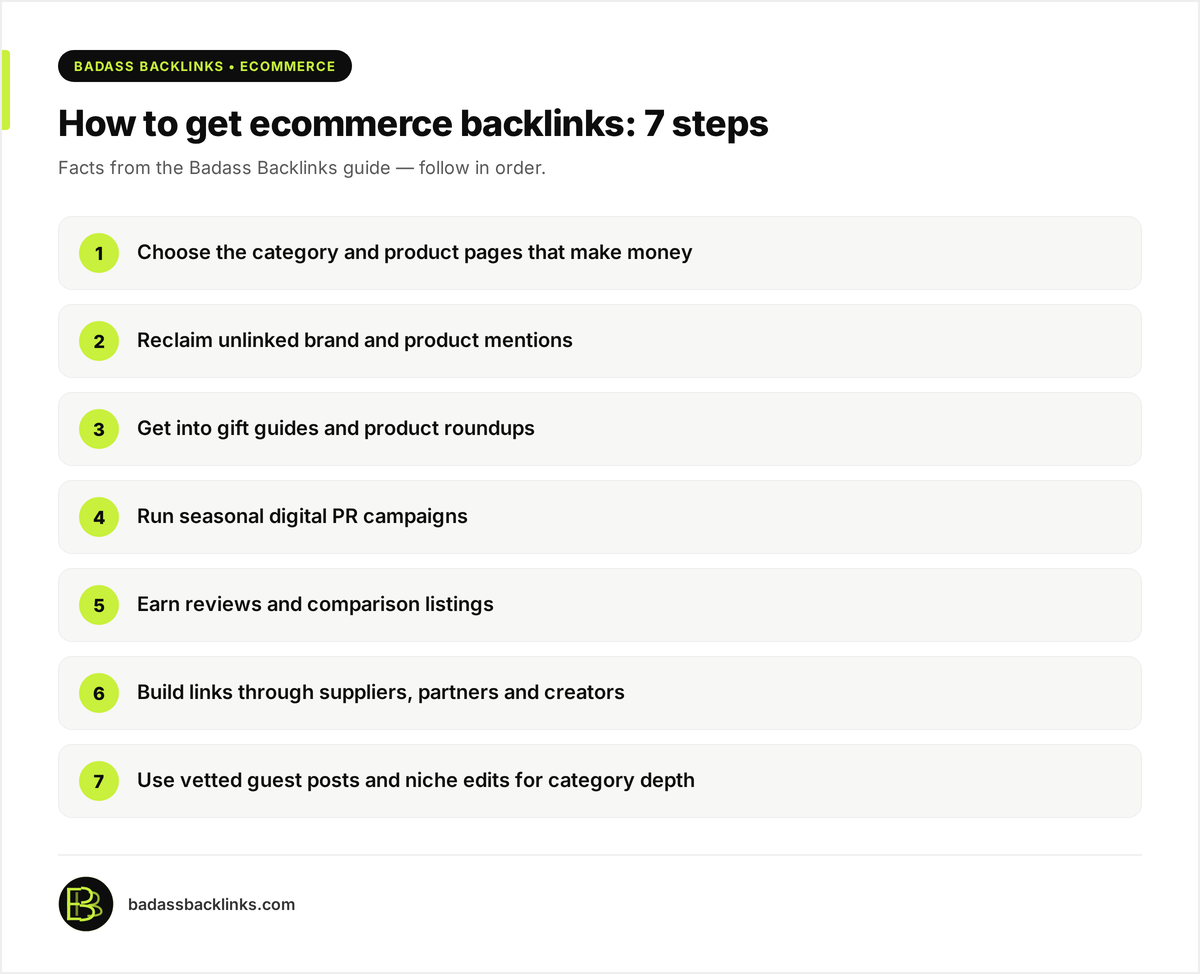
In short: choose the category and product pages that make money, reclaim unlinked brand and product mentions, get into gift guides and product roundups and run seasonal digital PR campaigns, with every step explained below.
- Choose the category and product pages that make money. Rank pages by revenue and gap to page one. Build to a short list.
- Reclaim unlinked brand and product mentions. Search for your brand and product names without links and ask politely for one to the relevant product page. Our DTC campaign converted 32 of 55.
- Get into gift guides and product roundups. Build a list of editors and creators who publish guides each season and pitch early with images, prices and samples.
- Run seasonal digital PR campaigns. Data stories tied to holidays, trends or your category. In the Muck Rack, 42% of journalists want original data.
- Earn reviews and comparison listings. Send products to independent reviewers without conditions on links.
- Build links through suppliers, partners and creators. Ask suppliers and stockists for “where to buy” links; co-create with creators and label sponsored links.
- Use vetted guest posts and niche edits for category depth. Point a few well-placed links at categories, using our guest posting guide and niche edit explainer to vet sites.
Ecommerce backlinks
Want links to the pages that actually sell?
We earn links to category and product pages through mention reclamation, gift guides and vetted placements.
See ecommerce backlinksAssets
Content that earns links for stores
Content that earns links for stores: buying guides, category data, size and fit tools and seasonal campaigns.
| Asset | Example | Links from |
|---|---|---|
| Buying guides | How to choose running shoes | Bloggers, forums |
| Category data | Sales trends by season (anonymised) | News, trade press |
| Size and fit tools | Size calculators | Resource pages |
| Seasonal campaigns | Holiday trend report | Gift guide editors |
| Brand story | Sustainability or sourcing report | Trade and lifestyle media |
Link buying guides to the matching category with descriptive anchors. That internal link is how content links lift revenue pages.
Deep dive
Seasonal link building calendar for stores
Seasonal link building calendar for stores: holiday gift guides, Valentine\u2019s Day, Mother\u2019s and Father\u2019s Day and back to school.
| Season | Pitch window | Angle |
|---|---|---|
| Holiday gift guides | August to October | Gifts by price and recipient |
| Valentine\u2019s Day | November to December | Gifts and experiences |
| Mother\u2019s and Father\u2019s Day | 2 to 3 months ahead | Gift roundups |
| Back to school | April to June | Essentials lists |
| Black Friday | September to October | Deals and trend data |
Editors plan guides well before readers shop. Pitch late and you are pitching to a closed list. Keep a calendar and a ready pitch kit with images, prices, samples and a short brand story.
Deep dive
Outreach templates for each e-commerce link source
This playbook is about execution, so here are the short pitches we use as starting points for the four highest-return sources. Adapt every one; editors spot templates instantly.
| Source | Subject line | The core of the message |
|---|---|---|
| Unlinked mention | Quick thanks for featuring [Product] | Thank them for the mention, point to the exact product page that matches what they wrote about, and ask if they would link it for readers who want to buy. |
| Gift guide | [Product] for your [Season] gift guide, under $[price] | One line on who the gift suits, price, a product page link, high-resolution images and an offer of a sample with no link required. |
| Review creator | Sample of [Product] for honest review | Offer the product with no conditions. If they cover it and link, ask that the link be marked sponsored or nofollow, as Google requires for gifted products. |
| Supplier or stockist | Listing [Brand] on your stockists page | Confirm you stock or use their materials and ask for a listing with a link to the matching category page. |
Track every pitch in a sheet with the target URL you asked for. The most common failure in store outreach is a link that lands on the homepage instead of the category page you needed.
Deep dive
Why product pages matter more as AI shopping grows
Shopping is moving into assistants and agents that research, compare and sometimes buy for the user. Glenn Gabe flagged one data point worth watching: Mark Zuckerberg says the Muse assistant has drawn more than 10 million users, with over 25% making purchases through the app.
On the topic of agents, people are using Muse to purchase products. Actually, shopping is the top activity… Big heads-up for ecommerce retailers -> Mark Zuckerberg says Muse has drawn 10M+ users since its launch and 25%+ of users are making purchases through the app, with an average purchase size of $200+
Glenn Gabe (@glenngabe) October 22, 2026
“Plaid told us that they hadn’t seen activity like they’re seeing with their connector on any other service before,” Zuckerberg said, referring to the financial technology company that connects payment apps to customers’ bank accounts. Muse uses Plaid’s connector to enable agentic shopping.”
https://t.co/Q4fVVXJj5Q
For link building, the implication is simple. Assistants lean on pages that other sites describe and cite, so links and mentions that name a specific product, with accurate price, specs and availability on the page they point to, are worth more than generic brand links. Keep product data consistent across your site, marketplaces and the reviews that link to you.
Deep dive
A 30-day sprint to get your first store links
If you are starting from zero, run the playbook as a four-week sprint before committing budget to placements or PR. It shows which sources respond for your products and gives you links on the pages that sell.
At the end of the month you should know your reply rate per source and which product pages attract links naturally. Scale the source that converted, and drop the one that did not.
Compliance
Rules and risks for ecommerce links
The main rules and risks to respect are paid and gifted links, affiliate links, anchors and dead product URLs.
- Paid and gifted links. Links given in exchange for free products are paid links under Google’s Google Search Central; qualify them per Google Search Central.
- Affiliate links. Mark as sponsored; they do not count as editorial links.
- Anchors. Exact-match product anchors on every link look unnatural; the Ahrefs study found a 0% median exact-match share among top-20 pages.
- Dead product URLs. Redirect discontinued products to the closest category so links are not lost.
- Duplicate URLs. Point links at canonical category and product URLs.
First-hand
Mention reclamation in practice: a DTC store
Our DTC ecommerce case study shows why mention reclamation sits at step two of this playbook: 32 of 55 unlinked mentions became links, the highest-converting tactic in the campaign. The full strategy is in the case study; the headline numbers are below.
DTC store: before and after 8 months
Source: BadAss Backlinks DTC case studyBudget
What ecommerce link building costs
There is no reliable public price list for niche link building, but several large datasets give useful benchmarks.
Published link cost benchmarks (USD)
Sources: Editorial.Link survey of 518 SEOs; BuzzStream guest post study of about 257,000 sites; Ahrefs outreach test; PressWhizz 2026 report on 22,703 placements.In the BuzzStream data, ecommerce guest posts averaged $341. Mention reclamation and gift guides cost time rather than placement fees. Digital PR teams most commonly report a cost per link of $300 to $500 in the BuzzStream report, and the Editorial.Link survey found 80.9% of SEOs expect link costs to rise. Cheap links are usually cheap because the site has no traffic: BuzzStream found 39.6% of guest post sites had zero organic traffic. Our pricing page explains how we scope campaigns.
Choosing help
Ecommerce link building agency vs in-house
Hire an agency when you need volume, vetted publisher relationships and speed; keep ecommerce link building in-house when you have writers, time and deep niche knowledge. The comparison below shows the trade-offs.
| Task | Best owner |
|---|---|
| Product seeding and samples | In-house |
| Mention reclamation | Agency or in-house |
| Gift guide outreach | Agency or PR |
| Digital PR | Agency |
| Guest posts and niche edits | Agency |
Ask any agency which category pages it would target first and why. Check its Clutch reviews and case studies.
Reporting
How to measure ecommerce link building
Measure ecommerce link building by rankings, organic traffic and conversions on the pages that receive links, not by link count alone. These are the metrics to track: rankings for category keywords, referring domains to categories and products, organic revenue and referral sales from guides and reviews.
| Metric | Why |
|---|---|
| Rankings for category keywords | Revenue pages |
| Referring domains to categories and products | Where links point |
| Organic revenue | The outcome |
| Referral sales from guides and reviews | Direct return |
| Mention conversion rate | Efficiency |
Avoid
7 ecommerce link building mistakes
The most common ecommerce link building mistakes are building every link to the homepage, ignoring unlinked product mentions, pitching gift guides too late and requiring links in exchange for free products. Each one is explained below with the fix.
- Building every link to the homepage.
- Ignoring unlinked product mentions.
- Pitching gift guides too late.
- Requiring links in exchange for free products.
- Linking to non-canonical URLs.
- Losing links on discontinued products.
- Measuring links instead of revenue.
Expert insight
Expert insight on backlinks for an e-commerce website
The quotes below are verbatim public statements, linked to the original source. We have not interviewed these people; the case study figures are our own client results.
“Sending someone a product in exchange for them writing about it and including a link”
Google Search Central, Spam policies, listed as an example of link spam
“Big heads-up for ecommerce retailers”
Glenn Gabe, on X, 22 October 2026
From our case study data
DTC e-commerce case study: An 8-month campaign lifted organic traffic from 7,200 to 13,600 visits a month (+89%) and converted 32 of 55 unlinked mentions into links; 28 product pages reached page 1. Read the full case study
Conclusion
The bottom line on backlinks for an e-commerce website
Backlinks for an e-commerce website come from being worth recommending: gift guides, roundups, suppliers and stories. Plan around the retail calendar and backlinks for an e-commerce website keep compounding.
Quick answers
Quick answers about backlinks for an e-commerce website
Short, direct answers to the questions people ask search engines and AI assistants about backlinks for an e-commerce website.
How do online stores get into gift guides?
Online stores get into gift guides by pitching editors months ahead of the season with product details, images and pricing.
Do manufacturer and supplier links help e-commerce SEO?
Manufacturer and supplier “where to buy” pages give relevant, easy backlinks to stockists.
Is it OK to give products to bloggers for links?
Google lists sending products in exchange for a link as link spam, so gifted-product links should be sponsored or nofollow.
When should a store start seasonal link building?
Start seasonal link building well before the season, because editors plan gift guides early.
Which store pages should get backlinks?
Category pages and linkable content should get most store backlinks; product pages benefit through internal links.
What results can an e-commerce link campaign deliver?
Our DTC client grew organic traffic from 7,200 to 13,600 visits a month over 8 months.
Questions
Frequently asked questions
What are ecommerce backlinks?
Links from other websites to an online store’s product, category and brand pages that help those pages rank in search.
How does ecommerce link building work?
Stores reclaim unlinked mentions, get into gift guides and reviews, run seasonal digital PR, work with suppliers and creators, and use vetted guest posts and niche edits, then pass authority to category pages through internal links.
Should I hire an ecommerce link building agency?
If you want links to category and product pages rather than just the homepage, an agency with retail placements helps. Check its Clutch reviews and case studies.
What do ecommerce link building services include?
Unlinked mention reclamation, gift guide and review outreach, digital PR, guest posts, niche edits and reporting on category rankings and revenue.
How do I get backlinks for an ecommerce site?
Find unlinked mentions of your brand and products, pitch gift guides months ahead, create seasonal data stories, earn reviews and ask suppliers, partners and creators to link.
Do affiliate links count as backlinks?
Affiliate links should be qualified (rel=”sponsored”) and usually do not pass ranking credit. Editorial links from reviews and guides are what move rankings.
References
Sources
Every statistic on this page links back to the original publisher below. Figures were checked on 24 October 2026.
- BadAss Backlinks, DTC E-commerce Backlink Case Study: 8-month campaign: organic traffic 7,200 to 13,600 visits a month (+89%); traffic value $4,100 to $10,500 a month (+156%); 32 of 55 unlinked mentions converted to links (58%); 28 product pages on page 1. badassbacklinks.com/backlink-case-studies/dtc-ecommerce-backlink-case-study
- Moz, Anchor Text Distribution: Avoiding Over-Optimization: 34.6% of links to category and product pages used targeted (exact or phrase) anchors; only about 25% of links to category pages were targeted. moz.com/blog/anchor-text-distribution-avoiding-over-optimization
- BuzzStream, The Cost of Guest Posts, Based on 500k Sites (2026): About 257,000 guest post sites analysed: average vendor price $461, average direct price $295; 96.2% judged low quality; 39.6% had zero organic traffic; only 1.37% high quality; ecommerce niche average $341. www.buzzstream.com/blog/guest-post-costs
- Muck Rack, State of Journalism 2025: Survey of 1,515 journalists: 84% say at least some stories originate from pitches; 86% disregard irrelevant pitches; 42% want original data or research; 77% use AI tools. media.muckrack.com/documents/6.9.2025_state_of_journalism.pdf
- Google Search Central, Spam policies for Google web search: Defines link spam, including buying or selling links that pass ranking credit, excessive link exchanges and large-scale guest posting campaigns with keyword-rich anchors. developers.google.com/search/docs/essentials/spam-policies
- Google Search Central, Qualify your outbound links: rel=”sponsored” for paid or sponsored links, rel=”ugc” for user-generated content, rel=”nofollow” otherwise. developers.google.com/search/docs/crawling-indexing/qualify-outbound-links
- Ahrefs, Anchor Text study (384,614 pages): 384,614 pages ranking in the top 20 for 19,840 keywords; median share of exact-match anchors was 0% at every position; average Spearman correlation between exact-match anchors and rank 0.1436 (weak); notes most SEOs recommend about 1% to 5% exact match; Penguin affected about 3.1% of queries. ahrefs.com/blog/anchor-text
- Ahrefs, Should You Buy Backlinks: Average quoted price for a paid link insertion $361.44 (450 sites, nine niches); paid guest posts $77.80; only 12.6% of sites agreed to sell; cites Authority Hacker’s $83 average. ahrefs.com/blog/buy-backlinks
- Editorial.Link, Link Building Statistics survey: 518 SEO professionals surveyed; $508.95 average acceptable price for one high-quality link; 80.9% expect costs to rise. editorial.link/link-building-statistics
- PressWhizz, Link Building Pricing Report 2026: 22,703 completed placements worth $3.66M; average $161.25, median $112; casino $252, sports $246 and finance $221 among the most expensive niches. presswhizz.com/case-studies/link-building-pricing-report
- BuzzStream, State of Digital PR 2026: 150+ digital PR practitioners: 95.9% pitch data-led content; about 60% have monthly budgets under $10k; most common cost per link $300 to $500 (19.6%); 39.2% do not know their cost per link; 62.8% cite outdated journalist info; 60.8% say finding journalists is harder; 85.8% call backlinks the most effective outcome; 66.2% cite AI citations. www.buzzstream.com/blog/state-of-digital-pr