BadAss Backlinks · AI Search Guide · Updated October 2026
LLM SEO: A Practical Guide for Teams Who Already Do SEO
LLM SEO is the work of making your brand and pages visible in answers from large language models such as ChatGPT, Gemini and Google AI Overviews. Most of LLM SEO is still good SEO, with more weight on brand mentions, clear answers and citable facts.
TL;DR
- LLM SEO is making your brand easy for AI systems like ChatGPT, Gemini and AI Overviews to find, understand and cite.
- Google says there are no extra technical requirements for AI features. SEO fundamentals still do most of the work.
- The strongest public correlation with AI Overview visibility is branded web mentions (0.664 in Ahrefs data), well ahead of backlinks (0.218).
- We rate 8 commonly cited factors as Confirmed, Correlated or Hypothesis so you can prioritise.
On this page
Authority for AI search
What do you need?
Mentions and links on trusted sites are the hard part. That is what we do.
- Brand mentions on trusted sites
- Editorial links that rank
- Digital PR built on real data
Guest posts from $85 and niche edits from $69 per link. Monthly plans optional.
See link building services
Every SEO team is being asked the same question: “Are we showing up in ChatGPT?” Most of the answers online are either vendor pitches or guesses dressed up as frameworks. This guide is for people who already know SEO and want to know what actually changes.
Short version: less than the hype suggests, and the hard part is still authority. If you want help with that part, see our link building services.
Definition
What is LLM SEO?
LLM SEO is the practice of making your brand and content easy for large language model products to retrieve, understand and cite. Those products include ChatGPT search, Google AI Overviews and AI Mode, Gemini, Perplexity, Copilot and Claude. You will also see it called GEO (generative engine optimisation), AEO (answer engine optimisation) or AI SEO.
There are two routes into an AI answer. The first is training data: what the model learned before release. The second is retrieval: the system searches the web at answer time and cites what it finds. Retrieval is where you can make a difference this quarter, and it is mostly driven by search indexes you already optimise for.
Primary sources
What Google and OpenAI actually say
Start with what the platforms themselves say.
Google’s Google Search Central documentation says there are “no additional technical requirements” to appear in AI Overviews or AI Mode. The same SEO best practices apply: crawlable, indexable pages, helpful content, structured data that matches visible text. Traffic from AI features is included in Search Console’s Performance report. Google also says clicks from AI Overviews tend to be higher quality, with users more likely to spend more time on the site.
OpenAI
OpenAI’s OpenAI documentation separates three crawlers. OAI-SearchBot is used to surface sites in ChatGPT search, and sites that block it will not be shown in ChatGPT search answers. GPTBot collects training data. ChatGPT-User visits pages when a user asks. You can block training and still allow search.
# robots.txt: allow ChatGPT search, opt out of training
User-agent: OAI-SearchBot
Allow: /
User-agent: GPTBot
Disallow: /
Yeah if this change sticks it’s going to be pretty hard to optimize anything without good brand recognition
Lily Ray (@lilyraynyc) August 19, 2026
Lily Ray’s point lands on the same conclusion as the data below: brand recognition is becoming the moat.
Reader poll
Your vote is saved in this browser only. No live tally is stored on a server, so results show votes cast on this device.
Evidence
8 LLM SEO factors, rated by evidence
Each factor is rated by the strength of public evidence.
Stated by the platform in its own documentation.
Supported by a large public study showing correlation, not proven cause.
Plausible and widely recommended, but no public evidence isolates it.
1. Entity consistency Hypothesis
Describe your company, products and people the same way everywhere: site, About page, profiles, directories, press. Language models build an understanding of an entity from many documents. Inconsistent names, categories or claims make it harder to state anything about you confidently. No public study isolates this, so we rate it a hypothesis, but it costs little to fix.
2. Cited by trusted sources Correlated
Pages that rank and are referenced widely are more likely to be retrieved. The Ahrefs study found 37.9% of URLs cited in AI Overviews also ranked in the top 10, down from about 76% in July 2025. Ranking still helps, but citations increasingly come from beyond the top 10. Being referenced by trusted publications widens the pool of pages that can cite you.
3. Extractable structure Hypothesis
Clear headings, a direct answer under each question, short paragraphs, tables and lists make it easy for retrieval systems to lift a passage. Google says there are no special requirements for AI features, so this is about being easy to quote, not a ranking factor. Hypothesis, but aligned with good writing.
4. Dates and freshness Hypothesis
Show published and updated dates, and actually update facts. Answer engines that fetch live pages (ChatGPT search, Perplexity, AI Mode) can see stale numbers. We rate this a hypothesis; there is no public study isolating date signals for citations.
5. Methodology and original data Hypothesis
Explain where your numbers come from. Google’s guidance on Google Search Central Blog asks for unique, valuable content. Original data gives AI systems something to cite that exists nowhere else. The citation benefit is a hypothesis; the content quality benefit is Google’s stated position.
6. Structured data Confirmed
Google’s Google Search Central page confirms there are no extra technical requirements for AI Overviews and AI Mode, and that structured data should match the visible text. Structured data helps machines parse your page; it does not open AI citations on its own. Confirmed: use it accurately; do not expect it to be a shortcut.
7. Brand mentions Correlated
An Ahrefs study of 75,000 brands found branded web mentions correlated with AI Overview visibility at 0.664, branded anchors at 0.527 and backlinks at 0.218. Strongest correlation we have found for AI visibility, but correlation, not proof of cause.
8. Reddit, Wikipedia and YouTube presence Correlated
AI answers lean on a handful of platforms. In the same Ahrefs citation study, 18.2% of AI Overview citations that did not rank in the top 100 were YouTube URLs. Semrush found ChatGPT-cited pages ranked in positions 21+ almost 90% of the time, which means platforms and pages outside the usual top 10 get pulled in. Genuine participation, not spam, is what holds up.
Authority is still the hard part
Authority is still the hard part. That is what we do.
Structure and schema take a week. Getting cited by trusted publications takes outreach, relationships and data worth covering. We build the mentions and links AI systems pick up.
See link building servicesAnatomy
What a citation-ready page looks like
Here is the anatomy of a page we would expect to be easy to cite. None of it is exotic; it is good SEO writing with a few habits made non-negotiable.
| Element | What it looks like | Why |
|---|---|---|
| Answer-first opening | A 40 to 60 word direct answer under the H1 or each H2 | Easy for retrieval to lift a passage |
| Named author | Real person, credentials, consistent profile | Supports trust and entity understanding |
| Dated facts | Published and updated dates; year next to every statistic | Fetching systems can tell what is current |
| Methodology note | Sample size, date range and source for each number | Makes your data citable |
| Comparison tables | Clean HTML tables, one idea per column | Structured comparisons are easy to quote |
| Outbound citations | Links to primary sources | Signals the page is a reference, not a pitch |
| Matching schema | Article, Organization, FAQ that mirror visible text | Google requires structured data to match the page |
Where link building fits
It is tempting to treat LLM SEO as a replacement for link building. The data says the opposite. Retrieval still starts from search indexes, and the Ahrefs study shows 37.9% of AI Overview citations rank in Google’s top 10. Links remain one of the main reasons pages rank. On top of that, brand mentions, the strongest correlate in the Ahrefs data, are a by-product of the same work: digital PR, expert commentary and guest contributions on trusted sites.
The practical shift is in what you ask for. A link from an article that also describes what your company does, in consistent language, is worth more in an AI-search world than a link in a list of twenty. Brief your outreach and PR to earn context, not just anchors. Our digital PR service is built around exactly that, and our roundup of AI SEO agencies compares other approaches.
Compare
What still matters, what matters more, less, and what is new
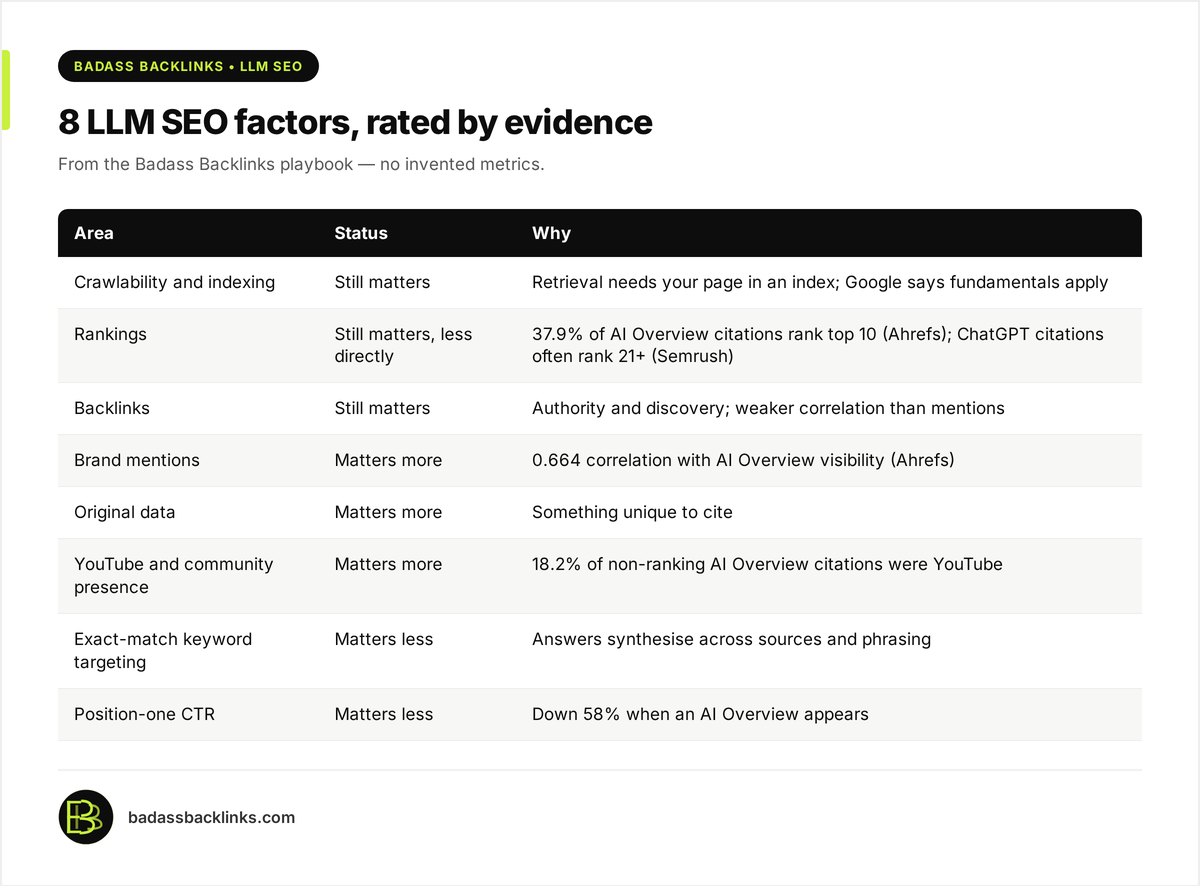
For LLM SEO, crawlability, rankings and links still matter; brand mentions and clear answers matter more; and a few tracking tasks are new.
| Area | Status | Why |
|---|---|---|
| Crawlability and indexing | Still matters | Retrieval needs your page in an index; Google says fundamentals apply |
| Rankings | Still matters, less directly | 37.9% of AI Overview citations rank top 10 (Ahrefs); ChatGPT citations often rank 21+ (Semrush) |
| Backlinks | Still matters | Authority and discovery; weaker correlation than mentions |
| Brand mentions | Matters more | 0.664 correlation with AI Overview visibility (Ahrefs) |
| Original data | Matters more | Something unique to cite |
| YouTube and community presence | Matters more | 18.2% of non-ranking AI Overview citations were YouTube |
| Exact-match keyword targeting | Matters less | Answers synthesise across sources and phrasing |
| Position-one CTR | Matters less | Down 58% when an AI Overview appears |
| Bot access rules (OAI-SearchBot etc.) | New | Block it and you are not shown in ChatGPT search |
| llms.txt | New, unproven | Proposed standard; no major platform confirms using it |
| Prompt-level visibility tracking | New | Search Console does not show prompts |
llms.txt
llms.txt: what it is and whether it works
The llms.txt proposal (llmstxt.org) proposal suggests a Markdown file at /llms.txt that gives language models a curated map of your site. The format is simple: a required H1 with the site name, a blockquote summary, then H2 sections listing links with short notes. An “Optional” section marks links that can be skipped.
# BadAss Backlinks
> Link building agency. Manual outreach, guest posts, niche edits and digital PR for SaaS, legal, finance, real estate and ecommerce brands.
## Services
- [Link building services](https://badassbacklinks.com/link-building-services/): scoped campaigns, monthly terms
- [Digital PR](https://badassbacklinks.com/digital-pr-backlink-service/): data-led campaigns for news links
- [Guest posting](https://badassbacklinks.com/guest-posting-services/): vetted sites with real traffic
## Guides
- [Link building statistics](https://badassbacklinks.com/link-building-statistics/): sourced industry data
- [What are backlinks](https://badassbacklinks.com/what-are-backlinks/): beginner explainer
## Optional
- [Case studies](https://badassbacklinks.com/backlink-case-studies/): campaign resultsChecklist
The 12-point LLM SEO checklist
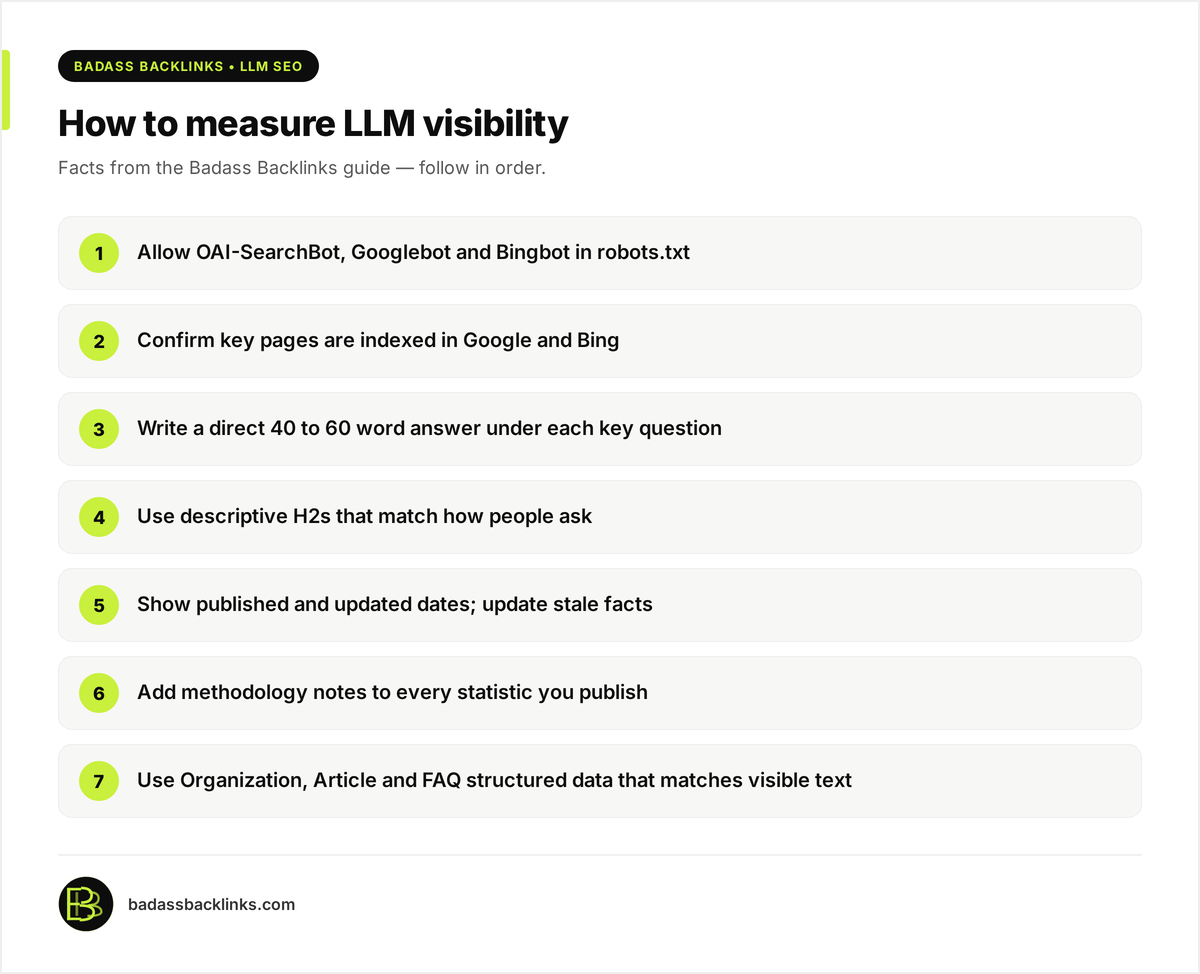
In short: allow OAI-SearchBot, Googlebot and Bingbot in robots.txt, confirm key pages are indexed in Google and Bing, write a direct 40 to 60 word answer under each key question and use descriptive H2s that match how people ask, with every step explained below.
- Allow OAI-SearchBot, Googlebot and Bingbot in robots.txt
- Confirm key pages are indexed in Google and Bing
- Write a direct 40 to 60 word answer under each key question
- Use descriptive H2s that match how people ask
- Show published and updated dates; update stale facts
- Add methodology notes to every statistic you publish
- Use Organization, Article and FAQ structured data that matches visible text
- Make About, author and contact pages consistent with external profiles
- Earn mentions on trusted publications in your niche
- Participate genuinely on Reddit, YouTube and industry communities
- Publish an llms.txt file (low cost, unproven)
- Track AI referrals in GA4 and run a monthly prompt check
Avoid
What does not work
The LLM SEO tactics that do not work are shortcuts that skip real visibility, such as unproven files, keyword stuffing for prompts and mass-produced pages.
Worth your time
- Earning mentions on trusted sites
- Original data and clear methodology
- Clean crawl access for search bots
- Answer-first page structure
Not worth it
- Hidden prompt injections in page text
- Mass AI-written pages targeting prompts
- Fake Reddit accounts and astroturfing
- Schema that does not match visible content
- Buying “AI citation” packages
Google’s March 2024 spam policies on scaled content abuse apply whether the pages target keywords or prompts. Astroturfing community sites gets accounts banned and brands called out in public, which is the opposite of the brand signal you want.
Reporting
How to measure LLM visibility
Measurement is the weakest part of LLM SEO, so combine sources.
| Source | What it shows | Limit |
|---|---|---|
| Google Search Console | AI Overview and AI Mode traffic is included in Performance data | Not separated from regular search |
| GA4 referrals | Visits from chatgpt.com, perplexity.ai, copilot and others | Only clicks, not mentions |
| Manual prompt panel | Whether you are named for 20 to 50 buyer prompts | Answers vary by user and session |
| AI visibility tools | Share of voice across prompts at scale | Sampled; methodology varies |
| Brand mention monitoring | New mentions on trusted sites | Leading indicator, not outcome |
Practitioners believe links still matter here: 73.2% of SEOs in the Editorial.Link survey think backlinks influence AI search visibility, and 66.2% of digital PR teams in the BuzzStream report already cite AI citations as an outcome they track.
Search Console
What Search Console can tell you about AI search
Teams that already do SEO have one big advantage: Search Console. It does not give a clean “AI traffic” view for every surface, but practitioners are finding useful signals in it, and they are worth adding to your reporting now.
- Look for AI-related reporting where it exists. Lily Ray reported that on one enterprise site, the Search Console Gen AI report showed the most cited page in AI Overviews and AI Mode was the company’s detailed About page, with five times more impressions than the homepage.
- Mine conversational queries. Aleyda Solis shared analysis by Jan-Willem Bobbink of 155 sites over 16 months: AI Mode queries are not labelled in Search Console, but bare replies typed at an AI, such as “yes” or “yes please”, show up as logged searches and can be tracked over time.
- Segment by page type. Compare impressions for About, methodology, pricing and comparison pages against blog posts. Entity and trust pages often matter more than teams expect.
- Pair it with prompt tracking. Search Console shows Google surfaces only. Track a fixed set of prompts in ChatGPT, Gemini and Perplexity monthly for the rest.
I’m working on an enterprise brand’s website, and something interesting stood out in its Google Search Console Gen AI report:
Lily Ray 😏 (@lilyraynyc) October 22, 2026
The most cited page on the company’s website in AI Overviews & AI Mode, with 5x more impressions than the homepage, is its “About” page.
It’s a comprehensive, detailed page about the company’s history, background, and evolution over time.
It’s not a “special page” created for LLMs or AI agents. It’s written for humans, visually appealing, and contains detailed information about the brand in a format that both humans and LLMs can easily understand.
So what’s the big “GEO” takeaway here?
Create comprehensive “About” pages with detailed, accurate information about your company’s history.
In other words, the same recommendation many of us in SEO have been making for years, especially since E-A-T became a bigger part of the conversation in 2017 (and long before that, in many cases).
Why do I think this is a more sustainable approach than creating separate pages specifically for LLMs?
Because those pages create an easily gameable surface.
Notably, Google, OpenAI, and Anthropic haven’t explicitly asked website owners to create separate, LLM-specific versions of their content, use Markdown, etc. I would change my perspective if they did (they won’t.)
The problem: it’s inevitable that bad actors (and plenty of brands) will use these pages to inject prompts, exaggerate claims, or give AI agents promotional information that doesn’t match what real users see, with the goal of manipulating what AI says about their brand.
My prediction is that as this behavior becomes more widespread (it’s already spreading thru the GEO world like wildfire), the AI companies will increasingly develop ways to ignore, discount, or otherwise treat these pages as untrustworthy.
And depending on how these systems evolve, the consequences might extend beyond the individual pages themselves.
The unfortunate part is that even well-intentioned companies simply trying to “help” LLMs understand their content better could become collateral damage. Even if their LLM-specific pages contain exactly the same accurate information as their human-facing website, they could still get caught up in broader efforts to crack down on this type of content, or flag the sites using “manipulative” approaches.
This is why I’m extremely cautious about employing tactics like this in the first place.
Meanwhile, there’s a much simpler way to work on this:
Take all that time and effort you’re spending creating special content for LLMs and use it to improve the information available to actual humans on your website.
Make your company’s history, expertise, people, products, and reputation easy to find, understand, and verify.
You’re still giving LLMs the information they need; you’re just doing it in a way that’s actually useful to your human readers, too.
And unlike tactics designed to exploit how AI systems currently work, this is an investment that’s unlikely to become a liability when those systems inevitably start cracking down.
Google doesn’t label AI Mode queries in Search Console, but they leave a trace: people reply to an AI, and the reply gets logged as a search: @jwbobbink classified every query of 155 sites over 16 months to see how often that happens, and how fast it’s growing 👇 Here are key insights:
Aleyda Solis 🕊️ (@aleyda) October 15, 2026
* Replies typed at an AI are now normal. Bare replies such as “yes”, “ja” or “yes please” showed up as searches on 94 of the 155 sites. Per million impressions they grew from 5.6 to 116: 21 times as many in 16 months.
* German speakers say please to an AI, Indonesian speakers don’t. Three in four German yes-replies come with “bitte” or “gerne” (“ja bitte” on 52 sites). Dutch speakers add “graag” two times in three, English speakers say “yes please” 40% of the time, and Indonesian speakers never do.
* Follow-up questions are rising from a small base. Queries like “what about salary” are still rare, but they grew 39x over the window, most of it after May 2026.
* The typical site sees seven times more AI-shaped queries. The median site’s AI-shaped share of impressions went from 0.032% to 0.22%. Across all impressions pooled the share fell, because a few very large sites carry most of the volume.
* AI-shaped queries rarely get clicked. Their click-through rate was 2.9%, against 35.6% for all queries pooled.
* It’s still small. AI-shaped queries were 0.13% of all impressions. The growth is the story, not the size.
More: https://t.co/xaQuuHbWY9
The practical action from both observations: make your About, team and methodology pages detailed, factual and well linked, because they are the pages AI systems use to decide who you are.
Plan
A 30-day LLM SEO plan
The 30-day LLM SEO plan below moves from technical access checks to content answers, brand mentions and prompt tracking, in that order.
| Days | Focus | Actions |
|---|---|---|
| 1 to 5 | Access and baseline | Check robots.txt for OAI-SearchBot, GPTBot, Googlebot, Bingbot; confirm indexing; set up GA4 AI referral segment; run a 30-prompt baseline |
| 6 to 10 | Entity cleanup | Align About page, Organization schema, LinkedIn, directories and review profiles; fix inconsistent names and claims |
| 11 to 18 | Content structure | Rewrite top 10 commercial and informational pages answer-first; add dates, methodology, FAQ |
| 19 to 25 | Authority | Pitch one data story; secure 3 to 5 mentions on trusted niche publications; contribute to 2 community threads genuinely |
| 26 to 30 | Measure and plan | Re-run the prompt panel; compare referrals; publish llms.txt; plan next quarter around gaps |
Expert insight
Expert insight on LLM SEO
The quotes below are verbatim public statements, linked to the original source. We have not interviewed these people; the case study figures are our own client results.
“There are no additional requirements to appear in AI Overviews or AI Mode, nor other special optimizations necessary.”
Google Search Central, AI features and your website
“Yeah if this change sticks it’s going to be pretty hard to optimize anything without good brand recognition”
Lily Ray, on X, 19 August 2026
“Four in five buying prompts in ChatGPT now get a questionnaire before any recommendation.”
Aleyda Solis, sharing Rankscale research, on X, 22 October 2026
Conclusion
The bottom line on LLM SEO
LLM SEO is SEO with more weight on brand, clarity and citations. Keep the fundamentals, earn mentions on trusted sites and track prompts, and LLM SEO becomes part of your normal workflow.
Quick answers
Quick answers about LLM SEO
Short, direct answers to the questions people ask search engines and AI assistants about LLM SEO.
Is LLM SEO different from regular SEO?
LLM SEO builds on regular SEO; Google says AI features need no special optimisation beyond SEO best practices.
How do I get my brand mentioned in ChatGPT answers?
Earn mentions on sites AI models read: reviews, roundups, news and forums, plus clear answers on your own pages.
Does llms.txt help AI visibility?
llms.txt is a proposed standard and no major AI search provider has confirmed using it.
Do backlinks matter for AI search?
Backlinks and brand mentions still matter because AI answers draw on pages that rank and sources that are widely cited.
How do I track visibility in AI answers?
Track a fixed set of prompts over time and watch referrals from AI tools in analytics.
What should I do first for LLM SEO?
Start with the 12-point checklist and 30-day plan on this page.
Questions
Frequently asked questions
What is LLM SEO?
Optimising your brand and content so AI products such as ChatGPT search, Google AI Overviews, Gemini and Perplexity can find, understand and cite you. It builds on SEO fundamentals rather than replacing them.
Does llms.txt work?
llms.txt is a proposed standard published at llmstxt.org. No major AI search platform has publicly confirmed it uses the file for retrieval or ranking. It is cheap and harmless to add, but unproven.
How do I get my brand into ChatGPT answers?
Allow OAI-SearchBot so ChatGPT search can show your pages, make sure you rank in Bing and Google, and earn mentions on the trusted sites and communities that AI answers draw from.
Is LLM SEO different from SEO?
Mostly no. Google says there are no additional technical requirements for its AI features. The differences are emphasis: brand mentions, original data and community presence matter more.
Which structured data helps with AI search?
Organization, Article, Product, FAQ and other relevant types help machines parse your page, but Google says structured data must match visible text and is not required for AI features.
How do I measure LLM SEO?
Use Search Console (AI feature traffic is included), GA4 referrals from AI products, a monthly manual prompt panel and an AI visibility tool for scale.
References
Sources
Every statistic on this page links back to the original publisher below. Figures were checked on 24 October 2026.
- Google Search Central, AI features and your website: No additional technical requirements to appear in AI Overviews or AI Mode; same SEO fundamentals apply; structured data should match visible content; AI feature traffic is included in Search Console Performance reports. developers.google.com/search/docs/appearance/ai-features
- Google Search Central Blog, Top ways to ensure your content performs well in AI search (2025): Focus on unique, valuable content; Google says clicks from AI Overviews are higher quality, with users more likely to spend more time on the site. developers.google.com/search/blog/2025/05/succeeding-in-ai-search
- OpenAI, Overview of OpenAI crawlers: OAI-SearchBot surfaces sites in ChatGPT search; sites opted out are not shown in answers; GPTBot is used for training; ChatGPT-User handles user-initiated visits. platform.openai.com/docs/bots
- llms.txt proposal (llmstxt.org): Proposed /llms.txt Markdown file: H1 name required, blockquote summary, then H2 sections listing links with notes. llmstxt.org
- Ahrefs, 38% of AI Overview Citations Pull From the Top 10: 37.9% of URLs cited in AI Overviews also ranked in the top 10, down from about 76% in July 2025; 18.2% of non-ranking cited pages were YouTube URLs. ahrefs.com/blog/ai-overview-citations-top-10
- Semrush, Impact of AI Search on SEO Traffic: Pages cited by ChatGPT search rank in organic positions 21+ for related queries almost 90% of the time; 50% of links in ChatGPT 4o responses point to business or service websites. www.semrush.com/blog/ai-search-seo-traffic-study
- Ahrefs, AI Overview brand visibility factors (75K brands): Branded web mentions had a 0.664 correlation with AI Overview visibility, branded anchors 0.527, backlinks 0.218. ahrefs.com/blog/ai-overview-brand-correlation
- Ahrefs, Update: AI Overviews reduce clicks by 58%: Follow-up using December 2025 data found the CTR reduction had grown to 58%. ahrefs.com/blog/ai-overviews-reduce-clicks-update
- Ahrefs, AI Overviews reduce clicks by 34.5%: 300,000 keywords; position-one CTR was 34.5% lower when an AI Overview appeared (March 2025 data). ahrefs.com/blog/ai-overviews-reduce-clicks
- G2, 2025 Buyer Behavior Report: 1,169 B2B software decision-makers; 79% say AI search changed how they research software; 29% start research with AI search more often than Google. learn.g2.com/hubfs/G2-2025-Buyer-Behavior-Report-AI-Always-Included.pdf
- Gartner, 67% of B2B Buyers Prefer a Rep-Free Experience (2026): Survey of 646 B2B buyers (Aug to Sep 2025): 67% prefer a rep-free experience; 45% used AI during a recent purchase. www.gartner.com/en/newsroom/press-releases/2026-03-09-gartner-sales-survey-finds-67-percen
- Editorial.Link, Link Building Statistics 2026 (518 SEOs): 73.2% believe backlinks influence appearing in AI search; 80.9% believe unlinked brand mentions affect rankings; 57.1% expect results within 1 to 3 months; agencies allocate 32.1% of SEO budget to link building. editorial.link/link-building-statistics
- BuzzStream, State of Digital PR 2026: 150+ digital PR practitioners: 95.9% pitch data-led content; about 60% have monthly budgets under $10k; most common cost per link $300 to $500 (19.6%); 39.2% do not know their cost per link; 62.8% cite outdated journalist info; 60.8% say finding journalists is harder; 85.8% call backlinks the most effective outcome; 66.2% cite AI citations. www.buzzstream.com/blog/state-of-digital-pr
- Google, March 2024 core update and spam policies: New policies on expired domain abuse, scaled content abuse and site reputation abuse. developers.google.com/search/blog/2024/03/core-update-spam-policies