BadAss Backlinks · Strategy Guide · Updated October 2026
27 Link Building Strategies That Still Work in 2026 (Ranked by Effort vs Return)
The link building strategies that still work in 2026 are the ones that earn editorial links: digital PR, original data, guest posting on relevant sites, link reclamation and partner links. The 27 link building strategies below are ranked by effort versus return.
TL;DR
- We ranked 27 white-hat link building strategies by effort vs return, and also show cost and typical links per month.
- Fastest low-cost wins: unlinked mentions, partner pages, link reclamation and internal links.
- Highest ceiling: digital PR with original data and research reports. 95.9% of digital PR teams pitch data-led content.
- Pick three or four strategies that match your budget, niche and team. Do not try all 27.
On this page
Strategy, then execution
What do you need?
We audit your site and recommend the 3 or 4 strategies with the best return.
- Strategy based on your competitors
- Manual outreach on real sites
- Monthly reporting on rankings
Guest posts from $85 and niche edits from $69 per link. Monthly plans optional.
Get a strategy call
Most “link building strategies” lists give you 100 ideas and no way to choose. This one gives you 27 that we have seen work, ranked by effort vs return: how much work each takes against how much ranking value its links usually deliver. We also show cost and typical links per month. Scores are our planning estimates from running campaigns, not a published benchmark, and we say where real data exists.
If you want a team to run the shortlist for you, our link building services start with exactly this exercise.
Method
How we scored each strategy
Each strategy is scored on four axes, then ranked by return divided by effort.
Expected ranking value of the links: authority, relevance, durability and whether they reach the pages you need to rank. 5 means links that can move competitive pages on their own.
Team time and skill needed. 1 is an afternoon a month; 5 is a dedicated specialist.
Cash cost beyond time: $ is negligible, $$$$ means research, design or paid data.
Planning band for one person working the tactic consistently: Low (0 to 2), Med (3 to 6), High (7+).
“We need very few links to rank pages… Over the years we’ve made links less important.” @methode #serpconf2024
Patrick Stox (@patrickstox) April 19, 2024
@patrickstox I shouldn’t have said that… I definitely shouldn’t have said that
Gary Illyes (@methode) April 19, 2024
If Google needs “very few links,” the strategies worth your time are the ones that earn strong, relevant links. That is how we scored them.
Overview
All 27 strategies ranked by effort vs return
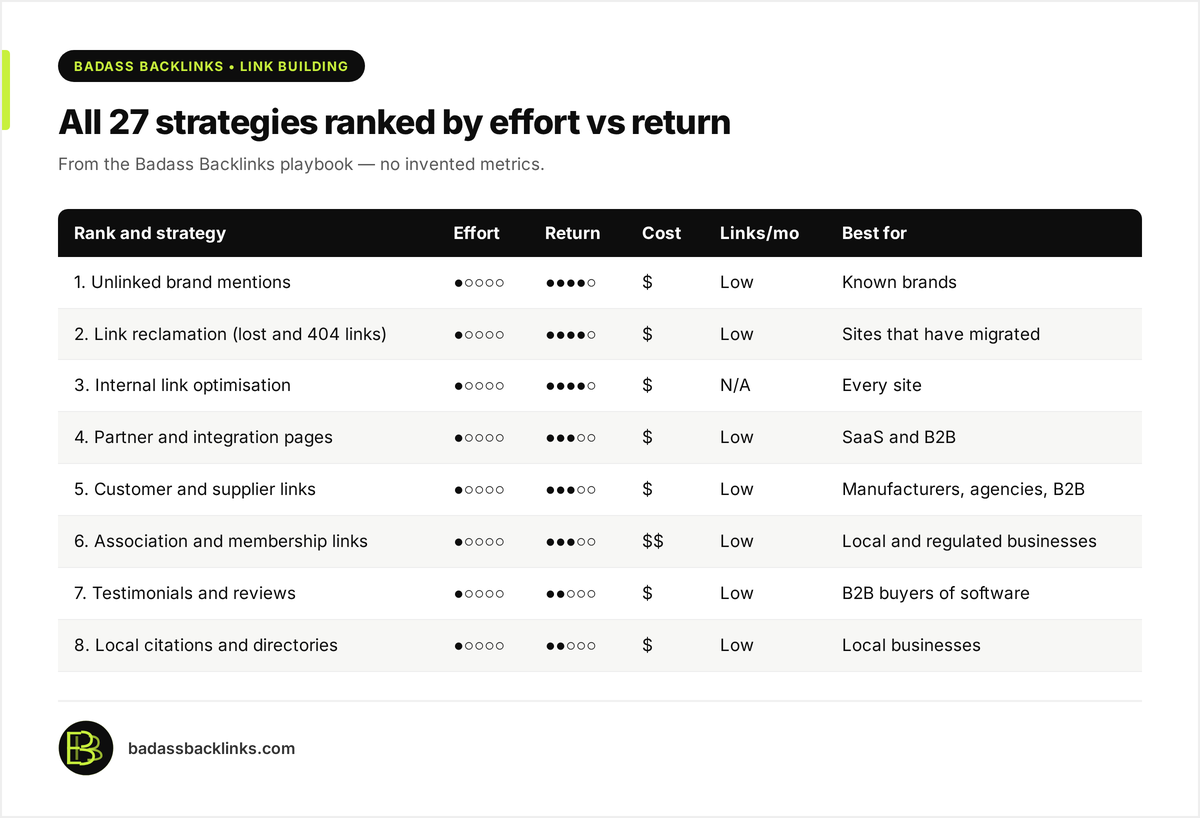
Strategies are ranked by return divided by effort, so the top of the list gives you the most value per hour. Ties go to the higher-return strategy.
Quick wins
Low effort, high return
#1 Unlinked brand mentions; #2 Link reclamation (lost and 404 links); #3 Internal link optimisation; #4 Partner and integration pages; #5 Customer and supplier links; #6 Association and membership links; #9 Expert source platforms
Big bets
High effort, high return
#10 Reactive PR (newsjacking); #11 Listicle and roundup inclusion; #12 Original statistics pages; #13 Digital PR with original data; #14 Original research reports; #15 Tangential content campaigns; #16 Linkable tools and calculators; #17 Guest posting on vetted sites
Fill-ins
Low effort, lower return
#7 Testimonials and reviews; #8 Local citations and directories; #18 Resource page link building; #19 Podcast guesting; #20 Scholarships and community sponsorships; #21 Image and asset reclamation; #25 HARO-style expert roundups; #26 Community and forum participation; #27 Content syndication
Time sinks
High effort, lower return
#22 Broken link building; #23 Skyscraper improvements; #24 Data visualisations and embeds
Effort and return are BadAss Backlinks planning estimates from running campaigns, not measured industry data.
| Rank and strategy | Effort | Return | Cost | Links/mo | Best for |
|---|---|---|---|---|---|
| 1. Unlinked brand mentions | ●○○○○ | ●●●●○ | $ | Low | Known brands |
| 2. Link reclamation (lost and 404 links) | ●○○○○ | ●●●●○ | $ | Low | Sites that have migrated |
| 3. Internal link optimisation | ●○○○○ | ●●●●○ | $ | N/A | Every site |
| 4. Partner and integration pages | ●○○○○ | ●●●○○ | $ | Low | SaaS and B2B |
| 5. Customer and supplier links | ●○○○○ | ●●●○○ | $ | Low | Manufacturers, agencies, B2B |
| 6. Association and membership links | ●○○○○ | ●●●○○ | $$ | Low | Local and regulated businesses |
| 7. Testimonials and reviews | ●○○○○ | ●●○○○ | $ | Low | B2B buyers of software |
| 8. Local citations and directories | ●○○○○ | ●●○○○ | $ | Low | Local businesses |
| 9. Expert source platforms | ●●○○○ | ●●●○○ | $ | Low | Specialists with credentials |
| 10. Reactive PR (newsjacking) | ●●●○○ | ●●●●○ | $$ | Med | Teams with fast sign-off |
| 11. Listicle and roundup inclusion | ●●●○○ | ●●●●○ | $$ | Med | Products and SaaS |
| 12. Original statistics pages | ●●●○○ | ●●●●○ | $$ | Med | Any niche with data |
| 13. Digital PR with original data | ●●●●● | ●●●●● | $$$$ | Med | Brands that can fund research |
| 14. Original research reports | ●●●●● | ●●●●● | $$$$ | Med | B2B and SaaS |
| 15. Tangential content campaigns | ●●●●○ | ●●●●○ | $$$ | Med | Boring niches |
| 16. Linkable tools and calculators | ●●●●○ | ●●●●○ | $$$ | Med | SaaS, finance, real estate |
| 17. Guest posting on vetted sites | ●●●○○ | ●●●○○ | $$ | Med | Most B2B and B2C sites |
| 18. Resource page link building | ●●○○○ | ●●○○○ | $ | Low | Educational content |
| 19. Podcast guesting | ●●○○○ | ●●○○○ | $ | Low | Founders and experts |
| 20. Scholarships and community sponsorships | ●●○○○ | ●●○○○ | $$ | Low | Local businesses |
| 21. Image and asset reclamation | ●●○○○ | ●●○○○ | $ | Low | Brands with original photos or graphics |
| 22. Broken link building | ●●●○○ | ●●○○○ | $ | Low | Sites with evergreen guides |
| 23. Skyscraper improvements | ●●●○○ | ●●○○○ | $$ | Low | Competitive informational SERPs |
| 24. Data visualisations and embeds | ●●●○○ | ●●○○○ | $$ | Low | Data-rich brands |
| 25. HARO-style expert roundups | ●●○○○ | ●○○○○ | $ | Low | Thought leaders |
| 26. Community and forum participation | ●●○○○ | ●○○○○ | $ | Low | Niche experts |
| 27. Content syndication | ●●○○○ | ●○○○○ | $ | Low | Publishers and thought leaders |
Reader poll
Your vote is saved in this browser only. No live tally is stored on a server, so results show votes cast on this device.
Details
The 27 strategies in detail, ranked by effort vs return
The 27 strategies in detail, ranked by effort vs return: unlinked brand mentions, link reclamation, internal link optimisation and partner and integration pages.
1. Unlinked brand mentions
Effort: 1/5 · Return: 4/5 · Cost: $ · Links per month: Low · Best for: Known brands
Find articles that mention your brand without linking and ask for a link. These convert well because the writer already chose to mention you. In our DTC ecommerce case study, 32 of 55 unlinked mentions became links (58%).
2. Link reclamation (lost and 404 links)
Effort: 1/5 · Return: 4/5 · Cost: $ · Links per month: Low · Best for: Sites that have migrated
Find backlinks pointing to pages that now 404 and redirect them, or ask the linking site to update. This recovers equity you already earned.
3. Internal link optimisation
Effort: 1/5 · Return: 4/5 · Cost: $ · Links per month: N/A · Best for: Every site
Not external link building, but often the fastest win. Route equity from strong pages to target pages with descriptive anchors. Google’s Google Search Central guidance applies equally to internal links.
4. Partner and integration pages
Effort: 1/5 · Return: 3/5 · Cost: $ · Links per month: Low · Best for: SaaS and B2B
Ask technology partners, integrations, suppliers and resellers to list you on their partner or integration pages. These are relevant, trusted and usually easy to secure.
5. Customer and supplier links
Effort: 1/5 · Return: 3/5 · Cost: $ · Links per month: Low · Best for: Manufacturers, agencies, B2B
Supplier directories, “where to buy” pages and client case studies often link out. Ask existing relationships first.
6. Association and membership links
Effort: 1/5 · Return: 3/5 · Cost: $$ · Links per month: Low · Best for: Local and regulated businesses
Trade bodies, chambers of commerce and professional associations list members. For law firms, finance and real estate, these are some of the most trusted local links available.
7. Testimonials and reviews
Effort: 1/5 · Return: 2/5 · Cost: $ · Links per month: Low · Best for: B2B buyers of software
Write genuine testimonials for products you use. Many vendors publish them with a link. Only do this for tools you actually use.
8. Local citations and directories
Effort: 1/5 · Return: 2/5 · Cost: $ · Links per month: Low · Best for: Local businesses
Get listed accurately in reputable local and industry directories. They are low-value individually but establish consistency. See our citation building service.
9. Expert source platforms
Effort: 2/5 · Return: 3/5 · Cost: $ · Links per month: Low · Best for: Specialists with credentials
Answer journalist queries on source platforms with short, quotable, specific answers. Volume of requests is high and competition is fierce, so answer only where you are genuinely qualified and respond fast.
10. Reactive PR (newsjacking)
Effort: 3/5 · Return: 4/5 · Cost: $$ · Links per month: Med · Best for: Teams with fast sign-off
Comment on breaking news in your niche within hours. Monitor journalist requests and trending stories, prepare expert quotes and pitch quickly. Speed beats polish. This works best when you have a named spokesperson with real credentials.
11. Listicle and roundup inclusion
Effort: 3/5 · Return: 4/5 · Cost: $$ · Links per month: Med · Best for: Products and SaaS
Get included in “best X” articles your buyers read. These links sit on commercial-intent pages and drive referral traffic. Pitch with a clear reason to include you. Our niche edits guide explains when updating existing articles is appropriate.
12. Original statistics pages
Effort: 3/5 · Return: 4/5 · Cost: $$ · Links per month: Med · Best for: Any niche with data
Curate and update the definitive statistics page for your topic, with every figure sourced. Writers looking for numbers will cite it. Update it at least yearly, or it will be replaced.
13. Digital PR with original data
Effort: 5/5 · Return: 5/5 · Cost: $$$$ · Links per month: Med · Best for: Brands that can fund research
Run a survey, analyse public data or mine your own product data, then pitch the findings to journalists. The BuzzStream report found 95.9% of practitioners pitch data-led content, and the Muck Rack survey found 42% of journalists want original data or research. Expect fewer, stronger links per campaign.
14. Original research reports
Effort: 5/5 · Return: 5/5 · Cost: $$$$ · Links per month: Med · Best for: B2B and SaaS
Annual industry reports become reference points that get cited repeatedly. They take months to build but compound for years.
15. Tangential content campaigns
Effort: 4/5 · Return: 4/5 · Cost: $$$ · Links per month: Med · Best for: Boring niches
Create content adjacent to your product that a wider audience cares about. In Moz and Fractl data on 835 campaigns, Moz (Fractl) earned 30% more media mentions than brand-focused campaigns. An insurance brand writing about road-trip costs is the classic example.
16. Linkable tools and calculators
Effort: 4/5 · Return: 4/5 · Cost: $$$ · Links per month: Med · Best for: SaaS, finance, real estate
Build a free calculator, checker or generator that people bookmark and cite. Tools attract links passively for years. Keep it simple, fast and unique; a mortgage calculator in a crowded SERP will not earn much.
17. Guest posting on vetted sites
Effort: 3/5 · Return: 3/5 · Cost: $$ · Links per month: Med · Best for: Most B2B and B2C sites
Write genuinely useful articles for relevant sites with real traffic. The BuzzStream study found 96.2% of guest post sites were low quality, so vetting is the whole job. Our SEO guest post guide has a seven-point filter.
18. Resource page link building
Effort: 2/5 · Return: 2/5 · Cost: $ · Links per month: Low · Best for: Educational content
Many sites keep curated lists of useful resources. Search for resource pages in your niche, check they are maintained, and suggest your best guide or tool where it fills a real gap.
19. Podcast guesting
Effort: 2/5 · Return: 2/5 · Cost: $ · Links per month: Low · Best for: Founders and experts
Appear on niche podcasts; most show notes link to guests. You also get audience exposure and content to repurpose. Prepare one or two original insights per appearance.
20. Scholarships and community sponsorships
Effort: 2/5 · Return: 2/5 · Cost: $$ · Links per month: Low · Best for: Local businesses
Sponsoring local events, charities and teams often earns links from their sites. Avoid scholarship schemes created only for .edu links; Google treats manipulative patterns as link schemes.
21. Image and asset reclamation
Effort: 2/5 · Return: 2/5 · Cost: $ · Links per month: Low · Best for: Brands with original photos or graphics
Find sites using your images, charts or logos without credit and ask for an attribution link.
22. Broken link building
Effort: 3/5 · Return: 2/5 · Cost: $ · Links per month: Low · Best for: Sites with evergreen guides
Find dead outbound links on relevant pages, then offer your page as a replacement. Link rot makes the supply endless: the Ahrefs found 66.5% of links since 2013 had rotted. Your replacement page must genuinely match the dead resource.
23. Skyscraper improvements
Effort: 3/5 · Return: 2/5 · Cost: $$ · Links per month: Low · Best for: Competitive informational SERPs
Find content with many links, create something substantially better, then reach out to linkers. It works less well than it used to because editors receive many such pitches. The improvement has to be obvious in one glance.
24. Data visualisations and embeds
Effort: 3/5 · Return: 2/5 · Cost: $$ · Links per month: Low · Best for: Data-rich brands
Turn data into charts other sites want to embed, with an attribution link. Use descriptive or branded attribution anchors, not keyword-stuffed embed codes, which Google has warned against.
25. HARO-style expert roundups
Effort: 2/5 · Return: 1/5 · Cost: $ · Links per month: Low · Best for: Thought leaders
Contribute short expert answers to roundup articles in your niche. Quality varies widely; prioritise sites with real traffic.
26. Community and forum participation
Effort: 2/5 · Return: 1/5 · Cost: $ · Links per month: Low · Best for: Niche experts
Answer questions on communities your buyers use. Links are often nofollow, but the visibility and brand mentions matter, especially for AI search.
27. Content syndication
Effort: 2/5 · Return: 1/5 · Cost: $ · Links per month: Low · Best for: Publishers and thought leaders
Republish articles on larger platforms with a canonical or attribution link. Make sure the syndication partner credits the original.
Too many options?
We will pick the three strategies that fit your site.
A free audit of your link profile against the pages outranking you, with a recommended mix and a 90-day plan.
Get my strategyPlanning
How to choose the right strategies for your site
Use three filters to pick your mix.
| Situation | Start with | Add later |
|---|---|---|
| New site, small budget | Partners, associations, directories, unlinked mentions | Guest posting, resource pages |
| Established brand | Unlinked mentions, link reclamation, reactive PR | Data-led digital PR, research reports |
| SaaS | Integration pages, listicles, tools | Original research, guest posting |
| Local business | Associations, sponsorships, citations | Local PR, guest posts on local sites |
| Ecommerce | Unlinked mentions, listicles, supplier links | Tangential content campaigns |
| Regulated (finance, legal, health) | Associations, expert sources, guest posts on vetted sites | Data-led PR with compliance review |
Budget context helps. In the BuzzStream report, about 60% of digital PR teams have monthly budgets under $10,000, and the most common cost per link was $300 to $500. In the Editorial.Link survey, agencies allocate 32.1% of SEO budget to link building. Published link price benchmarks are in our link building statistics roundup.
Sequencing
A 90-day plan for combining strategies
Here is how we sequence strategies for a typical established site in the first 90 days. Treat it as a template, not a promise of output.
| Weeks | Focus | Strategies | Deliverable |
|---|---|---|---|
| 1 to 2 | Audit and quick wins | Link reclamation, internal links, unlinked mentions | Fixed 404 links, mention outreach list, internal link map |
| 3 to 4 | Relationship links | Partners, suppliers, associations, testimonials | Partner outreach sent, listings requested |
| 5 to 8 | Editorial outreach | Vetted guest posts, resource pages, listicle inclusion | First editorial placements live |
| 9 to 12 | Asset and PR | Statistics page or tool, reactive PR, first data campaign | Asset launched, first pitches sent |
By the end of the quarter you will know your cost per link for each strategy, which tells you where to put the next quarter’s budget. Strategies that produce nothing after a fair test get dropped. Strategies that produce strong links get scaled. That loop matters more than which 27 ideas you started with.
Execution
Outreach rules that apply to every strategy
Almost every strategy on this list ends in outreach. The details decide your reply rate.
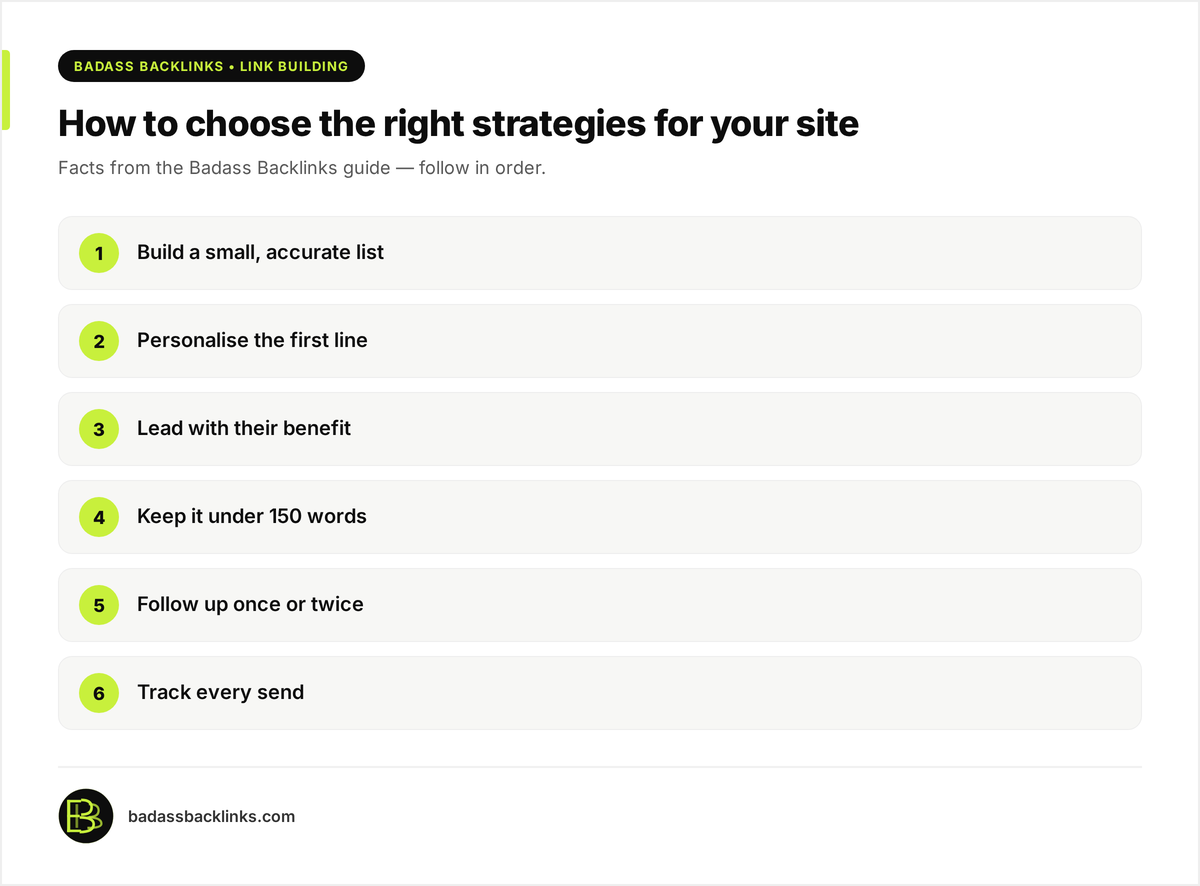
- Build a small, accurate list. Thirty well-researched contacts beat three hundred scraped ones. Outdated contact data is the most common complaint in the BuzzStream survey.
- Personalise the first line. Reference something they actually wrote. In BuzzStream’s data, 48% of digital PR pros always personalise.
- Lead with their benefit. What their readers get, not what you get.
- Keep it under 150 words. One ask, one link.
- Follow up once or twice. 55.4% of practitioners follow up once and 33.1% twice. More than that damages relationships.
- Track every send. Reply rate, link rate and cost per link by strategy, so you can drop what does not work.
Need a hand with tracking? Our free outreach monitoring tool logs prospects and live links.
Reporting
How to measure which strategies work
Measure link building strategy by rankings, organic traffic and conversions on the pages that receive links, not by link count alone. These are the metrics to track: referring domains to target pages, rankings for target keywords, cost per link by strategy and reply and acceptance rate.
| What to track | Why | Review |
|---|---|---|
| Referring domains to target pages | The output that moves rankings | Monthly |
| Rankings for target keywords | The outcome you are paying for | Monthly |
| Cost per link by strategy | Shows which strategies to scale | Quarterly |
| Reply and acceptance rate | Diagnoses pitch quality | Per campaign |
| Referral traffic | Proof that links reach people | Monthly |
| Lost links | Links rot over time | Quarterly |
The BuzzStream report found 39.2% of digital PR teams do not know their cost per link, and BuzzStream’s wider research found 63% want to get better at reporting impact. Measuring cost per link by strategy is the single best way to decide which of these 27 deserve more budget.
Avoid
Strategies that no longer work
The link building strategies that no longer work are the manipulative ones Google’s spam policies describe, plus tactics that once worked but now earn ignored links.
Still worth it
- Strategies that produce links an editor chose
- Assets people cite without being asked
- Relationships that produce repeat links
Skip these
- PBNs and link farms
- Paid links disguised as editorial
- Mass directory and comment spam
- Exact-match anchors at scale
- Expired domain redirects for link equity
Google’s Google Search Central cover all of the “skip” column. Since 2016, Penguin devalues spam rather than demoting whole sites, so most of these simply waste money. Some still trigger manual actions.
Cyrus Shepard makes the same point from the other side: most links are ignored by default, so the strategies worth your effort are the ones that produce links Google has a reason to count.
New: How to Create Links for SEO Google Can’t Ignore
Cyrus Maxx (@CyrusShepard) October 20, 2026
The web has TRILLIONS of links. Google ignores most by default. Links are not equal. Two nearly identical links may send completely different signals.
How to create links with the most *power*
– Topic Stability
– Anchor Context
– Editorial Diversity
– Magical Power Links
– New Information Links (1/2 🧵)
Expert insight
Expert insight on link building strategies
The quotes below are verbatim public statements, linked to the original source. We have not interviewed these people; the case study figures are our own client results.
“The web has TRILLIONS of links. Google ignores most by default. Links are not equal.”
Cyrus Shepard (@CyrusShepard), on X, 20 October 2026
“Link spam is the practice of creating links to or from a site primarily for the purpose of manipulating search rankings.”
Google Search Central, Spam policies for Google web search
“DYK that after 18 years we’re still using PageRank (and 100s of other signals) in ranking?”
Gary Illyes, Google, on X, 9 February 2017
From our case study data
DTC e-commerce case study: An 8-month campaign lifted organic traffic from 7,200 to 13,600 visits a month (+89%) and converted 32 of 55 unlinked mentions into links; 28 product pages reached page 1. Read the full case study
Conclusion
The bottom line on link building strategies
The best link building strategies earn links editors want to give. Rank tactics by effort versus return, measure every link building strategy and drop the ones that stop paying off.
Quick answers
Quick answers about link building strategies
Short, direct answers to the questions people ask search engines and AI assistants about link building strategies.
What is the best link building strategy for beginners?
Unlinked mention reclamation, partner links and resource page outreach are the best link building strategies for beginners.
Which link building strategies no longer work?
Strategies that no longer work include link farms, PBNs, mass directory submissions and spun guest posts.
How do I choose a link building strategy?
Choose a link building strategy by the effort you can afford and the return it has shown for sites like yours.
Are link exchanges a safe strategy?
Excessive link exchanges are listed by Google as link spam.
How do I measure which link building strategies work?
Measure link building strategies by links earned per hour, link quality and the ranking change on target pages.
How many link building strategies should I run at once?
Most teams run two to four link building strategies at once and drop the weakest each quarter.
Questions
Frequently asked questions
What is the best link building strategy?
There is no single best one. For most sites, a mix of unlinked mentions, partner links, vetted guest posts and one data-led digital PR campaign gives the best balance of cost and link quality.
Which link building strategies are fastest?
Unlinked mention reclamation, partner and integration pages, lost link reclamation and internal link fixes usually produce results within weeks.
How many links should I build per month?
Enough to close the gap with the pages outranking you, at a pace your team can sustain with quality. Compare referring domains rather than setting an arbitrary target.
Is guest posting still a good strategy?
Yes, on vetted sites with real traffic and natural anchors. BuzzStream found 96.2% of guest post sites are low quality, so vetting matters more than volume.
Do link building strategies differ for local businesses?
Yes. Local businesses get more value from associations, sponsorships, local press and citations than from national PR.
Are paid links a strategy?
Google says paid links that pass ranking credit violate its spam policies and should be labelled sponsored. We do not recommend them as a strategy.
References
Sources
Every statistic on this page links back to the original publisher below. Figures were checked on 24 October 2026.
- BuzzStream, State of Digital PR 2026: 150+ digital PR practitioners: 95.9% pitch data-led content; about 60% have monthly budgets under $10k; most common cost per link $300 to $500 (19.6%); 39.2% do not know their cost per link; 62.8% cite outdated journalist info; 60.8% say finding journalists is harder; 85.8% call backlinks the most effective outcome; 66.2% cite AI citations. www.buzzstream.com/blog/state-of-digital-pr
- Muck Rack, State of Journalism 2025: Survey of 1,515 journalists: 84% say at least some stories originate from pitches; 86% disregard irrelevant pitches; 42% want original data or research; 77% use AI tools. media.muckrack.com/documents/6.9.2025_state_of_journalism.pdf
- Moz (Fractl), Tangential Content Earns More Links: 835 Fractl campaigns: tangential campaigns earned 30% more media mentions and 77% more social shares on average than brand-focused campaigns. moz.com/blog/tangential-content
- BuzzStream, The Cost of Guest Posts, Based on 500k Sites (2026): About 257,000 guest post sites analysed: average vendor price $461, average direct price $295; 96.2% judged low quality; 39.6% had zero organic traffic; only 1.37% high quality; ecommerce niche average $341. www.buzzstream.com/blog/guest-post-costs
- BadAss Backlinks, DTC E-commerce Backlink Case Study: 8-month campaign: organic traffic 7,200 to 13,600 visits a month (+89%); traffic value $4,100 to $10,500 a month (+156%); 32 of 55 unlinked mentions converted to links (58%); 28 product pages on page 1. badassbacklinks.com/backlink-case-studies/dtc-ecommerce-backlink-case-study
- Ahrefs, Link Rot Study: 66.5% of links to 2,062,173 sites created since 2013 have rotted; 74.5% of links lost overall. ahrefs.com/blog/link-rot-study
- Google Search Central, Link best practices: Anchor text tells people and Google about the linked page; write descriptive, concise anchor text; avoid stuffing keywords into anchors. developers.google.com/search/docs/crawling-indexing/links-crawlable
- Editorial.Link, Link Building Statistics 2026 (518 SEOs): 73.2% believe backlinks influence appearing in AI search; 80.9% believe unlinked brand mentions affect rankings; 57.1% expect results within 1 to 3 months; agencies allocate 32.1% of SEO budget to link building. editorial.link/link-building-statistics
- Google Search Central, Spam policies for Google web search: Defines link spam, including buying or selling links that pass ranking credit, excessive link exchanges and large-scale guest posting campaigns with keyword-rich anchors. developers.google.com/search/docs/essentials/spam-policies
- Google Search Central Blog, Penguin is now part of our core algorithm (2016): Penguin became real-time and more granular, devaluing spam by adjusting ranking based on spam signals rather than affecting the ranking of the whole site. developers.google.com/search/blog/2016/09/penguin-is-now-part-of-our-core