BadAss Backlinks · SEO Guide · Updated October 2026
Anchor Text for SEO: The Complete Distribution Guide (+ Free Ratio Calculator)
Anchor text is the clickable text of a link, and Google uses it to understand what the linked page is about. A natural anchor text profile is mostly branded, URL and generic anchors, with exact-match anchors kept to a small share.
TL;DR
- Anchor text is the clickable text of a link. Google says it uses it to understand the linked page, so it still matters.
- Ahrefs looked at 384,614 top-20 pages and found the median share of exact-match anchors was 0% at every ranking position.
- Our planning range for an established site: 40% to 50% branded, 15% to 20% naked URL, 15% to 20% partial, 10% to 15% generic, 1% to 5% exact, 1% to 5% image.
- Run your own numbers through the calculator below, then fix the gaps with your next 10 links.
On this page
Anchor text audit
Where are you starting?
We rebalance over-optimised profiles with branded and partial-match editorial links.
- Full anchor distribution review
- Next-90-day anchor plan
- Editorial links on real sites
Guest posts from $85 and niche edits from $69 per link. Monthly plans optional.
Get an anchor audit
Anchor text is one of the oldest signals in SEO and still one of the easiest to get wrong. Too many exact-match anchors and you look like you bought your links. Too few descriptive anchors and you leave relevance on the table. This guide uses real study data, not folklore, to set a distribution you can plan around, then gives you a calculator to check your own profile.
If you would rather hand the fix to a team that builds editorial links with the anchors you are missing, see our link building services. Everyone else, read on.
Definition
What is anchor text?
Anchor text is the visible, clickable text of a hyperlink. It tells readers and search engines what the linked page is about. In the HTML <a href="https://example.com/">best running shoes</a>, the anchor text is “best running shoes”.
Google confirms this in its own documentation. Its Google Search Central page says anchor text “tells people and Google something about the page you’re linking to” and asks site owners to write anchors that are descriptive, reasonably concise and relevant to the target page. The same page warns against stuffing keywords into anchors. That one paragraph is the whole topic in miniature: anchors carry meaning, and over-engineering them is a spam pattern.
Anchor text matters in two places. External anchors are written by other sites linking to you, so you control them only through outreach, guest posts and the assets you create. Internal anchors are written by you, on your own site, and you control every one of them. The rules for the two are different, and we cover both below.
Types
The 6 types of anchor text and their risk
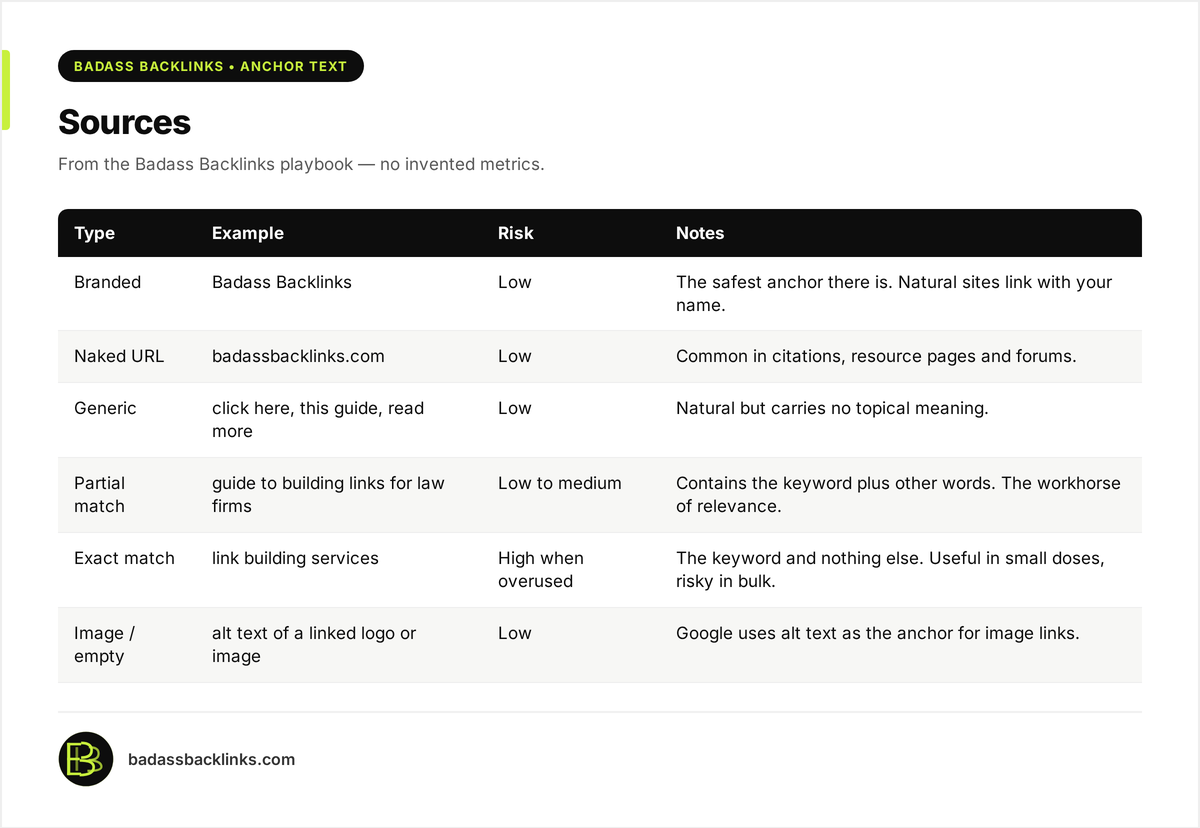
The 6 types of anchor text and their risk: branded, naked URL, generic and partial match.
| Type | Example | Risk | Notes |
|---|---|---|---|
| Branded | BadAss Backlinks | Low | The safest anchor there is. Natural sites link with your name. |
| Naked URL | badassbacklinks.com | Low | Common in citations, resource pages and forums. |
| Generic | click here, this guide, read more | Low | Natural but carries no topical meaning. |
| Partial match | guide to building links for law firms | Low to medium | Contains the keyword plus other words. The workhorse of relevance. |
| Exact match | link building services | High when overused | The keyword and nothing else. Useful in small doses, risky in bulk. |
| Image / empty | alt text of a linked logo or image | Low | Google uses alt text as the anchor for image links. |
Two more variants show up in most tools. Brand plus keyword anchors (“BadAss Backlinks link building”) behave like branded anchors with a relevance bonus, and many SEOs count them as partial match. LSI or topical anchors use related phrases rather than the keyword, which is what most natural editorial links look like.
Good anchors
- Read naturally inside the sentence
- Describe the destination page accurately
- Vary across referring domains
- Lean on your brand and URL
- Match how a journalist or blogger would actually write
Bad anchors
- The same money keyword on dozens of domains
- Keyword-stuffed phrases like “cheap best SEO services UK”
- Anchors that do not match the target page
- Exact match in footers, sidebars and author bios
- Anchors requested word for word in every guest post
The data
What a healthy anchor text distribution looks like
There is no Google-approved ratio. Google has never published one. What we have are large observational studies, and they agree on one thing: top-ranking pages do not carry many exact-match anchors.
The Ahrefs study is the biggest public dataset on the question. It found the median share of exact-match anchors was 0% at every position in the top 20, and the correlation between exact-match anchors and rankings was weak (an average Spearman correlation of 0.1436). In other words, plenty of pages rank with almost no exact-match anchors, and having more of them is barely associated with ranking higher. The same article notes that most SEOs recommend somewhere around 1% to 5% exact match.
Moz looked at the problem from the ecommerce side. In its sample, 34.6% of links pointing at category and product pages used targeted anchors (exact or phrase match), and only about 25% of links to category pages did. Commercial pages attract more descriptive anchors than homepages, which is normal, but even there targeted anchors are a minority.
Planning range midpoints for an established site (BadAss Backlinks)
Our planning ranges, informed by the Ahrefs and Moz studies above. Not a Google threshold.| Anchor type | Our planning range (established site) | Why |
|---|---|---|
| Branded | 40% to 50% | Majority of natural links point with a brand name |
| Naked URL | 15% to 20% | Citations, directories, forums |
| Partial match | 15% to 20% | Main relevance lever |
| Generic | 10% to 15% | Natural noise |
| Exact match | 1% to 5% | Ahrefs notes this is what most SEOs recommend |
| Image / empty | 1% to 5% | Logos, badges, linked charts |
Reader poll
Your vote is saved in this browser only. No live tally is stored on a server, so results show votes cast on this device.
Context
How the ratio changes by site age, YMYL and competition
One ratio does not fit every site. We adjust the plan on three axes.
Site age
A new domain has few links, so every anchor is a large share of the total. Five exact-match anchors out of twenty links is 25%. For sites under 12 months we push branded anchors to 50% to 60% and keep exact match close to zero until the profile has depth. This also mirrors reality: when a company launches, people link with its name.
YMYL niches
Google’s quality rater guidelines and its Google Search Central guidance put trust first for money and health topics. For finance, legal and medical sites we keep exact match at 0% to 3% and lean harder on branded and naked anchors. Our finance link building work and law firm campaigns follow this rule.
High-competition SERPs
Pages fighting for very competitive commercial terms often need more partial-match anchors to make relevance obvious. The Moz data shows commercial pages naturally attract more targeted anchors. Here we let partial match rise to 20% to 25%, but we still keep exact match under 5%.
| Profile | Branded | Naked | Partial | Generic | Exact | Image |
|---|---|---|---|---|---|---|
| Established | 40-50% | 15-20% | 15-20% | 10-15% | 1-5% | 1-5% |
| New (under 12 months) | 50-60% | 15-25% | 5-15% | 10-15% | 0-2% | 1-5% |
| YMYL | 45-55% | 15-20% | 10-15% | 10-15% | 0-3% | 1-5% |
History
Over-optimisation and the Penguin legacy
Anchor obsession comes from Penguin. In April 2012 Google launched a webspam update that, in its own words on the Google Search Central Blog, affected about 3.1% of English queries to a degree a regular user might notice. Sites built on thousands of exact-match links fell hard.
In September 2016 Google announced that Google Search Central Blog. Two changes matter. Penguin became real-time, so recovery no longer waited for a refresh. And it became more granular: rather than demoting whole sites, it devalues spam by adjusting rankings based on spam signals. The practical result is that today, manipulative anchors are more likely to be ignored than to sink the whole domain. That is still a waste of money, and manual actions for unnatural links still exist.
Google’s Google Search Central list keyword-rich anchors in large-scale guest posting campaigns as link spam. Its 2017 Google Search Central Blog reminder made the same point: guest posts that stuff keyword-rich links are the problem, not guest posts as such. Over-optimisation is now less a ranking cliff and more a signal that your links will not count.
🎯SEO Pro Tip #72: Avoid building direct anchor match backlinks.
Nick (@Nick_zv_) January 19, 2023
If 80% of your backlink anchors match the keywords you want to rank for, Google is very likely to catch on that you’re buying these backlinks.
Instead, use a variety of anchor texts, including brand mentions.
Backlinks will destroy your website.
Kai Cromwell (@KaiCromwell) December 6, 2022
If you’re not careful.
Using exact-match anchor text is a surefire way to get your website penalized.
Aim for this anchor text ratio:
– 50% – Branded
– 25% – Topic-related
– 15% – Miscellaneous/CTA
– 10% – Target keyword variations
Both tweets push the same idea: variety, led by your brand. Kai Cromwell’s 50% branded suggestion lands almost exactly on our planning range.
How to
How to audit your anchor text with Ahrefs and Search Console
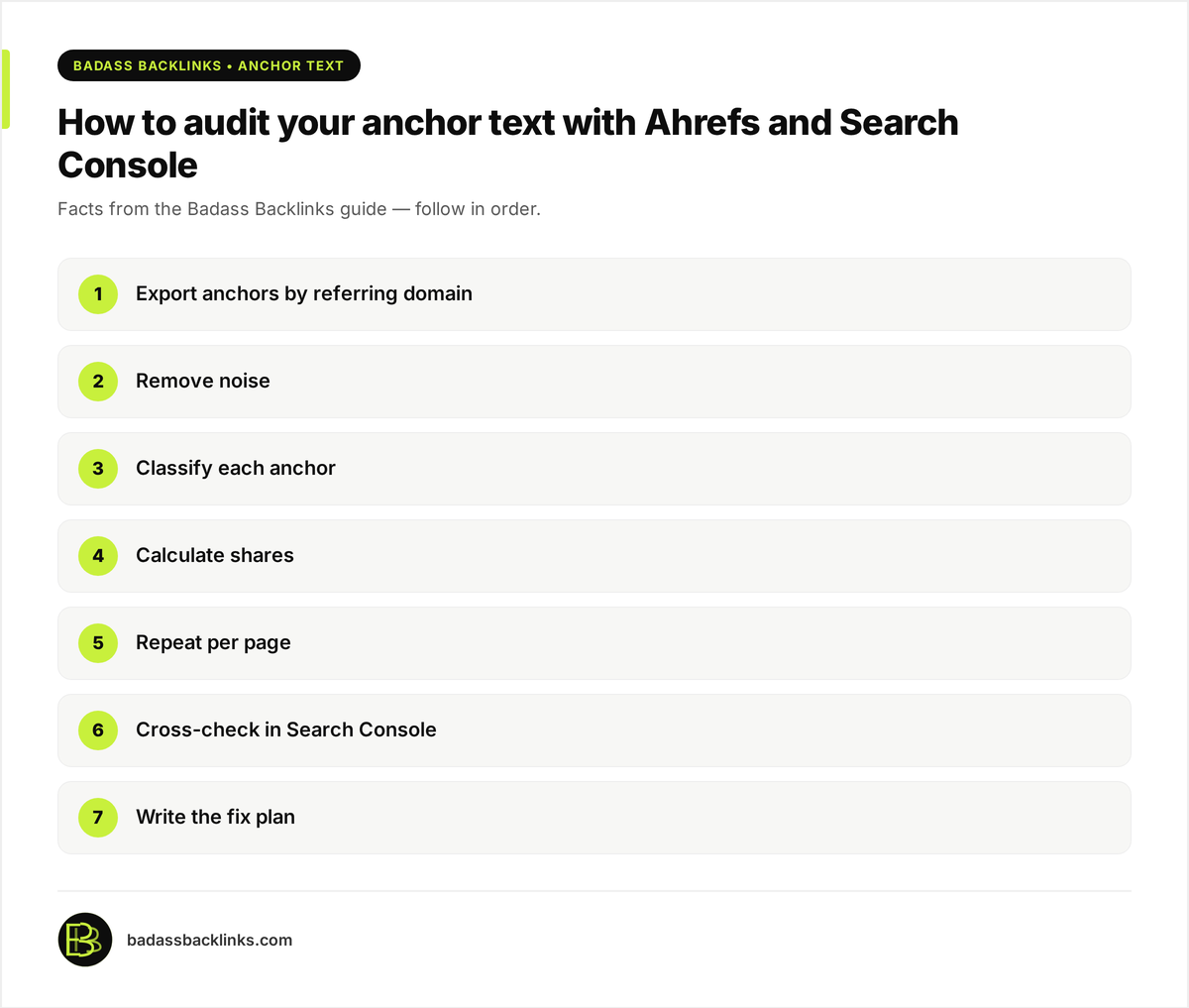
Here is how we audit anchor text for clients, using Ahrefs Site Explorer and Google Search Console.
- Export anchors by referring domain. In Ahrefs, open Anchors and sort by referring domains, not by total links. One sitewide footer link can create thousands of links from one domain and distort everything.
- Remove noise. Filter out obvious spam domains you did not build, scraper sites and links already disavowed. Google mostly ignores them anyway.
- Classify each anchor into the six types. Brand plus keyword goes to partial. Empty anchors go to image.
- Calculate shares and compare with the range for your profile. Use the calculator below.
- Repeat per page. Sitewide numbers hide problems. A money page with 40% exact-match anchors can sit inside a healthy domain profile.
- Cross-check in Search Console. The Links report shows top linking text. Look for anchors you never built and for manual actions under Security and Manual Actions.
- Write the fix plan. You rarely remove links. You dilute with new branded, naked and partial anchors.
Worked audit: a SaaS profile
In our B2B SaaS CRM case study, the client arrived with a previous vendor’s work in place: 41% of anchors were exact match. That is roughly eight times the top of our range. We did not disavow the lot. Over the campaign we built 128 links with branded, naked and descriptive partial anchors, and organic traffic grew from 4,200 to 18,500 visits a month in six months. The diluted profile is the reason the new links could do their job.
| Anchor type | Before (share) | Target | Action |
|---|---|---|---|
| Exact match | 41% | Under 5% | No new exact anchors |
| Branded | Low | 40% to 50% | Majority of new links |
| Partial match | Mixed | 15% to 20% | Descriptive phrases in editorial context |
| Naked URL | Low | 15% to 20% | Resource and citation links |
Your next 10 links
Want us to build the anchors you are missing?
We audit your anchor profile, write the plan and place branded, naked and descriptive partial-match links on real editorial sites. No exact-match spam.
Get an anchor planFree tool
Anchor text ratio calculator
Plug your own counts in. The defaults show a profile that is heavy on exact match, the most common problem we see.
Free tool
Anchor text ratio calculator
Paste the anchor counts from your Ahrefs or Semrush anchors report (count referring domains, not total links). Choose the profile that fits your site and the calculator compares your mix with our planning ranges and suggests what your next 10 links should use.
Ranges are BadAss Backlinks planning ranges, not Google thresholds. Google publishes no anchor ratio.
On-site
Internal link anchor text rules
Internal anchors are different. Google’s link guidance asks for descriptive anchors everywhere, and there is no evidence that descriptive internal anchors trigger link spam systems. This is your safest relevance lever.
- Use descriptive anchors that name the target topic. “Our guide to digital PR pricing” beats “click here”.
- Vary internal anchors naturally, but do not fear repeating the target keyword on internal links.
- Do not point two different pages at the same exact anchor. You blur which page should rank.
- Keep anchors short. Google asks for concise text.
- Fix generic internal anchors first. They are the easiest win on most sites.
The simplest SEO win we have ever experienced is updating generic internal link anchor text to keyword anchors.
Ross Tavendale (@rtavs) May 22, 2023
Ross Tavendale’s point is easy to test on your own site. Crawl it, export internal anchors, and replace “read more” and “here” with descriptive phrases. For more on the different link types you can earn, see our guide to backlink types.
2026
Does anchor text matter for AI search?
AI search has shifted attention from anchor keywords to brand. In an Ahrefs analysis of 75,000 brands, branded web mentions correlated with AI Overview visibility at 0.664, branded anchors at 0.527 and raw backlinks at 0.218. Brand signals beat link counts by a wide margin.
Practitioners have noticed. In the Editorial.Link survey of 518 SEOs, 73.2% believe backlinks influence the chance of appearing in AI search, and 80.9% believe unlinked brand mentions affect rankings. For anchor strategy that means one thing: the branded slice of your profile is not just a safety buffer any more. It is the part most likely to help you in AI answers.
Avoid
8 anchor text mistakes we fix most often
The most common anchor text mistakes are measuring by total links instead of referring domains, requesting the same exact anchor in every guest post, ignoring page-level ratios and disavowing instead of diluting. Each one is explained below with the fix.
- Measuring by total links instead of referring domains. Sitewide links distort everything.
- Requesting the same exact anchor in every guest post. This is the pattern Google calls out.
- Ignoring page-level ratios. A healthy domain can hide one over-optimised money page.
- Disavowing instead of diluting. Most old exact-match links can be balanced with new branded ones.
- Using exact match on new sites. A handful of links makes every anchor a big share.
- Copying a competitor’s ratio. Their profile includes links they never built.
- Forgetting image links. Missing alt text gives you empty anchors.
- Neglecting internal anchors. They are fully under your control.
Expert insight
Expert insight on anchor text
The quotes below are verbatim public statements, linked to the original source. We have not interviewed these people; the case study figures are our own client results.
“Google uses links as a signal when determining the relevancy of pages and to find new pages to crawl.”
Google Search Central, Link best practices for Google
“If 80% of your backlink anchors match the keywords you want to rank for, Google is very likely to catch on that you’re buying these backlinks.”
Nick Zviadadze, on X, 19 January 2023
“Link spam is the practice of creating links to or from a site primarily for the purpose of manipulating search rankings.”
Google Search Central, Spam policies for Google web search
From our case study data
B2B SaaS CRM case study: 128 links took organic traffic from 4,200 to 18,500 visits a month in six months, after a previous vendor had left 41% exact-match anchors. Read the full case study
Conclusion
The bottom line on anchor text
Anchor text should describe the linked page honestly and vary the way real editorial links do. Keep exact-match anchor text rare, lean on branded anchors and audit your anchor text profile before every campaign.
Quick answers
Quick answers about anchor text
Short, direct answers to the questions people ask search engines and AI assistants about anchor text.
What is a safe anchor text ratio for backlinks?
A safe anchor text ratio keeps branded and natural anchors as the majority and exact-match anchors low; compare against the pages already ranking for your keyword.
Can too much exact-match anchor text get me penalised?
Too much exact-match anchor text can look manipulative and trigger link spam action, which is why distribution matters.
Does anchor text matter for internal links?
Anchor text matters for internal links too; descriptive internal anchors help Google understand page topics.
What is the difference between branded and naked URL anchors?
A branded anchor uses the company name, while a naked URL anchor shows the address itself, such as badassbacklinks.com.
How do I check my anchor text distribution?
Export referring anchors from a backlink tool and group them into branded, URL, generic, exact, partial and other types.
Should I ask publishers for specific anchor text?
Suggest natural anchors that fit the sentence, but let editors change them; forcing exact-match anchors is a common mistake.
Questions
Frequently asked questions
What is a good anchor text ratio?
For an established site we plan around 40% to 50% branded, 15% to 20% naked URL, 15% to 20% partial match, 10% to 15% generic, 1% to 5% exact match and 1% to 5% image anchors. Google publishes no ratio; these are planning ranges based on public studies from Ahrefs and Moz.
How much exact match anchor text is safe?
Ahrefs found the median exact-match share among top-20 pages was 0%, and notes most SEOs recommend about 1% to 5%. We keep it under 5% for established sites, under 3% for YMYL sites and close to zero for new sites.
What percentage of anchors should be branded?
Around 40% to 50% for established sites and 50% to 60% for new ones. Branded anchors are the most natural pattern and correlate strongly with AI Overview visibility in Ahrefs data.
Does anchor text still matter in 2026?
Yes. Google documentation still says anchor text helps it understand the linked page. What has changed is that manipulative anchors are more likely to be devalued than rewarded.
Is exact match anchor text bad?
Not in small amounts. A natural profile contains some. It becomes a problem when the same money keyword appears across many domains, especially from guest posts, which Google names as a link spam pattern.
How do I check my anchor text distribution?
Export anchors by referring domain from Ahrefs or Semrush, classify them into six types, and calculate the share of each. Check key pages individually, then use the calculator on this page to compare with the planning range.
References
Sources
Every statistic on this page links back to the original publisher below. Figures were checked on 24 October 2026.
- Ahrefs, Anchor Text study (384,614 pages): 384,614 pages ranking in the top 20 for 19,840 keywords; median share of exact-match anchors was 0% at every position; average Spearman correlation between exact-match anchors and rank 0.1436 (weak); notes most SEOs recommend about 1% to 5% exact match; Penguin affected about 3.1% of queries. ahrefs.com/blog/anchor-text
- Moz, Anchor Text Distribution: Avoiding Over-Optimization: 34.6% of links to category and product pages used targeted (exact or phrase) anchors; only about 25% of links to category pages were targeted. moz.com/blog/anchor-text-distribution-avoiding-over-optimization
- Google Search Central, Link best practices: Anchor text tells people and Google about the linked page; write descriptive, concise anchor text; avoid stuffing keywords into anchors. developers.google.com/search/docs/crawling-indexing/links-crawlable
- Google Search Central, Creating helpful, reliable, people-first content: Explains E-E-A-T and that trust is weighted most heavily for YMYL topics. developers.google.com/search/docs/fundamentals/creating-helpful-content
- Google Search Central Blog, Another step to reward high-quality sites (2012): The webspam (Penguin) update affected about 3.1% of English queries to a degree a regular user might notice. developers.google.com/search/blog/2012/04/another-step-to-reward-high-quality
- Google Search Central Blog, Penguin is now part of our core algorithm (2016): Penguin became real-time and more granular, devaluing spam by adjusting ranking based on spam signals rather than affecting the ranking of the whole site. developers.google.com/search/blog/2016/09/penguin-is-now-part-of-our-core
- Google Search Central, Spam policies for Google web search: Defines link spam, including buying or selling links that pass ranking credit, excessive link exchanges and large-scale guest posting campaigns with keyword-rich anchors. developers.google.com/search/docs/essentials/spam-policies
- Google Search Central Blog, A reminder about links in large-scale article campaigns (2017): Warns against guest posts that stuff keyword-rich links, are published across many sites, or are written by people with no knowledge of the topic. developers.google.com/search/blog/2017/05/a-reminder-about-links-in-large-scale
- Ahrefs, AI Overview brand visibility factors (75K brands): Branded web mentions had a 0.664 correlation with AI Overview visibility, branded anchors 0.527, backlinks 0.218. ahrefs.com/blog/ai-overview-brand-correlation
- BadAss Backlinks, B2B SaaS CRM case study: Organic traffic 4,200 to 18,500 per month in six months; 128 links; previous vendor left 41% exact-match anchors. badassbacklinks.com/backlink-case-studies/b2b-saas-crm-case-study
- Editorial.Link, Link Building Statistics 2026 (518 SEOs): 73.2% believe backlinks influence appearing in AI search; 80.9% believe unlinked brand mentions affect rankings; 57.1% expect results within 1 to 3 months; agencies allocate 32.1% of SEO budget to link building. editorial.link/link-building-statistics