BadAss Backlinks · Digital PR Guide · Updated October 2026
Digital PR for Link Building: The Campaign Playbook (Idea to Coverage)
Digital PR for link building means creating a newsworthy story, data study or asset and pitching it to journalists so publications cover it and link to your site. Digital PR earns links you cannot buy, from news sites with real authority.
TL;DR
- Digital PR earns links by giving journalists stories, data and expert comment they want to publish.
- 95.9% of digital PR teams pitch data-led content, and 42% of journalists say they want original data or research.
- The most common cost per link reported by practitioners is $300 to $500; 39.2% do not know theirs.
- Small, accurate media lists beat big ones: 86% of journalists disregard irrelevant pitches.
On this page
Digital PR that earns links
What do you need?
We create data-led campaigns and pitch them to the journalists who cover your niche.
- Original data stories
- Targeted journalist lists
- Coverage on real publications
Guest posts from $85 and niche edits from $69 per link. Monthly plans optional.
See digital PR service
Digital PR is the link building tactic most likely to land you on a national news site. It is also the one most likely to burn a month of work for zero coverage. The difference is almost always in the idea, the data and the list, not the press release.
This playbook walks one campaign from idea to coverage in eight steps, using the most recent public data from BuzzStream’s State of Digital PR report and Muck Rack’s survey of 1,515 journalists. If you want a team to run campaigns for you, see our digital PR backlink service.
Definition
What is digital PR for link building?
Digital PR for SEO is the practice of creating newsworthy stories, data or expert commentary and pitching them to journalists and publishers, so that the resulting coverage links back to your site. It borrows the methods of traditional PR but measures success in links, referring domains, brand mentions and rankings rather than column inches.
Digital PR differs from other link building in one key way: you do not control the outcome. A journalist decides whether to cover you, what to write and whether to link. That is exactly why the links are valuable. They are editorial in the strictest sense.
| Digital PR | Guest posting | Traditional PR | |
|---|---|---|---|
| Who writes | Journalist | You | Journalist |
| Control over link | Low | High | Very low |
| Typical target | News and national media | Niche blogs and publications | News, trade, broadcast |
| Primary KPI | Links and mentions | Links | Coverage and reach |
| Scale | Campaign-based | Steady | Campaign-based |
2026
Why digital PR matters more in 2026
Three trends make digital PR more valuable now than five years ago.
Brand mentions drive AI visibility. In the Ahrefs study of 75,000 brands, branded web mentions were the strongest correlate of AI Overview visibility. Digital PR produces mentions and links in the same placement.
Cheap links are being ignored. Google’s spam policies and the 2024 updates targeted scaled content and paid placements. Editorial news links are the opposite of that pattern.
Journalists are stretched. BuzzStream cites roughly 3,000 journalist layoffs in 2025, and 60.8% of practitioners say finding the right journalist is harder. Fewer journalists means each one relies more on good pitches; the Muck Rack survey found 84% say at least some of their stories originate from pitches.
Reader poll
Your vote is saved in this browser only. No live tally is stored on a server, so results show votes cast on this device.
The playbook
The campaign playbook at a glance: idea to coverage
Every campaign we run follows the same path from idea to coverage. The rest of this playbook takes each stage in order. Lead times are our planning bands for a data-led campaign, not published benchmarks.
Formats
Choose your format: 6 digital PR campaign types compared
Six campaign formats cover almost everything we run. Cost, lead time and difficulty below are our planning bands, not published benchmarks; link yield depends far more on the story than the format.
| Type | What it is | Relative cost | Lead time | Difficulty | Best niche |
|---|---|---|---|---|---|
| Data-led study | Survey, public data or product data analysed into a story | High | 6 to 10 weeks | Hard | Finance, SaaS, property |
| Reactive / newsjacking | Expert comment on breaking news | Low | Hours to days | Medium | Legal, finance, any niche with experts |
| Tangential content | A story adjacent to your product with wider appeal | Medium to high | 4 to 8 weeks | Medium | Boring B2B niches |
| Index or ranking | Rank cities, products or brands on a metric | Medium | 4 to 8 weeks | Medium | Travel, property, ecommerce |
| Expert commentary programme | Ongoing source relationships with journalists | Low | Ongoing | Medium | Regulated professions |
| Creative or interactive asset | Tool, map or visual | High | 8 to 12 weeks | Hard | Brands with design budget |
Tangential campaigns deserve a special mention. Moz and Fractl analysed 835 campaigns and found Moz (Fractl). If your product is boring to a general audience, write about something adjacent that is not.
Step 1
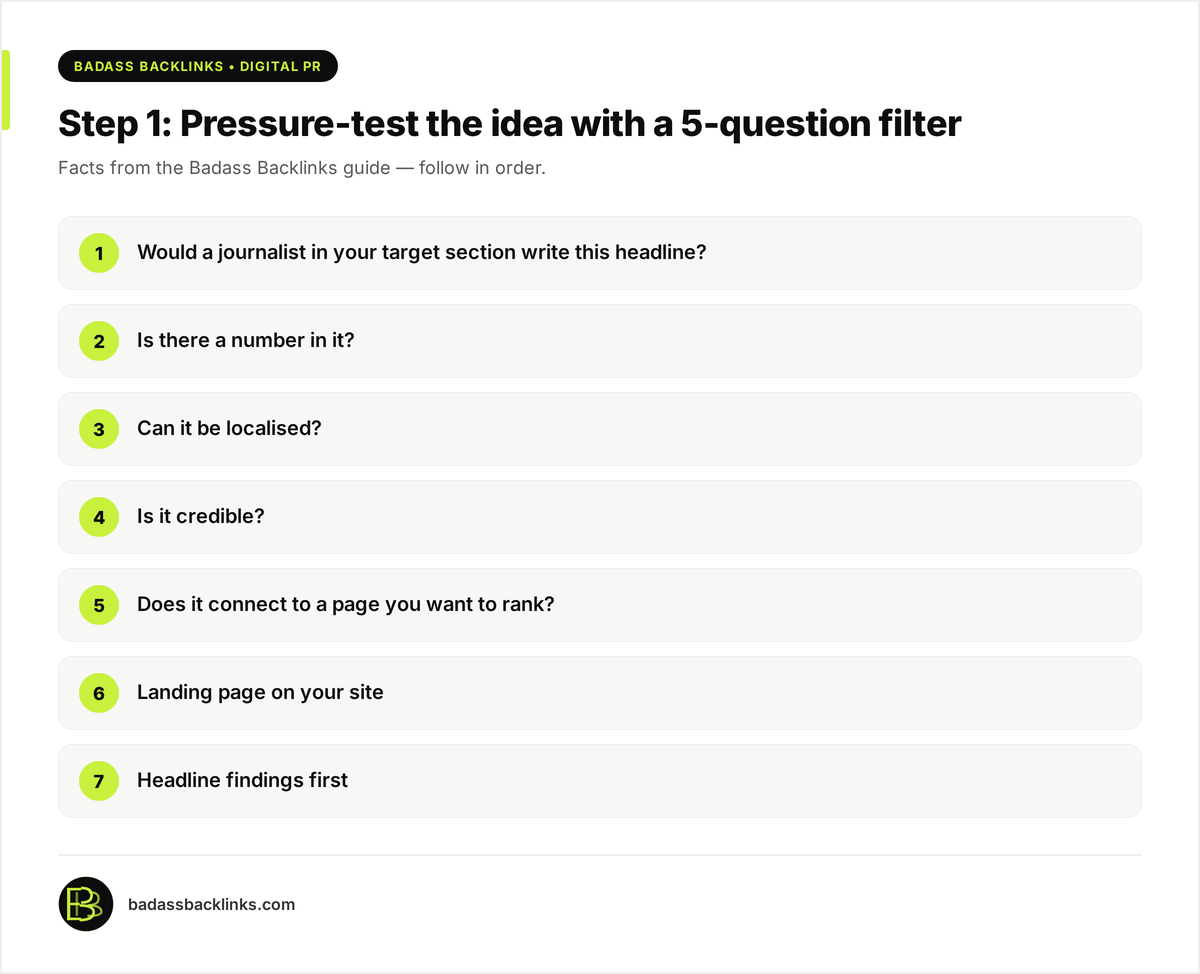
Step 1: Pressure-test the idea with a 5-question filter
Run every idea through five questions before you spend a penny on data.
- Would a journalist in your target section write this headline? Write the headline first. If it reads like an ad, kill it.
- Is there a number in it? Data-led ideas dominate: 95.9% of practitioners pitch them.
- Can it be localised? Regional cuts (cities, states, regions) multiply the number of outlets that can cover it.
- Is it credible? Sample size, methodology and source must survive a sceptical editor.
- Does it connect to a page you want to rank? If the coverage cannot reasonably link to a relevant page, the SEO value drops.
Step 2
Step 2: Find and analyse the data
You do not always need a survey. Public data is free, credible and underused.
| Source | What it covers | Best for |
|---|---|---|
| Office for National Statistics (ONS) | UK economy, population, work, housing | UK regional stories |
| US Census Bureau data | US population, business, housing, income | US state and city cuts |
| Eurostat | EU-wide statistics | Country comparisons |
| Statista | Aggregated market data (paid) | Context and secondary figures; cite the original source |
| Freedom of Information requests (UK) | Data from public bodies on request | Exclusive stories no one else has |
| Your own product data | Anonymised usage, pricing or search data | Unique, hard-to-copy stories |
Step 3
Step 3: Build the campaign asset
Build the campaign asset as a landing page on your own site that leads with the headline findings and explains the methodology.
- Landing page on your site. The asset lives on a relevant URL, ideally linked from a commercial page.
- Headline findings first. Three to five key numbers at the top.
- Methodology section. Sample, dates, sources, limitations.
- Regional and sector cuts. Tables journalists can lift.
- Expert quote. A named spokesperson with credentials.
- Embeddable visuals. Charts with an attribution line, built in HTML or SVG so they load fast.
Digital PR, done for you
Want coverage that links back?
We find the story, build the data, write the release and pitch the 30 journalists most likely to cover it. You get links from real publications.
See digital PR serviceStep 4
Step 4: Build the media list (30 targeted beats 300)
“30 targeted beats 300” is our rule for media lists, and the data backs it. The Muck Rack survey found 86% of journalists disregard irrelevant pitches, and BuzzStream found 62.8% of practitioners cite outdated journalist information as a problem.
- Read the last five articles by every journalist on your list.
- Segment by beat and region; send different angles to each segment.
- Prioritise journalists who link out to sources in their articles.
- Remove anyone who has not written on the topic in six months.
Step 5
Step 5: Write the pitch
A good pitch is short, specific and about the journalist’s readers.
Subject: [Specific finding] in [region/sector], new data
Hi [Name],
[One-sentence finding with the number.]
Three more from the data:
- [Stat 2]
- [Stat 3]
- [Regional cut relevant to their patch]
Methodology and full tables: [link]
[Spokesperson], [credential], is available for comment today.
Paul
In BuzzStream’s data, 48% of practitioners always personalise, 55.4% follow up once and 33.1% twice. And 77% of journalists in the Muck Rack survey use AI tools, so expect your pitch to be skimmed and summarised. Put the finding in the subject line.
Step 6
Step 6: Time the launch
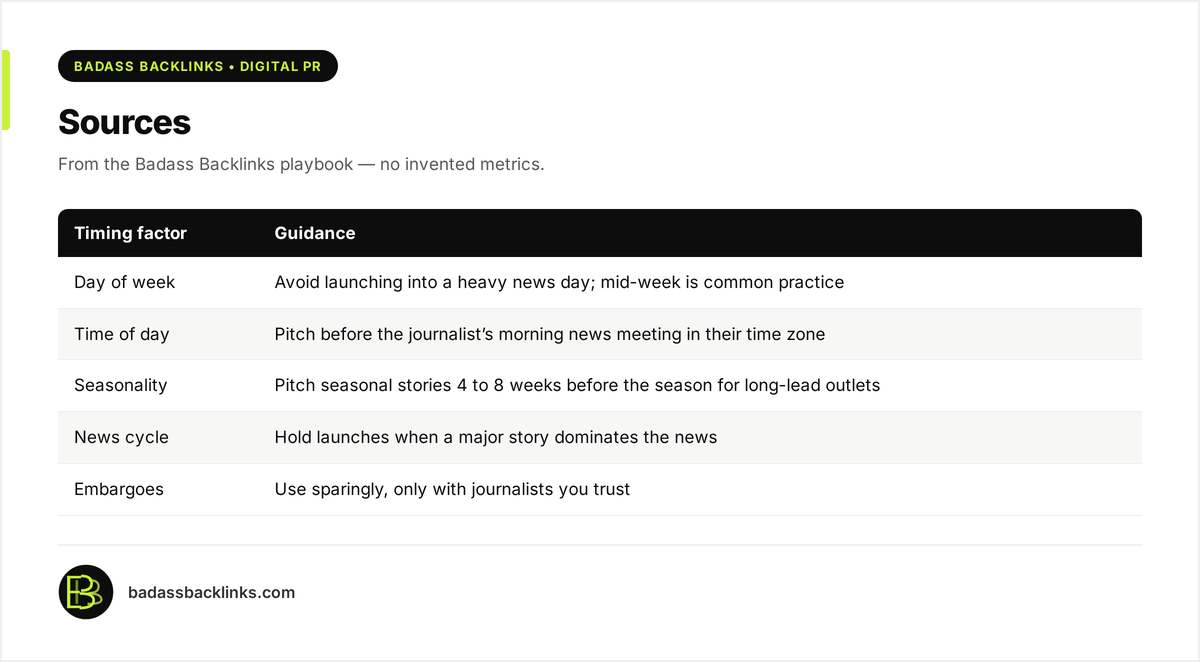
Time the launch around the news cycle: pick the day, hour and season when journalists are most likely to cover the story.
| Timing factor | Guidance |
|---|---|
| Day of week | Avoid launching into a heavy news day; mid-week is common practice |
| Time of day | Pitch before the journalist’s morning news meeting in their time zone |
| Seasonality | Pitch seasonal stories 4 to 8 weeks before the season for long-lead outlets |
| News cycle | Hold launches when a major story dominates the news |
| Embargoes | Use sparingly, only with journalists you trust |
For reactive PR, timing is everything: comment within hours of a story breaking, not days.
Steps 7 and 8
Steps 7 and 8: Follow up and turn coverage into links
Coverage rarely arrives in one burst. Expect a first wave within days of launch, a second wave as regional and trade titles pick up the story, and a tail of syndicated and copied coverage. Your job in this stage is to turn coverage into links.
- Reply within the hour. Journalists on deadline take the source who answers first. Have the spokesperson, extra data cuts and images ready.
- Follow up once or twice, with something new. A regional cut or a fresh quote, never “just checking in”.
- Chase missing credits politely. When coverage uses your data without a link, thank the journalist and ask for a link to the methodology page so readers can check the numbers.
- Log every piece. Publication, URL, link status (followed, nofollow, none) and target page.
- Re-pitch the tail. Two to four weeks later, offer updated or local angles to titles that missed the first wave.
Digital PR specialist Ricky Davies makes two points worth hearing before you plan a single campaign: digital PR links cannot be ordered like guest posts, and one campaign rarely closes a gap competitors have built over years.
You can’t order digital pr link building like a guest post and it’s something that annoys me when people think that you can.
Ricky Davies (@RickyDPR) October 15, 2026
Oh il have a link from Forbes, a link from CNN and a link from Huffington Post.
Digital pr doesn’t work like that, it’s the best way of building links, it takes time, effort and budget to consistently land these links too. If you miss out on one of them, then you won’t be successful with digital pr.
One digital pr campaign won’t change your life.
Ricky Davies (@RickyDPR) October 14, 2026
We have had businesses hire us for one campaign and then wonder why their rankings haven’t exploded over night.
It doesn’t work like that.
Your competitors could have built links through digital pr for years, your job is to close that gap.
So if you can only afford one campaign, or want to test the waters with digital pr then my advice is not too.
It isn’t a magic wand. It won’t provide you with page 1 rankings over night.
Digital pr is for serious business owners who want to build an online presence that ranks for years to come.
Reporting
How to measure a digital PR campaign
Measure digital PR by rankings, organic traffic and conversions on the pages that receive links, not by link count alone. These are the metrics to track: links from unique referring domains, followed vs nofollow split, brand mentions and rankings of the linked page.
| Metric | Why |
|---|---|
| Links from unique referring domains | The SEO outcome |
| Followed vs nofollow split | Many news sites nofollow; both have value |
| Brand mentions (linked and unlinked) | AI visibility and reclamation opportunities |
| Rankings of the linked page | Did the links move what matters? |
| Cost per link | Comparable with other tactics |
| Referral traffic | Real readers clicking through |
Follow up on unlinked coverage. A polite request to add a source link converts often, because the journalist already chose to cover you.
Reactive
The reactive PR playbook (the fast lane)
Reactive PR is the cheapest way into the press and the best format for brands with real experts but small budgets. It runs on speed and preparation.
- Pick three to five beats where your spokespeople have genuine expertise: for a mortgage broker, rates, house prices and first-time buyers.
- Pre-approve quotes. Agree positions on predictable topics (rate decisions, budget announcements, quarterly data releases) before they happen, so compliance is not the bottleneck.
- Monitor the calendar. Central bank decisions, statistics release dates, legislation and seasonal events are scheduled. Put them in a shared calendar.
- Watch journalist requests on source platforms and social media, and reply only where your expert fits.
- Send comment within hours. Two to four sentences, one clear opinion, one number if you have it, full name and title.
- Follow up for links. If the article quotes you without a link, ask politely for a link to the expert’s profile or the relevant guide.
Reactive work also feeds AI visibility: every quote is a brand mention on a trusted site, with your expert’s name and company in the same sentence.
Benchmarks
Digital PR budget and cost-per-link benchmarks
Published benchmarks from the BuzzStream report (150+ practitioners) give useful context.
Monthly digital PR budgets (BuzzStream 2026)
Source: BuzzStream State of Digital PR 2026. The $20k+ share rose from 4% to 8.8%.Cost per link reported
Source: BuzzStream State of Digital PR 2026.The most telling number is the last one. Nearly four in ten teams do not know their cost per link. If you cannot measure it, you cannot compare digital PR against guest posting or any other tactic.
Markets
Digital PR in the UK vs the US
The UK and US media markets work differently.
| Factor | UK | US |
|---|---|---|
| Market structure | Concentrated national press plus strong regional titles | Very large, fragmented by state, city and vertical |
| Regional angle | Regional cuts by nation and city work very well | State-level cuts multiply outlets |
| Data sources | ONS, FOI requests | Census Bureau, state agencies |
| Linking habits | Varies by publisher; some link sparingly | Varies; trade and local outlets often link to sources |
| Time zones | One time zone | Four mainland zones; stagger sends |
For campaigns across both markets, build separate lists and separate angles. A UK-wide stat rarely interests a Texas business editor.
Compliance
Digital PR in regulated niches
Finance, legal and health brands can run digital PR, but every claim must pass compliance.
- UK financial services: the Financial Conduct Authority rules require promotions to be clear, fair and not misleading. Data stories about products count.
- US broker-dealers: FINRA Rule 2210 requires fair and balanced communications and principal approval for retail communications.
- US investment advisers: the SEC governs advertisements, testimonials and endorsements.
- US lawyers: American Bar Association limits giving anything of value for recommendations; check state rules.
- Build compliance review into the timeline: add one to two weeks.
We cover regulated campaigns in our finance and law firm programmes.
Resourcing
The team and tools you need
A digital PR campaign needs a strategist, a data analyst, an outreach specialist and a designer or developer, plus the tools listed below.
| Role or tool | What it does | Note |
|---|---|---|
| Strategist | Ideas, angles, newsworthiness | The most important hire |
| Data analyst | Cleans data and finds the story | Can be part-time |
| Outreach specialist | Lists, pitches, relationships | Ideally specialises by sector |
| Designer or developer | Charts, interactives | Keep assets lightweight |
| Media database | Journalist contacts | Muck Rack (46.6%) and BuzzStream (44.6%) lead usage in BuzzStream data |
| Monitoring | Coverage and mention alerts | Feeds unlinked mention follow-up |
In-house or agency? BuzzStream’s wider research found 61% of organisations run link building fully in-house. Digital PR is the tactic most often outsourced because a single strong campaign needs strategist, analyst and outreach skills at once. Our comparison of the best digital PR services covers what to look for.
Avoid
8 digital PR mistakes
The most common digital PR mistakes are starting with the asset, not the headline, weak methodology, huge, untargeted lists and attachments instead of links. Each one is explained below with the fix.
- Starting with the asset, not the headline. If you cannot write the headline a journalist would use, the asset will not save it.
- Weak methodology. Small samples, leading questions and unnamed sources get rejected by careful editors.
- Huge, untargeted lists. 86% of journalists disregard irrelevant pitches.
- Attachments instead of links. Put the data on a page and link to it.
- Over-promoting the brand. The brand belongs in the methodology and the quote, not the headline.
- Ignoring unlinked coverage. Ask for the link.
- No landing page plan. Coverage pointing at a thin page wastes authority.
- Not tracking cost per link. 39.2% of teams do not know theirs.
Expert insight
Expert insight on digital PR for link building
The quotes below are verbatim public statements, linked to the original source. We have not interviewed these people; the case study figures are our own client results.
“You can’t order digital pr link building like a guest post”
Ricky Davies, digital PR specialist, on X, 15 October 2026
“One digital pr campaign won’t change your life.”
Ricky Davies, digital PR specialist, on X, 14 October 2026
“Google uses links as a signal when determining the relevancy of pages and to find new pages to crawl.”
Google Search Central, Link best practices for Google
From our case study data
DTC e-commerce case study: An 8-month campaign lifted organic traffic from 7,200 to 13,600 visits a month (+89%) and converted 32 of 55 unlinked mentions into links; 28 product pages reached page 1. Read the full case study
Conclusion
The bottom line on digital PR for link building
Digital PR for link building rewards strong stories, not volume pitching. Build a campaign asset journalists need, time it well, and measure digital PR by links, coverage and the rankings that follow.
Quick answers
Quick answers about digital PR for link building
Short, direct answers to the questions people ask search engines and AI assistants about digital PR for link building.
What is digital PR in SEO?
Digital PR in SEO is publicity work aimed at earning editorial links and brand mentions from online publications.
How many links does a digital PR campaign get?
The number of links a digital PR campaign gets varies widely with story strength and niche; no honest agency guarantees a number.
How do I pitch a journalist for a backlink?
Pitch the story, not the link: a short email with the headline finding, why it matters to their readers and the data source.
Is digital PR better than guest posting?
Digital PR usually earns stronger editorial links than guest posting but is less predictable; most programmes use both.
How long does a digital PR campaign take?
A digital PR campaign typically takes several weeks from idea to launch, plus follow-up coverage after launch.
What makes a story newsworthy for digital PR?
A newsworthy digital PR story has fresh data, a surprising angle, timeliness and relevance to a journalist’s beat.
Questions
Frequently asked questions
What is digital PR?
Creating newsworthy stories, data or expert comment and pitching them to journalists so the coverage links back to your site. It is PR measured in links, mentions and rankings.
How is digital PR different from link building?
Digital PR is one link building method. Unlike guest posting or outreach for resource links, the journalist controls the article and the link, which makes the links highly editorial.
How much does digital PR cost?
In BuzzStream’s 2026 survey about 60% of teams spend under $10,000 a month and the most common cost per link is $300 to $500. Campaign costs depend on data, design and outreach scope.
How many links does a digital PR campaign get?
The number of links a campaign gets varies widely by story strength and niche. There is no reliable public average; track your own cost per link and coverage rate.
Does digital PR work for small brands?
Yes, especially reactive PR and expert commentary, which need expertise more than budget. Data-led campaigns with regional cuts also work well for smaller brands.
What is a good coverage rate?
There is no published industry standard. Track the share of pitched journalists who cover the story and compare campaigns against each other.
References
Sources
Every statistic on this page links back to the original publisher below. Figures were checked on 24 October 2026.
- BuzzStream, State of Digital PR 2026: 150+ digital PR practitioners: 95.9% pitch data-led content; about 60% have monthly budgets under $10k; most common cost per link $300 to $500 (19.6%); 39.2% do not know their cost per link; 62.8% cite outdated journalist info; 60.8% say finding journalists is harder; 85.8% call backlinks the most effective outcome; 66.2% cite AI citations. www.buzzstream.com/blog/state-of-digital-pr
- Muck Rack, State of Journalism 2025: Survey of 1,515 journalists: 84% say at least some stories originate from pitches; 86% disregard irrelevant pitches; 42% want original data or research; 77% use AI tools. media.muckrack.com/documents/6.9.2025_state_of_journalism.pdf
- Moz (Fractl), Tangential Content Earns More Links: 835 Fractl campaigns: tangential campaigns earned 30% more media mentions and 77% more social shares on average than brand-focused campaigns. moz.com/blog/tangential-content
- Ahrefs, AI Overview brand visibility factors (75K brands): Branded web mentions had a 0.664 correlation with AI Overview visibility, branded anchors 0.527, backlinks 0.218. ahrefs.com/blog/ai-overview-brand-correlation
- Financial Conduct Authority, Financial promotions and adverts: UK rules requiring financial promotions, including websites, to be clear, fair and not misleading. www.fca.org.uk/firms/financial-promotions-adverts
- FINRA Rule 2210, Communications with the Public: Communications must be fair, balanced and not misleading; principal approval and filing requirements for retail communications. www.finra.org/rules-guidance/rulebooks/finra-rules/2210
- SEC, Marketing Rule for Investment Advisers (press release 2020-334): Rule 206(4)-1 governs adviser advertisements, testimonials and endorsements. www.sec.gov/newsroom/press-releases/2020-334
- American Bar Association, Model Rule 7.2: A lawyer shall not give anything of value to a person for recommending the lawyer’s services, except listed exceptions such as the reasonable cost of advertisements. www.americanbar.org/groups/professional_responsibility/publications/model_rules_of_profess
- Google Search Central, Spam policies for Google web search: Defines link spam, including buying or selling links that pass ranking credit, excessive link exchanges and large-scale guest posting campaigns with keyword-rich anchors. developers.google.com/search/docs/essentials/spam-policies
- BuzzStream, 80 Link Building Statistics (2026): 61% of organisations manage link building fully in-house; 30% of teams using external link builders are fully confident in results; 63% want better impact reporting. www.buzzstream.com/blog/link-building-statistics