BadAss Backlinks · Ecommerce SEO · Updated October 2026
E-commerce Link Building: Complete Guide
E-commerce link building is earning backlinks to an online store’s category, product and content pages from relevant publishers, gift guides, review sites and partners. Category and product pages rarely attract links on their own, so stores need a deliberate plan.
TL;DR
- Ecommerce link building earns links to the category and product pages that drive revenue, not just the homepage.
- The fastest wins are usually unlinked mentions and “best [product]” roundups: in our DTC case study, 32 of 55 mentions became links and 4 roundups added the store.
- That campaign lifted organic traffic from 7,200 to 13,600 visits a month (+89%) in 8 months without a single guest post.
- Internal links carry earned authority from guides and the homepage into categories.
On this page
Ecommerce link building
What do you need?
Done-for-you links to category and product pages.
- Links to category and product pages
- Unlinked mention reclamation
- Roundup and gift guide placements
Guest posts from $85 and niche edits from $69 per link. Monthly plans optional.
See the service
Online stores are built to sell, and most of their pages are commercial: categories, collections and products. That is exactly why they are hard to earn links to. Publishers link to stories, data and guides, not to a page of running shoes.
Ecommerce link building solves that problem with tactics that point links at revenue pages, plus internal linking that carries authority to them. This guide covers the strategy, a 9-step playbook, campaign types, costs and a real campaign with full numbers. For done-for-you campaigns, see our ecommerce backlinks service.
Definition
What is ecommerce link building?
Ecommerce link building is the process of earning links from relevant websites to an online store’s category, product and brand pages, so those pages rank in search and generate organic revenue.
Links remain one of the ways Google discovers pages and understands their importance; its Google Search Central documentation explains how crawlable links work. With Google holding about 89.94% of global search engine market share according to StatCounter Global Stats, ranking there is the main organic goal for most stores.
Context
Why ecommerce link building is different
Ecommerce link building is different because the pages that make money (categories and products) are the hardest to earn links to, so stores rely on mentions, roundups, gift guides and internal linking.
Ecommerce has four problems most sites do not. Scale: thousands of URLs compete for a limited link budget. Commercial intent: publishers rarely link to sales pages unprompted. Churn: products go out of stock and URLs disappear. And seasonality: the moments when links matter most (holidays, launches) are planned by publishers months ahead.
The Moz study shows the anchor side of this: 34.6% of links to category and product pages used targeted anchors, and only about 25% of links to category pages were targeted. Natural links to store pages tend to use brand and product names, which is a useful guide for your own anchor mix.
Reader poll
Your vote is saved in this browser only. No live tally is stored on a server, so results show votes cast on this device.
Link sources
Link sources that only work for online stores
Link sources that only work for online stores: unlinked brand and product mentions, “Best [product]” roundups, gift guides and independent reviews.
| Source | How it works | Best target page |
|---|---|---|
| Unlinked brand and product mentions | Ask sites already naming you to add a link | Product or category |
| “Best [product]” roundups | Get added to listicles that already rank | Product or category |
| Gift guides | Pitch seasonal guides months ahead | Product |
| Independent reviews | Send product without link conditions | Product |
| Stockist and supplier pages | “Where to buy” and brand partner pages | Homepage or category |
| Creator collaborations | Collab drops, disclosed | Product or collection |
| Comparison shopping and deal sites | Listings and deals | Product (usually nofollow) |
| Platform ecosystems | Shopify and WooCommerce partner showcases | Homepage |
Priorities
The best ecommerce links, tiered
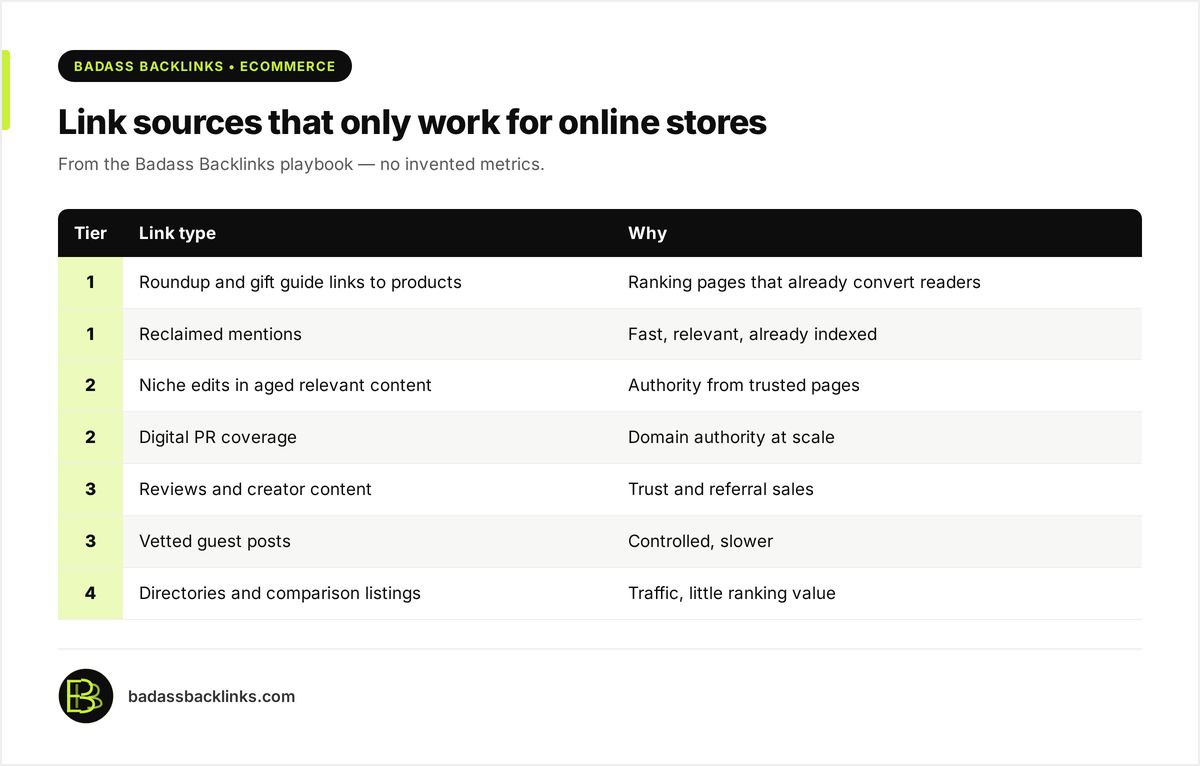
The best ecommerce links, tiered: roundup and gift guide links to products, reclaimed mentions, niche edits in aged relevant content and digital PR coverage.
| Tier | Link type | Why |
|---|---|---|
| 1 | Roundup and gift guide links to products | Ranking pages that already convert readers |
| 1 | Reclaimed mentions | Fast, relevant, already indexed |
| 2 | Niche edits in aged relevant content | Authority from trusted pages |
| 2 | Digital PR coverage | Domain authority at scale |
| 3 | Reviews and creator content | Trust and referral sales |
| 3 | Vetted guest posts | Controlled, slower |
| 4 | Directories and comparison listings | Traffic, little ranking value |
How to
How to do ecommerce link building: 9 steps
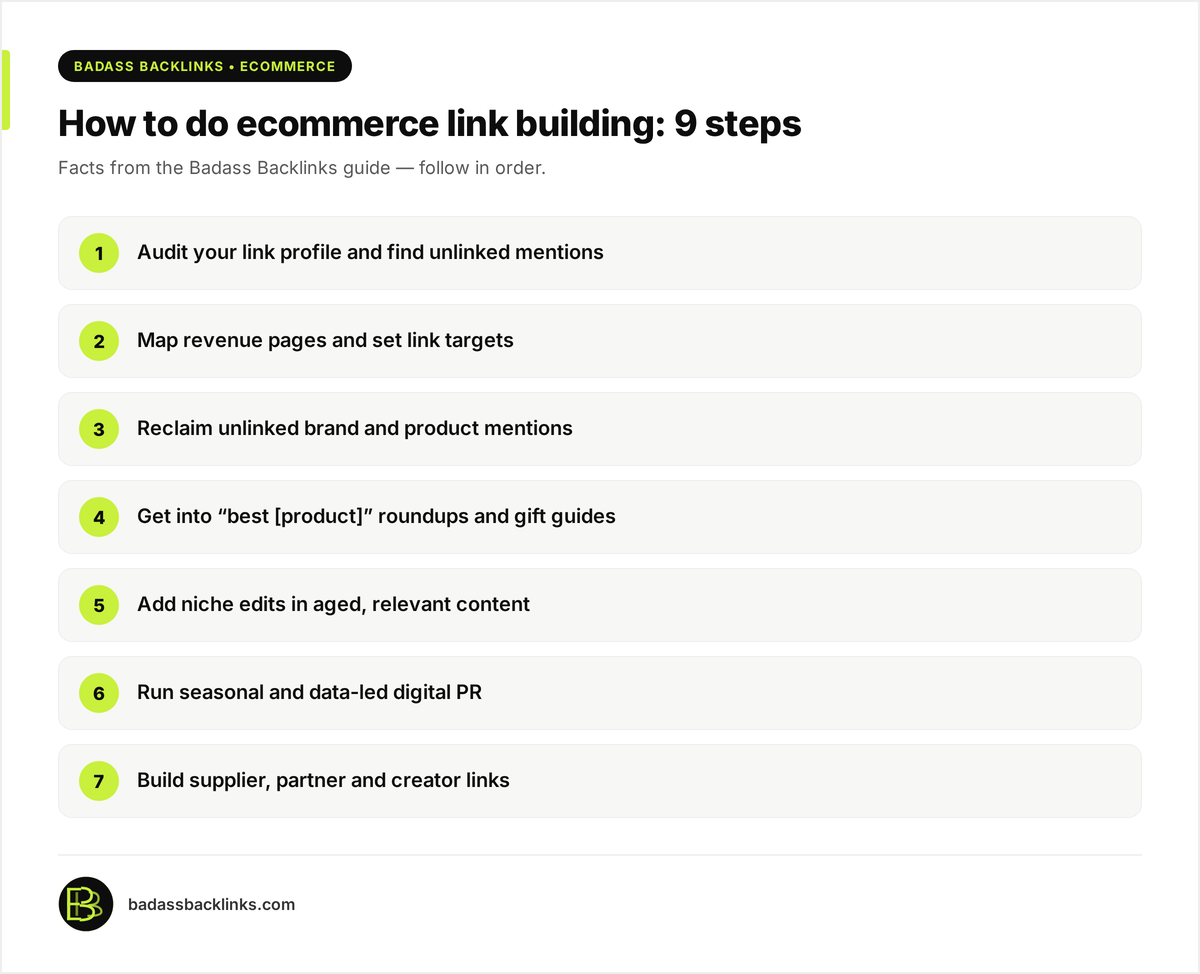
In short: audit your link profile and find unlinked mentions, map revenue pages and set link targets, reclaim unlinked brand and product mentions and get into “best [product]” roundups and gift guides, with every step explained below.
- Audit your link profile and find unlinked mentions. List referring domains and where they point. Search your brand and product names to find pages mentioning you without a link.
- Map revenue pages and set link targets. Rank category and product pages by revenue and by how close they are to page one.
- Reclaim unlinked brand and product mentions. Send short, friendly requests to link the mention to the right product page.
- Get into “best [product]” roundups and gift guides. Find the roundups ranking for your product terms and offer editors specs, photos and samples.
- Add niche edits in aged, relevant content. Place links inside existing, indexed articles on relevant sites; see our niche edits explainer.
- Run seasonal and data-led digital PR. Tie campaigns to seasons and trends with original data; 42% of journalists in the Muck Rack want original data or research.
- Build supplier, partner and creator links. Ask suppliers, stockists and creators for links, labelled sponsored where they are paid.
- Push authority to categories with internal links. Link from guides, blog posts and the homepage to priority categories with descriptive anchors.
- Measure revenue, not link counts. Track rankings and organic revenue for target pages.
Ecommerce link building
Want links pointed at the pages that sell?
We audit your mentions, get you into the roundups competitors own and build links to category and product pages.
See ecommerce backlinksAssets
Content that earns links for online stores
Content that earns links for online stores: buying guides, sizing and fit tools, seasonal trend data and care and how-to guides.
| Asset | Example | Who links |
|---|---|---|
| Buying guides | How to choose a hiking backpack | Bloggers, forums, roundups |
| Sizing and fit tools | Size calculator | Resource pages |
| Seasonal trend data | What shoppers bought this holiday (anonymised) | News, trade press |
| Care and how-to guides | How to waterproof a tent | Hobby sites |
| Brand reports | Sourcing or sustainability report | Trade and lifestyle media |
Each asset should link to the matching category. That internal link is what turns a content link into category authority.
Deep dive
Competitor link gap analysis for stores
A link gap analysis compares the sites linking to your competitors with the sites linking to you. For stores it answers three questions: which roundups and reviews competitors appear in, which publishers cover your category, and which pages on competitor sites attract links.
- Pick five competitors that rank for your main category terms, not just your biggest brand rivals.
- Export their referring domains with a backlink tool and remove the ones that already link to you.
- Sort the rest by type: roundups, reviews, news, blogs, directories.
- Look at which competitor pages receive links. If their buying guides attract links, you need guides too.
- Turn the list into an outreach plan, starting with roundups and reviews.
In our DTC case study, this exercise showed competitors in an average of 12 roundups each and the client in none. That single finding shaped the campaign.
Deep dive
Digital PR campaigns that work for retail
Digital PR campaigns that work for retail: seasonal data, price indexes, expert tips and product innovation.
| Campaign type | Example | Why it earns links |
|---|---|---|
| Seasonal data | Most-gifted products by region | Journalists need holiday data |
| Price indexes | Cost of a camping trip, tracked yearly | Repeatable coverage |
| Expert tips | Gear experts on staying safe outdoors | Reactive commentary |
| Product innovation | Launch of a genuinely new product | News value |
| Surveys | How people shop for a category | Original research |
The Muck Rack found 84% of journalists say at least some stories come from pitches, but 86% disregard irrelevant ones. Retail PR works when the story fits the journalist’s beat and the data is real.
Digital PR links usually land on the homepage or a campaign page, not on categories. Plan internal links from the campaign page to the relevant category before launch.
Deep dive
Anchor text for ecommerce pages
Anchor text for ecommerce pages: brand, brand plus product, descriptive and exact match.
| Anchor type | Example | Use |
|---|---|---|
| Brand | [Brand] | Most links |
| Brand plus product | [Brand] hiking backpack | Common and natural |
| Descriptive | lightweight hiking pack | Niche edits and roundups |
| Exact match | hiking backpacks | Rarely |
| URL or generic | see the range | Some links |
The Moz found 34.6% of links to category and product pages used targeted anchors. Use that as an upper bound rather than a target, and let editors choose anchors where they prefer. In the DTC campaign, product-specific anchors such as “lightweight hiking pack” and “survival shelter” were used in niche edits.
Deep dive
Where guest posts fit for stores
Guest posting is the default tactic for many agencies, but for stores it is often the slowest. A new article needs time to be indexed and trusted before it passes much value, and BuzzStream found the average ecommerce guest post cost $341 with most sites low quality. In the DTC campaign we wrote none.
Guest posts still help when a store needs topical depth on sites that do not run roundups, or when the brand founder has real expertise to share. Vet sites with our guest posting guide and point the post’s single link at a category or buying guide.
Deep dive
Link building for new stores vs established stores
New stores should start with reclamation, partner and supplier links; established stores have more mentions to reclaim and can support digital PR campaigns.
| New store | Established store | |
|---|---|---|
| Mentions to reclaim | Few | Often many |
| Best first tactic | Reviews, creators, supplier links, roundups | Reclamation and roundups |
| Link targets | Homepage and top categories | Categories and hero products |
| Content needed | Buying guides first | Refresh and interlink existing guides |
New stores rarely have mentions to reclaim, so they need to create reasons to be mentioned: send products to reviewers, work with creators and ask suppliers for listings. Established stores almost always have unclaimed mentions, which makes reclamation the obvious starting point.
Deep dive
Tools for ecommerce link building
Tools for ecommerce link building: backlink audit and gap analysis, mention monitoring, outreach tracking and link monitoring.
| Job | Tool type |
|---|---|
| Backlink audit and gap analysis | Backlink index tools |
| Mention monitoring | Brand mention and alert tools |
| Outreach tracking | Outreach CRM or spreadsheet |
| Link monitoring | Link checkers |
| Rankings and revenue | Rank tracker plus analytics |
Our free backlink monitoring tool checks whether earned links stay live, which matters for stores where publisher pages change often.
Deep dive
How to build links to category pages
Category pages usually have the most revenue potential and the fewest links. Three methods work.
- Roundup placement. “Best [product type]” articles can link to a category when you have several qualifying products.
- Data and guide hubs. Publish a buying guide, earn links to it, then link from it to the category.
- Niche edits. A link inside an existing article about the product type can point at the category with a descriptive anchor.
Keep category anchors varied: brand plus category, partial match, and descriptive phrases. The Moz data suggests natural links to categories are mostly untargeted.
Deep dive
When to build links to product pages
Product pages deserve direct links when they are hero products with steady demand, high margins and stable URLs. Seasonal or short-lived products are better served by category links, because the link value survives the product.
| Product type | Link target |
|---|---|
| Hero product, stable URL | Product page |
| Seasonal or limited product | Category or collection |
| Product with many variants | Canonical parent product |
| Discontinued product | Redirect to category |
Deep dive
How to run unlinked mention reclamation
In short: filter for pages without a link and with real traffic, find the right contact, send a short thank-you with the exact product URL to link and follow up once, then move on, with every step explained below.
- Search your brand, product and founder names in search engines and a mention monitoring tool.
- Filter for pages without a link and with real traffic.
- Find the right contact: the author or editor, not a generic inbox.
- Send a short thank-you with the exact product URL to link.
- Follow up once, then move on.
Unlinked mention reclamation is the highest-converting tactic we run for stores: in the BadAss Backlinks DTC case study, 58% of mentions converted. It works because the publisher already chose to write about you.
Deep dive
How to get into “best [product]” roundups
To get into “best [product]” roundups, find the articles ranking for those terms, see how each author tests products, and offer the editor specs, photos and samples so they can judge the product on merit.
- Search the “best [product]” terms you want to rank for and list the articles on page one.
- Check which competitors appear and how the author tests products.
- Offer the editor specs, photos, review copy and, where appropriate, a sample.
- Ask to be considered on merit; never pay for inclusion without a sponsored label.
- Keep a record of each article\u2019s update cycle and pitch before the next refresh.
Roundups are valuable twice: the article ranks for the buying term, and its readers are ready to buy.
Deep dive
Shopify and WooCommerce technical checklist
In short: canonical URLs, redirects, faceted navigation and internal links, with every step explained below.
- Canonical URLs. Shopify product URLs under collections should canonicalise to /products/; build links to the canonical.
- Redirects. Set 301s for removed products and changed handles.
- Faceted navigation. Keep filters out of the index and out of link targets.
- Internal links. Use breadcrumbs, related categories and guide links.
- Page speed. Referral visitors from roundups buy only if pages load quickly on mobile.
Deep dive
Ecommerce link building calendar
Ecommerce link building calendar: holiday gift guides, Black Friday, Valentine\u2019s Day and Mother\u2019s and Father\u2019s Day.
| Moment | Pitch window | Angle |
|---|---|---|
| Holiday gift guides | August to October | Gifts by price and recipient |
| Black Friday | September to October | Deals and data |
| Valentine\u2019s Day | November to December | Gifts |
| Mother\u2019s and Father\u2019s Day | 2 to 3 months ahead | Gift roundups |
| Summer and outdoor season | March to May | Gear and travel guides |
| Back to school | April to June | Essentials lists |
Gift guide editors finalise lists well before shoppers arrive. Plan your outreach backwards from publication dates.
Deep dive
Link building for international stores
Stores selling in several countries need links from each market\u2019s publishers to the matching country or language version. A UK roundup should link to the UK store, not the US one. Combine local digital PR with hreflang so search engines show the right version, and see our international link building guide on the blog for a market-by-market approach.
Deep dive
What to expect month by month
Expect early months to go on audits and mention reclamation, the middle months on outreach and PR, and clearer ranking gains from month six onward.
| Period | Typical activity | Typical outcome |
|---|---|---|
| Month 1 | Audit, reclamation outreach | First links live (12 in our DTC case) |
| Months 2 to 3 | Roundups, niche edits | Referring domains to products and categories grow |
| Months 4 to 6 | Digital PR, internal linking | Rankings climb for target pages |
| Months 6 to 8+ | Scale what works | Page-one rankings and organic revenue |
Timelines vary with competition and domain history. The DTC example is one campaign, not a guarantee.
Deep dive
Site architecture: how link equity reaches category pages
A complete e-commerce link strategy starts with the shape of the site, because most links you earn will not land on the page you most want to rank. Editors link to guides, data, brand stories and hero products far more readily than to a category grid. Architecture decides whether that equity reaches the pages that sell.
- Keep link targets shallow. Categories that sit three or more clicks from the homepage receive little equity from anything.
- Pair every link asset with a category. Before you build a guide or data piece, decide which category it will pass value to and write the internal link into the brief.
- Consolidate thin categories. Several near-duplicate collections split links and relevance. Merge them before building links.
- Protect discontinued URLs. When a linked product is retired, redirect it to the closest category, not the homepage.
Get this right and every tactic in this guide becomes more efficient, because one earned link can support a whole branch of the catalogue.
Deep dive
E-commerce link building for AI shopping assistants
Buyers increasingly start product research in AI assistants. Aleyda Solis shared research from Rankscale showing that four in five buying prompts in ChatGPT now get a questionnaire before any recommendation, and that ChatGPT asks for a budget but almost never for a brand.
Four in five buying prompts in ChatGPT now get a questionnaire before any recommendation. Most arrive already filled in… here are insights from @mathias_ptacek / @rankscale 👇
Aleyda Solis 🕊️ (@aleyda) October 22, 2026
* ChatGPT asks for a budget, almost never for a brand
* ChatGPT ticks the middle price band for you
* Ask twice and the form changes
* The form ends in a shopping request
Read more: https://t.co/ObAuuuHGJG
If assistants rarely ask for a brand, being recommended depends on how often trusted third-party pages describe your products against the needs and price bands buyers state. That makes the strategy in this guide more valuable, not less: roundup inclusion, accurate reviews, and mentions that name specific products and price points. Track which of your products appear in assistant answers for your main category prompts, and treat missing products as link and mention targets.
Deep dive
How to allocate a link building budget by store stage
Allocate a link building budget by store stage: new stores spend on foundations and reclamation, growing stores on outreach and roundups, and established brands on digital PR.
| Store stage | Main constraint | Where most effort goes | What to hold back |
|---|---|---|---|
| New store, under a year | Few mentions to reclaim, little brand demand | Suppliers, stockists, founders on podcasts, a few vetted placements to core categories | Large digital PR campaigns |
| Growing store | Categories stuck on page two | Roundups, gap analysis, link assets paired with categories | Product-level links except hero products |
| Established brand | Many mentions, weak category authority | Reclamation at scale, seasonal digital PR, international markets | Low-quality placements that add risk |
| Marketplace-heavy seller | Most demand captured off-site | Brand site authority, reviews and roundups that link to your own store | Links pointing to marketplace listings |
These are our planning guidelines from running store campaigns, not published benchmarks. The principle is constant: spend where the constraint is, and revisit the split every quarter.
Deep dive
How to build the business case for e-commerce link building
Finance teams approve link budgets when they see the link between pages, rankings and revenue. Build the case from your own data rather than industry averages.
- Pick the target pages. List the categories and products with the most revenue potential and their current positions.
- Estimate the gap. Compare referring domains to those pages with the pages ranking above you.
- Model the upside conservatively. Use your own conversion rate and average order value with realistic position gains, not best-case click-through rates.
- Set leading indicators. Links live, pages moved into the top 20, then top 10, so progress is visible before revenue.
- Report monthly on revenue pages only. Keep blog traffic separate so the result is not inflated.
The DTC case study above is a useful reference for how results tend to build over months, but your forecast should rest on your own numbers.
Compliance
Rules and risks
The main rules and risks to respect are gifted products, affiliate links, anchors and discontinued products.
- Gifted products. Links given in exchange for free products are paid links under the Google Search Central; reviewers should qualify them per Google Search Central.
- Affiliate links. Should be rel=”sponsored”; they are not editorial links.
- Anchors. Keep exact-match anchors rare; the Ahrefs study found the median exact-match share among top-20 pages was 0%.
- Discontinued products. Redirect to the closest category so earned links are not lost.
- Faceted URLs. Never build links to filter or parameter URLs.
First-hand
Case study: a DTC outdoor brand, 8 months, no guest posts
Our BadAss Backlinks DTC case study covers an outdoor gear brand selling premium backpacks, tents and survival tools. After three years it had 14 referring domains, all pointing at the homepage, and was spending more than $25,000 a month on Meta and Google Ads because organic traffic gave it no floor.
The audit found two gaps. 55 blogs, review sites and Reddit threads mentioned the brand without linking. And the five competitors ranking for its product keywords appeared in an average of 12 “best [product]” roundups each, while the client appeared in none.
| Tactic | Volume | Result |
|---|---|---|
| Unlinked mention reclamation | 55 mentions found | 32 converted to followed links (58%) |
| Niche edits in aged content | 20 insertions | Product-specific anchors |
| “Best gear” roundup inclusion | 4 roundups | Referral traffic plus rankings |
| Guest posts | 0 | Not needed |
Results after 8 months
Source: BadAss Backlinks DTC case study12 links went live in month 1 and the average response time to reclamation outreach was 4 days. By month 8, 28 product pages ranked on page 1. Full details are in the BadAss Backlinks DTC case study.
Budget
What ecommerce link building costs
There is no reliable public price list for niche link building, but several large datasets give useful benchmarks.
Published link cost benchmarks (USD)
Sources: Editorial.Link survey of 518 SEOs; BuzzStream guest post study of about 257,000 sites; Ahrefs outreach test; PressWhizz 2026 report on 22,703 placements.BuzzStream found ecommerce guest posts averaged $341. Reclamation and roundup outreach cost time rather than placement fees, which is why we start there. Digital PR teams most commonly report a cost per link of $300 to $500 in the BuzzStream report, and the Editorial.Link survey found 80.9% of SEOs expect link costs to rise. Cheap links are usually cheap because the site has no traffic: BuzzStream found 39.6% of guest post sites had zero organic traffic. Our pricing page explains how we scope campaigns.
Choosing help
Ecommerce link building agency vs in-house
Hire an agency when you need volume, vetted publisher relationships and speed; keep ecommerce link building in-house when you have writers, time and deep niche knowledge. The comparison below shows the trade-offs.
| Task | Best owner |
|---|---|
| Product samples and brand assets | In-house |
| Mention monitoring | Either |
| Reclamation and roundup outreach | Agency or in-house |
| Niche edits and guest posts | Agency |
| Digital PR | Agency or PR team |
| Internal linking and technical SEO | In-house |
Ask any agency which category pages it would target first and why, and how it handles gifted products. Check its Clutch reviews and case studies. Our case studies show full numbers.
Reporting
How to measure ecommerce link building
Measure ecommerce link building by rankings, organic traffic and conversions on the pages that receive links, not by link count alone. These are the metrics to track: organic revenue from target pages, rankings for category keywords, referring domains to categories and products and product pages on page 1.
| Metric | Why it matters |
|---|---|
| Organic revenue from target pages | The business outcome |
| Rankings for category keywords | Leading indicator |
| Referring domains to categories and products | Where authority lands |
| Product pages on page 1 | Our DTC campaign reached 28 |
| Referral revenue from roundups | Direct sales |
| Mention conversion rate | Outreach efficiency |
Avoid
9 ecommerce link building mistakes
The most common ecommerce link building mistakes are building every link to the homepage, ignoring unlinked mentions, missing the roundups competitors own and pitching gift guides too late. Each one is explained below with the fix.
- Building every link to the homepage.
- Ignoring unlinked mentions.
- Missing the roundups competitors own.
- Pitching gift guides too late.
- Requiring links for free products.
- Exact-match anchors everywhere.
- Linking to non-canonical or filter URLs.
- Losing links when products are discontinued.
- Reporting links instead of revenue.
Expert insight
Expert insight on e-commerce link building
The quotes below are verbatim public statements, linked to the original source. We have not interviewed these people; the case study figures are our own client results.
“Sending someone a product in exchange for them writing about it and including a link”
Google Search Central, Spam policies, listed as an example of link spam
“Big heads-up for ecommerce retailers”
Glenn Gabe, on X, 22 October 2026
“Four in five buying prompts in ChatGPT now get a questionnaire before any recommendation.”
Aleyda Solis, sharing Rankscale research, on X, 22 October 2026
From our case study data
DTC e-commerce case study: An 8-month campaign lifted organic traffic from 7,200 to 13,600 visits a month (+89%) and converted 32 of 55 unlinked mentions into links; 28 product pages reached page 1. Read the full case study
Conclusion
The bottom line on e-commerce link building
E-commerce link building works when links land on category pages and linkable content, then flow to products through internal links. Reclaim mentions first, add PR and partner links, and e-commerce link building becomes a steady revenue lever.
Quick answers
Quick answers about e-commerce link building
Short, direct answers to the questions people ask search engines and AI assistants about e-commerce link building.
How do I get backlinks to my Shopify store?
Get backlinks to a Shopify store through gift guides, product reviews, supplier and manufacturer pages, unlinked brand mention reclamation and data-led digital PR.
Should I build links to product pages or category pages?
Build most links to category pages and linkable content, then pass authority to product pages through internal links; product URLs change and sell out.
Is sending free products for links allowed?
Google lists sending a product in exchange for a review that includes a link as link spam, so gifted-product links should be marked sponsored or nofollow.
What is unlinked mention reclamation?
Unlinked mention reclamation means finding articles that mention your store without linking and asking the editor to add the link.
How long does e-commerce link building take?
In our DTC case study, an 8-month campaign lifted organic traffic from 7,200 to 13,600 visits a month.
How much should a store spend on link building?
The right link building budget depends on store stage; the budget section on this page breaks it down for new and established stores.
Questions
Frequently asked questions
What is ecommerce link building?
The process of earning links from other websites to an online store, especially its category and product pages, so those pages rank higher in search and bring in organic revenue.
Is link building worth it for ecommerce?
For most stores with real products and competition, yes. Organic rankings reduce dependence on paid ads. Our DTC client was spending more than $25,000 a month on ads before the campaign.
Which pages should an ecommerce store build links to?
Start with category and collection pages that drive revenue and rank on page two, then key product pages. Use guides and the homepage to pass authority internally.
What are the best ecommerce link building strategies?
Unlinked mention reclamation, “best [product]” roundups and gift guides, niche edits in aged relevant content, seasonal digital PR, supplier and creator links, and vetted guest posts.
How long does ecommerce link building take?
Reclaimed links can go live in weeks; in our DTC case study 12 links went live in month 1. Ranking gains usually build over several months.
How much does ecommerce link building cost?
BuzzStream found ecommerce guest posts averaged $341. Reclamation and roundups cost mostly time. See our pricing page for how we scope campaigns.
Should I hire an ecommerce link building agency?
If you lack outreach time or publisher relationships, an agency speeds things up. Ask which category pages it would target first and check its Clutch reviews and case studies.
References
Sources
Every statistic on this page links back to the original publisher below. Figures were checked on 24 October 2026.
- BadAss Backlinks, DTC E-commerce Backlink Case Study: 8-month campaign: organic traffic 7,200 to 13,600 visits a month (+89%); traffic value $4,100 to $10,500 a month (+156%); 32 of 55 unlinked mentions converted to links (58%); 28 product pages on page 1. badassbacklinks.com/backlink-case-studies/dtc-ecommerce-backlink-case-study
- Moz, Anchor Text Distribution: Avoiding Over-Optimization: 34.6% of links to category and product pages used targeted (exact or phrase) anchors; only about 25% of links to category pages were targeted. moz.com/blog/anchor-text-distribution-avoiding-over-optimization
- BuzzStream, The Cost of Guest Posts, Based on 500k Sites (2026): About 257,000 guest post sites analysed: average vendor price $461, average direct price $295; 96.2% judged low quality; 39.6% had zero organic traffic; only 1.37% high quality; ecommerce niche average $341. www.buzzstream.com/blog/guest-post-costs
- Muck Rack, State of Journalism 2025: Survey of 1,515 journalists: 84% say at least some stories originate from pitches; 86% disregard irrelevant pitches; 42% want original data or research; 77% use AI tools. media.muckrack.com/documents/6.9.2025_state_of_journalism.pdf
- Google Search Central, Spam policies for Google web search: Defines link spam, including buying or selling links that pass ranking credit, excessive link exchanges and large-scale guest posting campaigns with keyword-rich anchors. developers.google.com/search/docs/essentials/spam-policies
- Google Search Central, Qualify your outbound links: rel=”sponsored” for paid or sponsored links, rel=”ugc” for user-generated content, rel=”nofollow” otherwise. developers.google.com/search/docs/crawling-indexing/qualify-outbound-links
- Ahrefs, Anchor Text study (384,614 pages): 384,614 pages ranking in the top 20 for 19,840 keywords; median share of exact-match anchors was 0% at every position; average Spearman correlation between exact-match anchors and rank 0.1436 (weak); notes most SEOs recommend about 1% to 5% exact match; Penguin affected about 3.1% of queries. ahrefs.com/blog/anchor-text
- Ahrefs, Should You Buy Backlinks: Average quoted price for a paid link insertion $361.44 (450 sites, nine niches); paid guest posts $77.80; only 12.6% of sites agreed to sell; cites Authority Hacker’s $83 average. ahrefs.com/blog/buy-backlinks
- Google Search Central, Link best practices: Anchor text tells people and Google about the linked page; write descriptive, concise anchor text; avoid stuffing keywords into anchors. developers.google.com/search/docs/crawling-indexing/links-crawlable
- StatCounter Global Stats, Search engine market share (worldwide): Worldwide search engine share at time of access (October 2026): Google 89.94%, Bing 5.29%. gs.statcounter.com/search-engine-market-share
- Editorial.Link, Link Building Statistics survey: 518 SEO professionals surveyed; $508.95 average acceptable price for one high-quality link; 80.9% expect costs to rise. editorial.link/link-building-statistics
- PressWhizz, Link Building Pricing Report 2026: 22,703 completed placements worth $3.66M; average $161.25, median $112; casino $252, sports $246 and finance $221 among the most expensive niches. presswhizz.com/case-studies/link-building-pricing-report
- BuzzStream, State of Digital PR 2026: 150+ digital PR practitioners: 95.9% pitch data-led content; about 60% have monthly budgets under $10k; most common cost per link $300 to $500 (19.6%); 39.2% do not know their cost per link; 62.8% cite outdated journalist info; 60.8% say finding journalists is harder; 85.8% call backlinks the most effective outcome; 66.2% cite AI citations. www.buzzstream.com/blog/state-of-digital-pr