BadAss Backlinks · Finance SEO · Updated October 2026
How to Get Backlinks for a Finance / Fintech Website (2026 Playbook)
The best way to get backlinks for a finance website is to earn them with original data, expert commentary for journalists and coverage from trusted financial publications. Finance is a YMYL topic, so every link should also support trust.
TL;DR
- Finance link building earns links for banks, fintechs, advisers, lenders and insurers from trusted financial and news sites.
- Finance is YMYL: Google weights trust most heavily for topics that can affect people’s money.
- Finance links cost more: PressWhizz’s 2026 pricing report lists finance at $221 average per placement, among the most expensive niches.
- Credentials, fact-checking and original data earn the links that matter; cheap finance guest posts are the riskiest buy in SEO.
On this page
Finance link building
What do you need?
Trusted financial and news links for financial firms.
- Trusted financial publication links
- Data-led digital PR
- Compliance-aware content
Guest posts from $85 and niche edits from $69 per link. Monthly plans optional.
See finance link building
Finance is the niche where link building is most expensive, most spammed and most scrutinised. Search engines treat money topics as “Your Money or Your Life”, regulators watch what firms publish, and a large share of sites selling “finance guest posts” exist only to sell links.
This guide covers how financial firms earn links that build trust instead of risk. For done-for-you campaigns, see our backlinks for financial firms service.
Definition
What is finance link building?
Finance link building is the process of earning links from trusted financial, news and industry websites to a financial firm’s pages, so they rank for valuable money-related searches while staying compliant.
Google’s guidance on Google Search Central explains that trust is the most important part of E-E-A-T and matters most for YMYL topics. Links are one way trust is expressed across the web: a mention from a respected financial publication says more than any number of anonymous blog links.
Context
Why link building is different in finance
Link building is different in finance because money topics are YMYL, publishers are cautious about financial content, and trust signals matter as much as the links themselves.
Three things set finance apart. First, YMYL: content and the sites linking to it are held to a higher trust standard. Second, regulation: claims, comparisons and promotions may fall under the FCA in the UK, the SEC and FINRA in the US, ASIC in Australia and MAS in Singapore, so content often needs compliance sign-off. Third, the market for finance links is crowded with spam vendors because the keywords are lucrative.
The practical result: fewer, better links, with a longer approval process. Plan the compliance step into the timeline rather than fighting it.
Reader poll
Your vote is saved in this browser only. No live tally is stored on a server, so results show votes cast on this device.
Link sources
Link sources that only work in finance
Link sources that only work in finance: fintech publications, personal finance media, comparison and review sites and industry events.
| Source | Examples | Notes |
|---|---|---|
| Fintech publications | Fintech news sites and newsletters | Product launches, data, funding news |
| Personal finance media | Money sections of national news | Expert commentary and data |
| Comparison and review sites | Product comparison and review platforms | Follow their editorial and commercial disclosures |
| Industry events | Finovate, Money20/20 speaker and sponsor pages | Speaking earns profiles and coverage |
| Professional bodies | Accountancy, financial planning and banking associations | Member directories and articles |
| Regulatory and public registers | Regulator registers (FCA, FINRA BrokerCheck, ASIC) | Trust signals, rarely followed links |
| Financial education resources | University and nonprofit money guides | Earned with genuinely useful tools |
Priorities
The best links for finance, in priority order
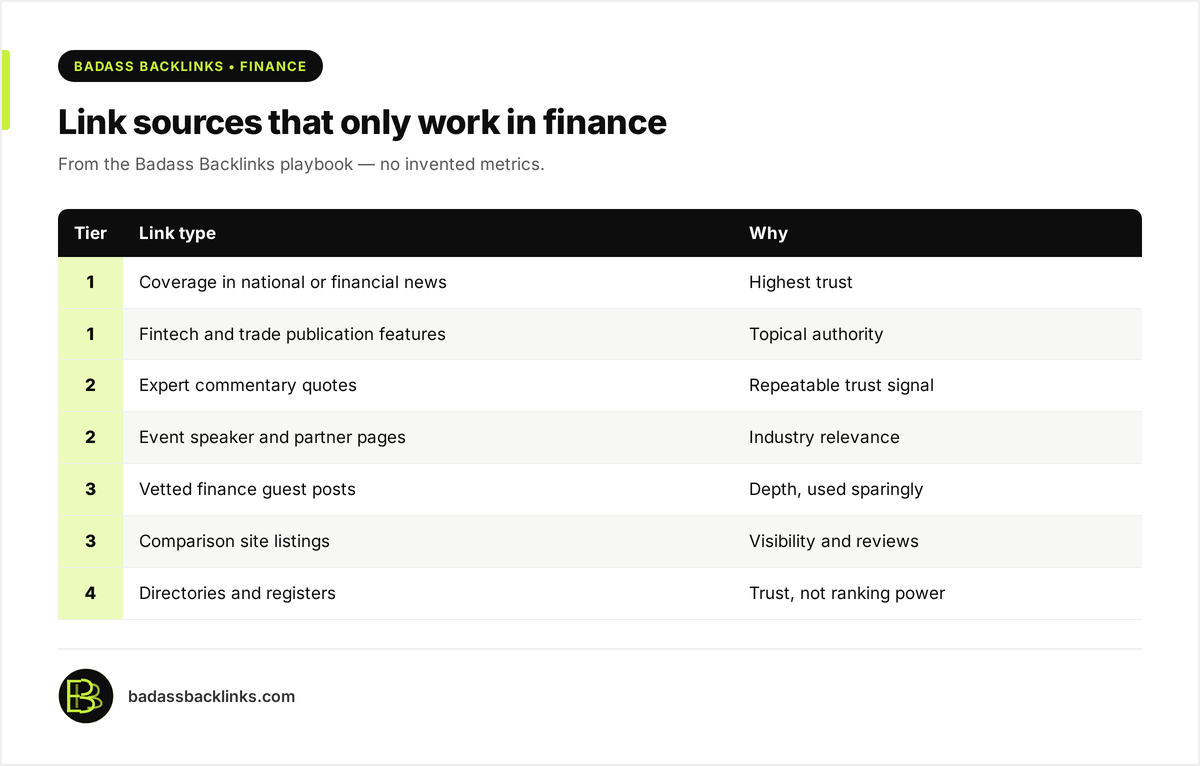
The best links for finance, in priority order: coverage in national or financial news, fintech and trade publication features, expert commentary quotes and event speaker and partner pages.
| Tier | Link type | Why |
|---|---|---|
| 1 | Coverage in national or financial news | Highest trust |
| 1 | Fintech and trade publication features | Topical authority |
| 2 | Expert commentary quotes | Repeatable trust signal |
| 2 | Event speaker and partner pages | Industry relevance |
| 3 | Vetted finance guest posts | Depth, used sparingly |
| 3 | Comparison site listings | Visibility and reviews |
| 4 | Directories and registers | Trust, not ranking power |
How to
How to do finance link building: 7 steps
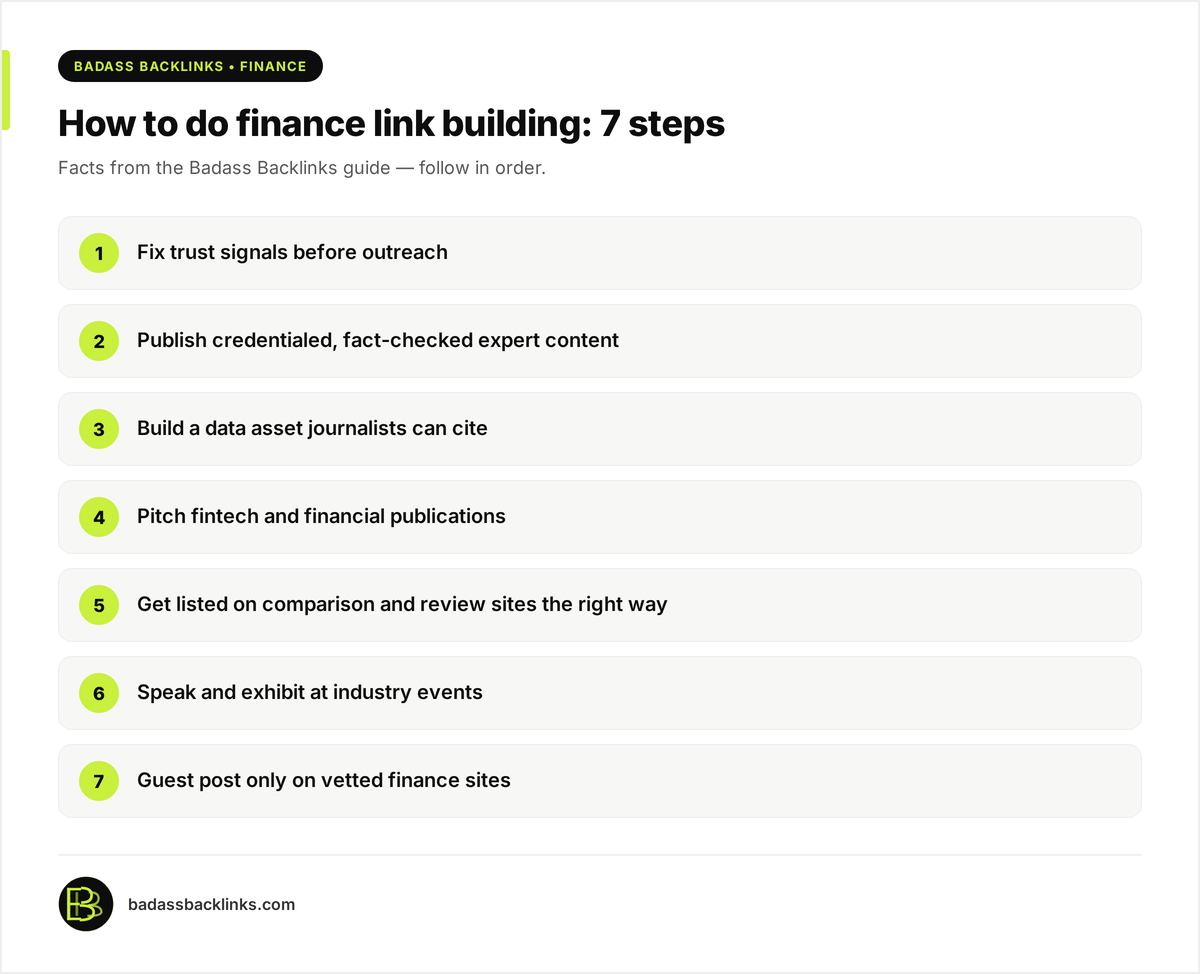
In short: fix trust signals before outreach, publish credentialed, fact-checked expert content, build a data asset journalists can cite and pitch fintech and financial publications, with every step explained below.
- Fix trust signals before outreach. Named authors with credentials, editorial and fact-check policies, clear disclaimers, regulatory status and contact details.
- Publish credentialed, fact-checked expert content. Content reviewed by qualified people, with dates and sources. Others link to what they can trust.
- Build a data asset journalists can cite. Surveys, anonymised product data or analysis of public data. In the Muck Rack, 42% of journalists want original data or research.
- Pitch fintech and financial publications. Target reporters covering your exact beat; 86% of journalists disregard irrelevant pitches.
- Get listed on comparison and review sites the right way. Get reviewed on merit and label any paid relationships.
- Speak and exhibit at industry events. Events such as Finovate and Money20/20 publish speaker and partner pages and generate press.
- Guest post only on vetted finance sites. Reject sites with no traffic or “write for us finance” spam; check against our guest posting guide.
Finance link building
Need trusted links that pass compliance?
We build data-led PR and vetted editorial links for financial firms, with a workflow that leaves room for compliance review.
See finance link buildingAssets
Content that earns links in finance
Content that earns links in finance: original surveys, calculators, index or tracker and explainers.
| Asset | Example | Links from |
|---|---|---|
| Original surveys | How consumers in your market save or borrow | Finance news |
| Calculators | Mortgage, savings, retirement and loan tools | Resource pages, educators |
| Index or tracker | Monthly rate or fee tracker | Journalists who repeat coverage |
| Explainers | New regulation explained by a qualified expert | Trade press |
| Glossaries | Plain-English definitions | Educational sites |
Every asset should carry a named reviewer, a date and a methodology. That is what makes it citable in a YMYL niche.
Deep dive
E-E-A-T signals that make finance pages worth linking to
Editors at financial publications check who wrote a page before they link to it. A page with no named author, no reviewer and no sources reads as a liability, however good the writing is. Search Engine Land made the same argument recently: if AI can produce the generic version of your content, your edge is the expert, the data and the customer story it cannot write.
The argument: E-E-A-T isn’t just for YMYL anymore.
Search Engine Land (@sengineland) October 17, 2026
If AI can write your #SEO content, your edge is the expert, the data and the customer story it can’t.
Why human experience wins: https://t.co/Y2vdsMB8cC https://t.co/oly0Wln4Wk
| Signal | What it looks like on a finance or fintech page | Why editors care |
|---|---|---|
| Named author | A real person with a bio, relevant qualification and a profile page | Lets the editor judge expertise in seconds |
| Reviewer | A second qualified person who checked figures and claims, with a review date | Reduces the risk of linking to an error |
| Sources | Primary sources such as regulators, central banks and official statistics, linked inline | Shows every number can be checked |
| Disclosures | Clear statements on affiliate relationships, fees and regulatory status | Expected in regulated content |
| Update date | A visible last-reviewed date and a log of material changes | Rates, rules and limits change often |
| Product facts | For fintech: security, licensing partner and data handling explained plainly | Answers the questions a journalist will ask |
Fintech companies have one extra advantage: product data. Anonymised, aggregated usage data (for example, how savings behaviour changed after a rate move) is the kind of first-party evidence journalists cannot get elsewhere. Clear it with legal and compliance first, publish the method and keep the raw tables available on request.
Deep dive
Finance link building across markets
Finance link building differs by market because publications, regulators and financial promotion rules change from country to country.
| Market | Main regulators | What it means for content and links |
|---|---|---|
| United Kingdom | FCA | Financial promotions rules can cover blog content and sponsored articles; get approval before outreach |
| United States | SEC, FINRA | Advisers and brokers face communications and advertising rules; keep records of published content |
| Australia | ASIC | Advice and product disclosure expectations shape what content can say |
| Singapore | MAS | Advertising guidelines apply to financial product content |
This is not legal advice; your compliance team owns the rules. The practical point for link building is that every guest post, quote and data study may need review, and some placements, such as paid product promotion on third-party sites, may count as financial promotions. Build the review step into your timeline and keep an archive of what went live where.
The upside is that regulation also filters out competitors. Firms that can turn expert content through compliance quickly earn the coverage that slower competitors miss, especially in reactive PR where journalists want comment the same day.
Deep dive
Expert commentary: the most repeatable finance link
Expert commentary is the most repeatable finance link because journalists need credentialed quotes every week; pick two or three spokespeople, pre-approve positions and answer requests fast.
- Pick two or three spokespeople with clear credentials, such as a chief economist, a certified planner or a head of credit.
- Pre-approve positions on recurring topics (rate changes, budgets, inflation data) so comment can go out within hours.
- Watch the calendar. Central bank decisions, budget days and inflation releases create predictable demand for comment.
- Answer journalist requests that match your expertise exactly; generic answers are ignored.
- Ask for a link to the expert bio or the data, not the homepage, when it fits the story.
Quotes build cumulative trust: the same named expert appearing across finance publications strengthens both the person and the firm as entities, which matters for search and for AI answers that cite sources.
Deep dive
Trust signals to fix before you build links
Trust signals to fix before you build links: author credentials, fact-check policy, disclaimers and regulatory status.
| Signal | What good looks like |
|---|---|
| Author credentials | Named authors with qualifications and bios |
| Fact-check policy | Published, with reviewer names |
| Disclaimers | Clear risk and advice disclaimers |
| Regulatory status | Registration details and links to registers |
| Contact and ownership | Real address, company details, complaints process |
| Dates and updates | Visible review dates on money content |
Links pointing at a page with no trust signals underperform, and journalists check before they cite. Fixing these first also makes outreach easier.
Deep dive
Link sources specific to fintech companies
Link sources specific to fintech companies: banking and payments partners, app marketplaces, developer documentation and open banking and industry bodies.
| Source | How the link is earned | Effort |
|---|---|---|
| Banking and payments partners | Partner directories and integration pages list the fintechs built on their rails | Low |
| App marketplaces | Accounting, ecommerce and payroll platforms list connected apps with a profile link | Low |
| Developer documentation | Public API docs and SDKs get linked from tutorials, forums and partner docs | Medium |
| Open banking and industry bodies | Member directories and working group pages | Low to medium |
| Fintech newsletters and podcasts | Founders and product leads featured as guests or sources | Medium |
| Accelerators and investors | Portfolio pages link to member companies | Low |
Most of these are relationship links you are already entitled to. Audit every partner, integration and investor first; it is common to find several that list the company without a link, or with an outdated URL.
Compliance
Rules and risks for finance links
The main rules and risks to respect are paid links, financial promotions, spam vendors and anchor text.
- Paid links. Covered by Google’s Google Search Central; paid placements should be rel=”sponsored” per Google Search Central.
- Financial promotions. Content that promotes a product may need regulatory approval. Involve compliance before outreach, not after.
- Spam vendors. Finance “guest post packages” are frequently on sites that sell to anyone.
- Anchor text. Keep commercial anchors rare; the Ahrefs study found the median exact-match share among top-20 pages was 0%.
- Affiliate links. Comparison and affiliate links should be qualified and disclosed.
First-hand
First-party data note
We have not yet published a finance case study, so we will not quote numbers we cannot show. The published benchmarks below are the best guide to costs. For first-hand campaign data in other niches, see our backlink case studies.
Budget
What finance link building costs
There is no reliable public price list for niche link building, but several large datasets give useful benchmarks.
Published link cost benchmarks (USD)
Sources: Editorial.Link survey of 518 SEOs; BuzzStream guest post study of about 257,000 sites; Ahrefs outreach test; PressWhizz 2026 report on 22,703 placements.Finance placements sit above average in the published data. Fewer, higher-trust links are usually the better spend. Digital PR teams most commonly report a cost per link of $300 to $500 in the BuzzStream report, and the Editorial.Link survey found 80.9% of SEOs expect link costs to rise. Cheap links are usually cheap because the site has no traffic: BuzzStream found 39.6% of guest post sites had zero organic traffic. Our pricing page explains how we scope campaigns.
Choosing help
Finance link building agency vs in-house
Hire an agency when you need volume, vetted publisher relationships and speed; keep finance link building in-house when you have writers, time and deep niche knowledge. The comparison below shows the trade-offs.
| Task | Best owner |
|---|---|
| Expert commentary | In-house experts |
| Compliance review | In-house |
| Data studies and PR | Agency or in-house PR |
| Guest post vetting and outreach | Agency |
| Events | In-house |
Choose an agency that can explain how it handles compliance review and can show finance placements. Check its Clutch reviews.
Reporting
How to measure finance link building
Measure finance link building by rankings, organic traffic and conversions on the pages that receive links, not by link count alone. These are the metrics to track: rankings for money keywords, referring domains from trusted publications, brand mentions and quotes and organic leads and applications.
| Metric | Why |
|---|---|
| Rankings for money keywords | The goal |
| Referring domains from trusted publications | Quality over count |
| Brand mentions and quotes | Trust and AI visibility |
| Organic leads and applications | The outcome |
| Spam share of new links | Risk control |
Avoid
7 finance link building mistakes
The most common finance link building mistakes are buying cheap finance guest post packages, skipping compliance until after publication, anonymous authors on money content and exact-match money anchors. Each one is explained below with the fix.
- Buying cheap finance guest post packages.
- Skipping compliance until after publication.
- Anonymous authors on money content.
- Exact-match money anchors.
- Pitching generic press releases.
- Ignoring trust pages.
- Counting links instead of leads.
Expert insight
Expert insight on backlinks for a finance website
The quotes below are verbatim public statements, linked to the original source. We have not interviewed these people; the case study figures are our own client results.
“Google’s automated ranking systems are designed to prioritize helpful, reliable information that’s created to benefit people, and not content that’s created to manipulate search engine rankings.”
Google Search Central, Creating helpful, reliable, people-first content
“If AI can write your #SEO content, your edge is the expert, the data and the customer story it can’t.”
Search Engine Land, on X, 17 October 2026
“Link spam is the practice of creating links to or from a site primarily for the purpose of manipulating search rankings.”
Google Search Central, Spam policies for Google web search
Conclusion
The bottom line on backlinks for a finance website
Backlinks for a finance website are earned with expertise: data, credentialed commentary and trustworthy pages. Fix trust signals first and backlinks for a finance website reinforce your YMYL credibility.
Quick answers
Quick answers about backlinks for a finance website
Short, direct answers to the questions people ask search engines and AI assistants about backlinks for a finance website.
Why do finance sites need high-trust backlinks?
Finance sites need high-trust backlinks because Google holds YMYL money topics to higher standards of trust.
Is expert commentary a good way to get finance backlinks?
Expert commentary is the most repeatable finance link tactic because journalists constantly need credentialed quotes.
Can fintech startups get links from banks or regulators?
Fintech startups more realistically earn links from partners, integration pages, startup press and data studies than from regulators.
What trust signals should a finance site fix first?
Fix author credentials, editorial policies, contact details and disclosures before building finance links.
Is buying finance guest posts risky?
Buying finance guest posts is risky because links bought for rankings count as link spam unless marked sponsored.
How do I measure finance link building?
Measure finance link building by rankings, organic sign-ups and coverage quality, not link count.
Questions
Frequently asked questions
What is finance link building?
Earning links from trusted financial, news and industry sites to a bank, fintech, adviser, lender or insurer’s website so its pages rank for competitive money searches.
How does finance link building work?
Firms strengthen trust signals, publish credentialed and fact-checked content, create original data, pitch financial journalists and fintech publications, and use vetted guest posts sparingly.
Should I hire a finance link building agency?
Yes if you lack media contacts or outreach time, but choose one that understands compliance review and can show finance placements. Check its Clutch reviews.
What do finance link building services include?
Trust audits, data-led digital PR, financial guest posts, expert commentary placement, comparison site listings and reporting on rankings and leads.
How do I get backlinks for finance?
Publish expert content with named, credentialed authors, build a data study, pitch fintech and finance media, get reviewed on comparison sites, speak at events and avoid cheap link vendors.
Why are finance backlinks so expensive?
Demand is high because finance keywords are valuable. PressWhizz’s 2026 report lists finance at $221 average per placement, against a $161.25 overall average.
References
Sources
Every statistic on this page links back to the original publisher below. Figures were checked on 24 October 2026.
- Google Search Central, Creating helpful, reliable, people-first content: Explains E-E-A-T and that trust is weighted most heavily for YMYL topics. developers.google.com/search/docs/fundamentals/creating-helpful-content
- PressWhizz, Link Building Pricing Report 2026: 22,703 completed placements worth $3.66M; average $161.25, median $112; casino $252, sports $246 and finance $221 among the most expensive niches. presswhizz.com/case-studies/link-building-pricing-report
- BuzzStream, The Cost of Guest Posts, Based on 500k Sites (2026): About 257,000 guest post sites analysed: average vendor price $461, average direct price $295; 96.2% judged low quality; 39.6% had zero organic traffic; only 1.37% high quality; ecommerce niche average $341. www.buzzstream.com/blog/guest-post-costs
- Muck Rack, State of Journalism 2025: Survey of 1,515 journalists: 84% say at least some stories originate from pitches; 86% disregard irrelevant pitches; 42% want original data or research; 77% use AI tools. media.muckrack.com/documents/6.9.2025_state_of_journalism.pdf
- Google Search Central, Spam policies for Google web search: Defines link spam, including buying or selling links that pass ranking credit, excessive link exchanges and large-scale guest posting campaigns with keyword-rich anchors. developers.google.com/search/docs/essentials/spam-policies
- Google Search Central, Qualify your outbound links: rel=”sponsored” for paid or sponsored links, rel=”ugc” for user-generated content, rel=”nofollow” otherwise. developers.google.com/search/docs/crawling-indexing/qualify-outbound-links
- Ahrefs, Anchor Text study (384,614 pages): 384,614 pages ranking in the top 20 for 19,840 keywords; median share of exact-match anchors was 0% at every position; average Spearman correlation between exact-match anchors and rank 0.1436 (weak); notes most SEOs recommend about 1% to 5% exact match; Penguin affected about 3.1% of queries. ahrefs.com/blog/anchor-text
- Ahrefs, Should You Buy Backlinks: Average quoted price for a paid link insertion $361.44 (450 sites, nine niches); paid guest posts $77.80; only 12.6% of sites agreed to sell; cites Authority Hacker’s $83 average. ahrefs.com/blog/buy-backlinks
- Editorial.Link, Link Building Statistics survey: 518 SEO professionals surveyed; $508.95 average acceptable price for one high-quality link; 80.9% expect costs to rise. editorial.link/link-building-statistics
- BuzzStream, State of Digital PR 2026: 150+ digital PR practitioners: 95.9% pitch data-led content; about 60% have monthly budgets under $10k; most common cost per link $300 to $500 (19.6%); 39.2% do not know their cost per link; 62.8% cite outdated journalist info; 60.8% say finding journalists is harder; 85.8% call backlinks the most effective outcome; 66.2% cite AI citations. www.buzzstream.com/blog/state-of-digital-pr