BadAss Backlinks · Finance SEO · Updated October 2026
Finance Link Building: Complete Guide
Finance link building is earning backlinks from financial publications, data journalism, expert commentary and trusted partners to a finance or fintech website. Finance is a YMYL niche, so link quality and author expertise matter more than volume.
TL;DR
- What it is: earning credible finance and news links for banks, fintechs, lenders, insurers, advisers and crypto brands.
- Why it is hard: money topics are YMYL and finance links cost more ($221 average vs $161.25 overall, PressWhizz).
- Compliance: treat placements as regulated communications under FINRA 2210, the SEC Marketing Rule or FCA rules as relevant.
- Best tactics: data studies, expert commentary, calculators, literacy partnerships, vetted guest posts.
- Avoid: finance link farms with falling traffic and every niche for sale.
On this page
Free link audit
What do you need?
Authority for fintech products
- Vetted finance publishers only
- Compliance-ready content workflow
- Specs guaranteed or replaced
Guest posts from $85 and niche edits from $69 per link. Monthly plans optional.
1,200+ links delivered · 95% client retention
Get a free fintech audit
Written by Paul with input from BadAss Backlinks founder SVS, based on finance campaigns we have run and a review of the top 10 Google results for “finance link building” in October 2026.
The direct answer
What is finance link building?
Finance link building is earning links and brand mentions from credible finance, business and news websites to the pages of banks, fintechs, lenders, insurers, investment firms, advisers and crypto companies, while meeting both Google’s strict YMYL quality bar and financial promotion rules. It is one of the most expensive and most scrutinised link building niches, so quality and compliance matter more than volume.
Money topics are the clearest example of “Your Money or Your Life” content in Google’s Search Quality Rater Guidelines, and Google’s guidance on helpful content says trust is the most important element of E-E-A-T. Finance links are also expensive: PressWhizz’s analysis of 22,703 orders found finance placements averaged $221, against an overall average of $161.25. And because promotional content about financial products is regulated, every guest post or sponsored article is potentially a financial promotion.
This guide covers why links matter in finance, the compliance workflow most guides ignore, tactics by sub-niche (banking, fintech, lending, insurance, wealth, crypto), how to avoid finance link farms, costs, and how to measure results.
Business case
Why link building matters for finance brands
Finance SERPs are dominated by banks, big publishers and comparison sites with massive link profiles, and Google applies its strictest trust standards to money topics; credible links are how challenger brands earn the authority to compete.
The competition is extreme
Keywords like “best savings account”, “personal loans”, “credit cards” or “how to invest” are fought over by comparison sites, major banks and national publishers. Each holds tens of thousands of referring domains. Backlinko’s study found the top result typically has 3.8 times more backlinks than the rest of page one.
Trust is the ranking currency
For money topics Google wants evidence that a source is reliable. Links and mentions from respected financial media, regulators’ lists, universities and professional bodies are among the strongest external trust signals a brand can earn.
AI answers reward trusted brands
Financial questions are among the most common AI Overview triggers. Ahrefs measured a 34.5% lower click-through rate for the top-ranking page when an AI Overview appears, and its 75,000-brand study found branded web mentions correlate most strongly with AI Overview visibility. Brands mentioned in context on credible financial publications are the ones assistants tend to name.
Compliance first
The finance link building compliance workflow
Treat every guest post, sponsored article and expert quote that promotes your products as a regulated communication: route it through compliance review, keep claims fair and balanced, disclose paid placements, and keep records.
Most finance link building guides skip this, but it is where campaigns fail. Depending on your market and licence, the main rules include:
| Regulator or rule | Applies to | What it means for link building |
|---|---|---|
| FINRA Rule 2210 | US broker-dealers | Retail communications must be fair, balanced and not misleading; many require principal approval before use and must be retained. |
| SEC Marketing Rule 206(4)-1 | US registered investment advisers | Advertisements may not include untrue or unsubstantiated claims; testimonials, endorsements and performance have specific conditions. |
| FCA financial promotions rules | UK authorised firms | Promotions must be clear, fair and not misleading; this includes content on third-party sites and social media. |
| Google spam policies and rel=”sponsored” | Everyone | Paid links should be qualified as sponsored; link schemes are penalised. |
A practical workflow
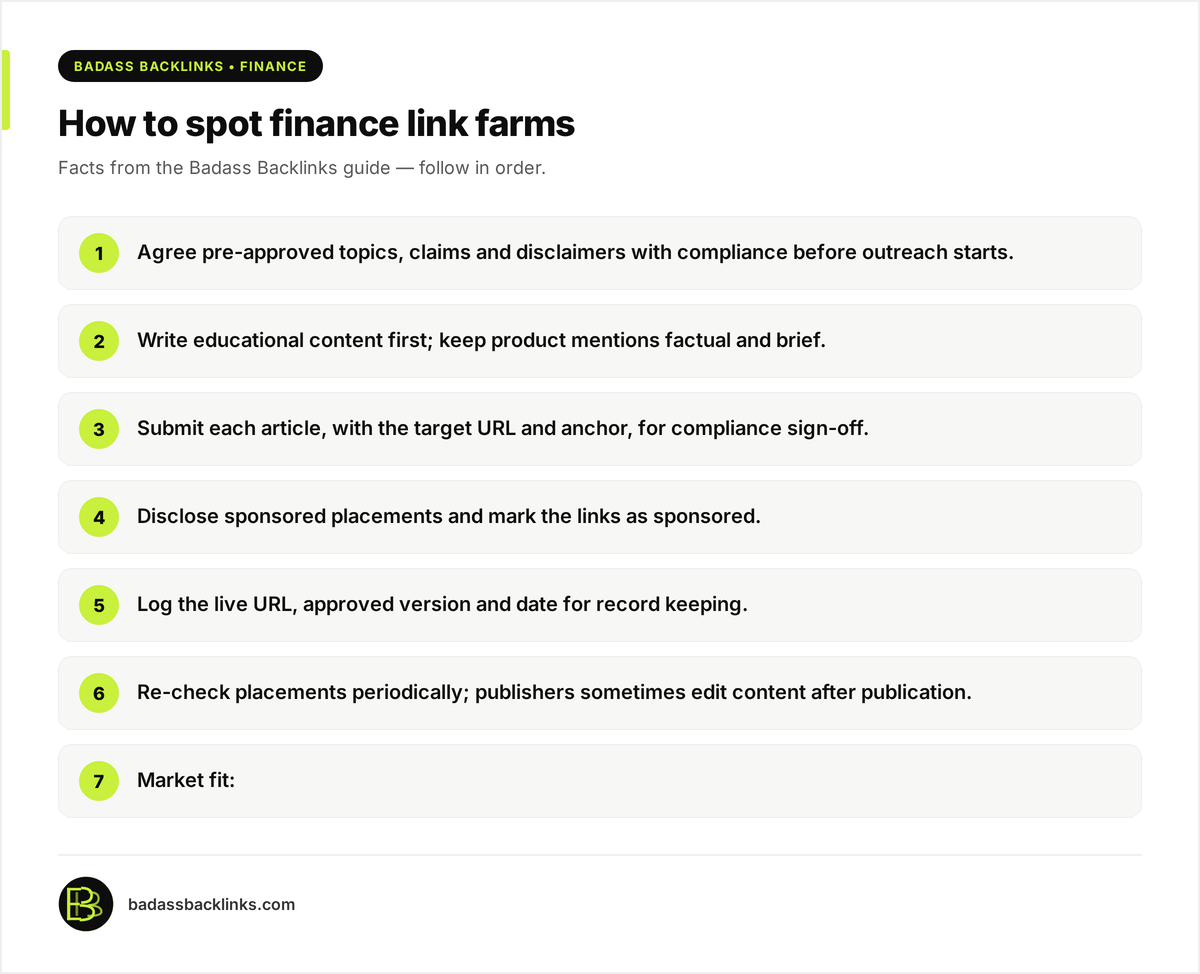
- Agree pre-approved topics, claims and disclaimers with compliance before outreach starts.
- Write educational content first; keep product mentions factual and brief.
- Submit each article, with the target URL and anchor, for compliance sign-off.
- Disclose sponsored placements and mark the links as sponsored.
- Log the live URL, approved version and date for record keeping.
- Re-check placements periodically; publishers sometimes edit content after publication.
Foundations
Get your E-E-A-T foundations right before building links
Links amplify trust signals that already exist on your site; they cannot replace them. Before outreach, make sure every money page shows who wrote it, who reviewed it, how the company is regulated and when the content was last updated.
Google’s helpful content guidance asks site owners to consider “who, how and why” for their content: who created it, how it was produced and why it exists. For finance that means visible expertise. Publishers and journalists check the same signals before linking; a fintech with anonymous content and no regulatory information will struggle to earn links from serious finance media.
- Named authors with credentials: qualifications such as CFA, CFP, chartered accountant or relevant industry experience, with bio pages.
- Expert reviewers: a “reviewed by” line from a qualified professional on product and advice pages.
- Regulatory transparency: licence numbers, registration details and regulator links in the footer and about page.
- Editorial policy: how content is researched, how products are compared and how conflicts of interest are handled.
- Update dates: rates, fees and rules change; show when each page was last checked.
- Primary sources: link to regulators, central banks and official statistics rather than other blogs.
These elements also improve conversion. Visitors comparing financial products look for the same proof of legitimacy that Google’s raters are asked to assess.
Sub-niches
Finance link building by sub-niche
Banking, fintech, lending, insurance, wealth management, accounting and crypto each have different link sources, regulators and risks, so a single “finance package” rarely fits.
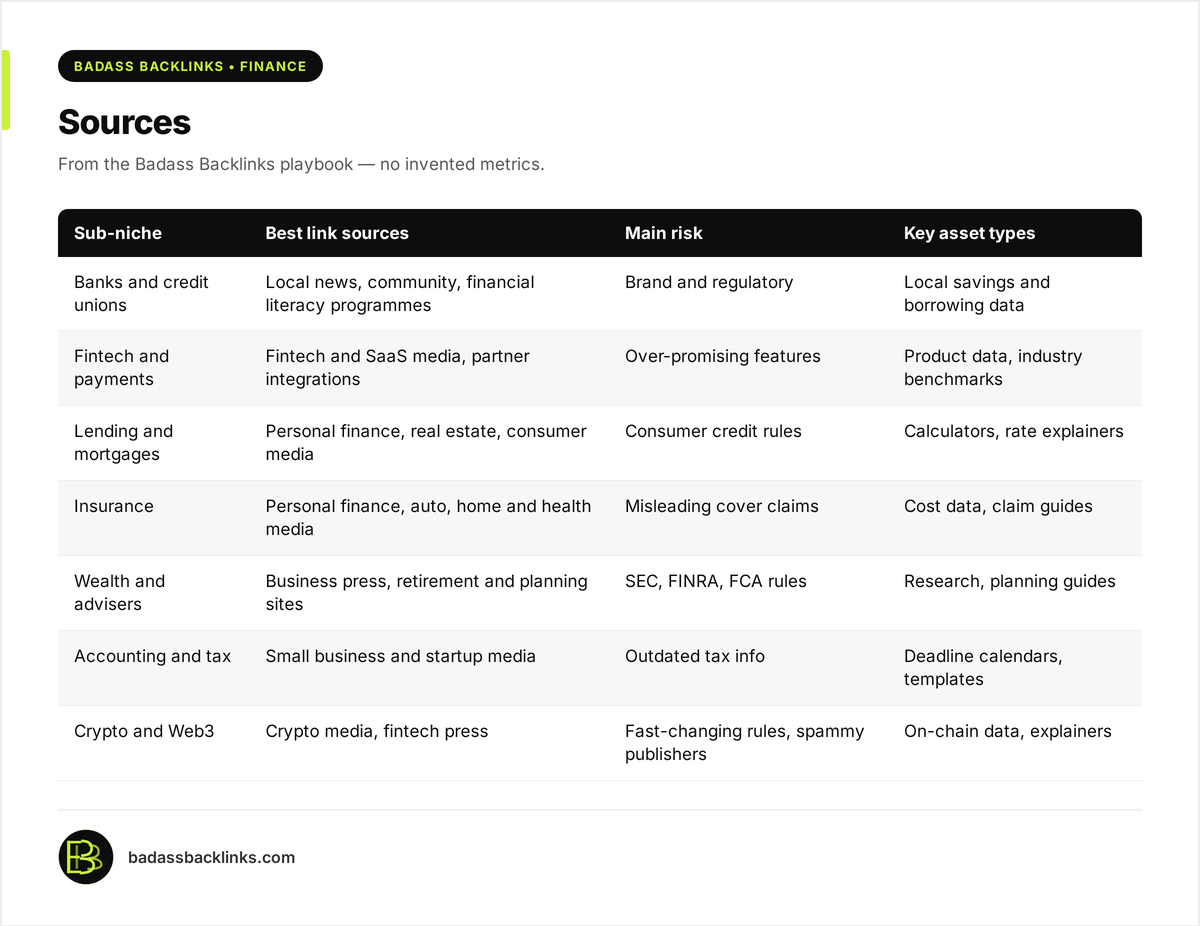
| Sub-niche | Best link sources | Main risk | Key asset types |
|---|---|---|---|
| Banks and credit unions | Local news, community, financial literacy programmes | Brand and regulatory | Local savings and borrowing data |
| Fintech and payments | Fintech and SaaS media, partner integrations | Over-promising features | Product data, industry benchmarks |
| Lending and mortgages | Personal finance, real estate, consumer media | Consumer credit rules | Calculators, rate explainers |
| Insurance | Personal finance, auto, home and health media | Misleading cover claims | Cost data, claim guides |
| Wealth and advisers | Business press, retirement and planning sites | SEC, FINRA, FCA rules | Research, planning guides |
| Accounting and tax | Small business and startup media | Outdated tax info | Deadline calendars, templates |
| Crypto and Web3 | Crypto media, fintech press | Fast-changing rules, spammy publishers | On-chain data, explainers |
Our SEO for banks guide covers bank-specific tactics, and our list of finance guest post sites covers vetted publishers.
Tactics
12 finance link building tactics that work
The safest, strongest finance tactics are original data studies, expert commentary, calculators and tools, financial literacy partnerships, editorial guest posts on vetted finance publications, and inclusion in comparison and “best of” content.
1. Original data studies
Finance journalists live on numbers. Anonymised spending, saving, borrowing or payments data, or a commissioned consumer survey, produces stories national media cite.
2. Expert commentary
Rate decisions, inflation releases, budget announcements and tax changes create daily demand for qualified quotes. Pre-approve a set of commentary topics with compliance so experts can respond within hours.
3. Calculators and tools
Loan, mortgage, savings, retirement, tax and currency calculators earn links from personal finance blogs and resource pages for years.
4. Financial literacy partnerships
Schools, universities, libraries and nonprofits run financial education programmes. Genuine contributions earn trusted links and goodwill.
5. Editorial guest posts on vetted finance publications
Write practical, compliant articles for publications your customers read. Avoid generic “write for us finance” sites that publish anything for a fee.
6. Inclusion in comparison and roundup content
“Best high-yield savings accounts” and “best business bank accounts” articles shape decisions and AI answers. Give authors accurate, current product details; paid inclusion should be disclosed.
7. Niche edits on ranking finance guides
A relevant mention in an established guide shows impact quickly, but vet the page carefully.
8. Podcasts and webinars
Personal finance, business and investing podcasts earn mentions and show notes links.
9. Partner and integration links
Fintechs can earn links from banking partners, accounting software marketplaces and platforms they integrate with.
10. Awards and industry bodies
Legitimate industry awards, associations and professional bodies list members and winners.
11. Statistics pages
Well-sourced statistics pages on your sub-niche are cited heavily by writers.
12. Unlinked mentions
Finance brands are frequently mentioned in news without links; reclaim them.
Free, no obligation
Find the finance links your competitors have
We map the links of the top finance brands for your products and flag which opportunities are credible, compliant and worth pursuing.
Get a free finance link auditQuality control
A 10-point vetting checklist for finance publishers
Approve a finance publisher only if it has real, stable traffic from your market, covers money topics with named expert authors, links out responsibly, and would make sense to a compliance officer reading the page.
- Market fit: most organic traffic comes from the country where you are licensed.
- Traffic trend: stable or rising over the past 12 months, with no cliff after core or spam updates.
- Topic depth: the site covers personal finance, business or investing in depth, not as one category among dozens.
- Authors: named writers with finance credentials or experience, and author pages.
- Editorial standards: a published editorial or corrections policy and evidence of fact-checking.
- Outbound links: recent articles link mainly to regulators, data sources and reputable brands, not to casinos, essay mills and payday lenders.
- Rankings: the site ranks for finance keywords your customers search.
- Sponsored labelling: paid content is labelled and links are qualified, which protects you as well as them.
- Reputation: no history of regulatory warnings, scam promotion or site reputation abuse.
- Compliance fit: the publisher accepts your required disclaimers and edits.
In our experience a large share of sites on public “finance write for us” lists fail three or more of these checks. Rejecting them early saves budget and protects your domain. When we deliver finance campaigns, every site we place passes this checklist, and the DR, traffic and niche you order are guaranteed.
What a good finance placement looks like
An article on a respected personal finance or business publication, written by a qualified author or your expert, that answers a real reader question in depth, cites primary sources, mentions your brand in a factual sentence that explains what you offer and for whom, and links to the most relevant page on your site with a natural anchor. It has been through your compliance review and is labelled appropriately if paid. It ranks, or could rank, for its own topic, which means it also sends referral traffic.
Compare that with the typical cheap finance guest post: a generic 600-word article on a site that publishes every niche, with three other commercial links, no author, and traffic from countries unrelated to the topic. The first builds trust with Google, AI systems and readers; the second spends budget on risk.
Risk
How to spot finance link farms
Many “finance guest post sites” are link farms: high DR, falling traffic, every niche accepted, and pages stuffed with casino, loan and crypto links. Links from them add risk, not trust.
- Organic traffic dropped sharply after a core or spam update.
- “Write for us” pages list prices for finance, CBD, casino and crypto together.
- Recent articles each contain several commercial links to unrelated sites.
- No named authors, no editorial standards, no corrections policy.
- Traffic comes from countries unrelated to the site’s topic.
- Content is thin, generic or obviously generated at scale.
Google’s spam policies and the March 2024 site reputation abuse and scaled content policies target exactly these patterns. Google said the March 2024 changes led to 45% less low-quality, unoriginal content in results. A cheaper link from a farm can cost far more in lost rankings.
Assets
How to build finance calculators and tools that earn links
A finance calculator earns links when it answers a specific question better than existing tools, shows its assumptions, uses current data and sits on a page that explains the result in plain language. Generic calculators that copy what every bank already offers rarely earn anything.
Pick a question that existing tools answer badly
Search your target question and test the top ten tools. Look for gaps: no local tax rules, out-of-date rates, no explanation of the result, no way to compare scenarios, or a poor mobile experience. Your tool should close one or more of those gaps for a defined audience, such as freelancers, first-time buyers, small business owners or retirees.
Make it trustworthy
- Show the formula and every assumption, with sources such as a central bank, tax authority or regulator.
- Display a “last updated” date and update rates and thresholds on a fixed schedule.
- Add a short explanation of what the result means and what it does not cover.
- Include required risk wording and a note that results are estimates, approved by compliance.
- Have a qualified reviewer sign off and name them on the page.
Make it linkable
- Give it a clean, permanent URL and a descriptive title.
- Write 600 to 1,200 words of supporting guidance around the tool so it can rank by itself.
- Offer an embed version or shareable result links where appropriate.
- Pitch it to personal finance bloggers, resource pages, university financial literacy pages and journalists covering the topic.
- Link from the tool page to the related product page with a natural anchor.
Calculator ideas by sub-niche
| Sub-niche | Tool idea | Who links |
|---|---|---|
| Banking and savings | Savings goal planner with current rate comparisons | Personal finance blogs, schools |
| Lending | True cost of borrowing including fees | Consumer and debt advice sites |
| Mortgages | Affordability by city using local taxes and insurance | Real estate agents, local news |
| Insurance | Coverage needs estimator | Family, auto and home sites |
| Wealth and retirement | Retirement gap calculator | Retirement and planning sites |
| Accounting and tax | Self-employed tax estimator by region | Freelancer and small business media |
| Payments and fintech | Payment processing fee comparison | E-commerce and SaaS publications |
One good tool, maintained for years, can outperform dozens of guest posts in both links and leads. It also gives every outreach email a reason to exist: you are offering a resource, not asking for a favour.
Why tools matter more as AI answers grow
Ahrefs’ December 2025 data found a 58% lower click-through rate for the top result when an AI Overview appears. Simple factual finance questions are increasingly answered on the results page, but an assistant cannot run a person’s own numbers through a well-built calculator with the same depth. Interactive tools keep earning visits and links where plain explainer articles are losing them, which makes them one of the safest long-term investments in finance content.
Insurance and lending: specific cautions
Insurance and consumer credit content is closely watched by regulators because it affects vulnerable customers. Avoid language that implies guaranteed approval or guaranteed savings, keep representative examples and rate information current, and make sure any comparison is fair. Publishers that run “guaranteed approval” loan content are a sign of a low-quality, high-risk site to avoid. The FCA’s financial promotions guidance in the UK and consumer finance rules elsewhere apply to content on third-party sites as well as your own, so the compliance workflow above applies to every placement.
PR
The finance digital PR playbook
Finance digital PR earns the highest-authority links in the niche by packaging data and expertise into stories journalists need, timed to the financial news calendar.
The financial news cycle is predictable: central bank rate decisions, inflation releases, jobs reports, budgets, tax deadlines, the start of the tax year, back-to-school costs and holiday spending. Each moment creates demand for data and quotes. Brands that prepare in advance get covered; brands that react a week late do not.
Data story ideas by sub-niche
| Sub-niche | Story idea | Likely coverage |
|---|---|---|
| Banking | How much people in each city have in savings, by age | Local and national news |
| Payments | Fastest-growing spending categories this year | Business and consumer press |
| Lending | Average debt by profession or region | Personal finance media |
| Insurance | Premium changes by area and why | Consumer and motoring media |
| Wealth | Retirement savings gap by generation | Business press, retirement sites |
| Accounting | Most common small business tax mistakes | Small business media |
| Crypto | Adoption patterns from anonymised user data | Fintech and crypto media |
Making it compliant
Data stories are usually easier to approve than product promotion because they are educational. Agree the methodology with compliance, avoid implying product performance, include appropriate risk wording for investment and crypto topics, and keep the approved press release on file. Expert spokespeople should be briefed on what they can and cannot say about products.
Measuring PR
Count linked and unlinked mentions, the authority and relevance of outlets, referral traffic, and changes in branded search. Follow up unlinked coverage with a polite request to link to the data source page.
Budget
How much does finance link building cost?
Finance placements typically cost $250 to $1,000+ each on credible publications, and most finance brands invest $3,000 to $10,000 a month; national digital PR campaigns cost more.
Finance is consistently priced above average. PressWhizz’s marketplace data found finance placements averaged $221, behind only casino ($252) and sports ($246). Editorial.Link’s survey found SEOs consider $508.95 an acceptable price for a high-quality link and reported $8,406 average monthly budgets in highly competitive niches. Top finance publications charge more, and many will not sell links at all, which is why data-led PR matters.
| Business | Typical monthly budget | Focus |
|---|---|---|
| Local bank, credit union, adviser | $1,500 to $4,000 | Local trust, literacy partnerships, guest posts |
| Fintech or lender | $3,000 to $8,000 | Data PR, comparisons, product pages |
| National brand or comparison site | $8,000 to $20,000+ | Digital PR at scale, category terms |
These are planning ranges from our campaigns, not quotes. See our finance backlink packages.
Estimate your finance link budget
Estimated monthly investment:
Uses $300 to $900 per vetted finance placement. Digital PR and compliance-heavy content are priced separately.
Get an exact quoteExecution
Anchor text and a 90-day plan for finance brands
Keep finance anchors overwhelmingly branded and descriptive, and use the first 90 days to fix trust foundations, agree compliance processes and earn the first credible placements.
| Anchor type | Example | Suggested share |
|---|---|---|
| Brand | Northpeak Finance | 40% to 55% |
| Naked URL | northpeak.com | 10% to 15% |
| Natural | according to this guide | 15% to 20% |
| Partial match | Northpeak’s business savings guide | 10% to 15% |
| Exact match | business savings account | Under 5% |
These shares are planning guidance from our campaigns, not a Google rule. Finance is a niche where over-optimised anchors are especially visible because so many low-quality sites use the same commercial phrases.
Days 1 to 30
- Audit backlinks and remove or disavow obvious farm and PBN links after review.
- Benchmark the top five competitors for your product terms.
- Fix author, reviewer and regulatory signals on target pages.
- Agree a compliance workflow, approved topics and disclaimers.
Days 31 to 60
- Publish one calculator or data asset.
- Start guest posts on vetted finance and business publications.
- Secure inclusion or corrections in key comparison articles.
- Prepare expert commentary for upcoming economic releases.
Days 61 to 90
- Launch the first data-led PR pitch.
- Add niche edits on ranking guides where vetted.
- Report rankings, applications and leads from organic.
- Plan quarterly PR around the financial calendar.
Reporting
How to measure finance link building
Track applications, accounts opened, leads or AUM from organic first, then rankings, referring domains versus competitors, and brand presence in AI answers.
| Metric | Why |
|---|---|
| Applications, sign-ups or qualified leads from organic | Revenue impact |
| Rankings for product and comparison terms | Where links are working |
| Referring domains from finance publications | Authority gap |
| Branded search volume | Brand demand |
| AI answer inclusion for product prompts | Visibility beyond blue links |
| Compliance log completeness | Regulatory safety |
Related: finance backlinks explained, digital PR link building, link building statistics and anchor text strategy.
Markets
Finance link building across markets
Links work best when they come from publications in the market where you are licensed and sell, and content must follow that market’s financial promotion rules.
| Market | Main regulators to consider | Link building note |
|---|---|---|
| United States | SEC, FINRA, CFPB and state regulators | Large publisher market; strict rules for advisers and broker-dealers |
| United Kingdom | FCA | Financial promotions rules apply to third-party content; check approval requirements |
| Canada | Provincial securities regulators, FCAC | Bilingual opportunities in Quebec |
| Australia | ASIC | Local personal finance media is concentrated; PR matters |
| Singapore | MAS | Smaller publisher pool; quality over quantity |
A UK fintech gains little from US personal finance blogs, and a US adviser cannot assume UK-style disclosures meet SEC requirements. Plan market by market, with local publications, local data and local compliance review.
Crypto and high-risk financial products
Crypto, trading and high-risk investment brands face the toughest environment: many mainstream publishers refuse their content, rules change quickly, and the publisher pool is full of low-quality sites. Focus on genuine data, education and expert commentary, use reputable crypto and fintech media, and include clear risk warnings. Avoid any publisher that will run unreviewed “guaranteed returns” style content; it is a regulatory and reputational risk as well as an SEO one.
Across every market, the same principle holds: in finance, the link is only as valuable as the trust of the site it comes from. A smaller number of credible, compliant placements beats a large number of cheap ones every time.
Expert insight
Expert insight on finance link building
The quotes below are verbatim public statements, linked to the original source. We have not interviewed these people; the case study figures are our own client results.
“Google’s automated ranking systems are designed to prioritize helpful, reliable information that’s created to benefit people, and not content that’s created to manipulate search engine rankings.”
Google Search Central, Creating helpful, reliable, people-first content
“Link spam is the practice of creating links to or from a site primarily for the purpose of manipulating search rankings.”
Google Search Central, Spam policies for Google web search
“If AI can write your #SEO content, your edge is the expert, the data and the customer story it can’t.”
Search Engine Land, on X, 17 October 2026
Conclusion
The bottom line on finance link building
Finance link building rewards patience and proof: original data, credentialed authors and coverage in respected financial outlets. Treat every link as a trust signal and finance link building supports both rankings and YMYL credibility.
Quick answers
Quick answers about finance link building
Short, direct answers to the questions people ask search engines and AI assistants about finance link building.
Why is finance link building harder than other niches?
Finance link building is harder because finance is a YMYL topic, many publishers refuse finance guest posts, and competitors have strong link profiles.
What links work best for fintech companies?
Data studies, expert commentary for journalists, partner and integration pages and coverage in financial publications work best for fintech companies.
Is it safe to buy guest posts on finance sites?
Paid guest posts on finance sites carry risk because Google treats links bought for rankings as link spam; any paid placement should be marked rel=”sponsored”.
How does E-E-A-T affect finance link building?
E-E-A-T affects finance link building because links from reputable financial sources support the expertise and trust signals that YMYL pages need.
How much does finance link building cost?
Finance links usually cost more than general links; the cost section on this page lists published ranges.
What content earns links in finance?
Original data, calculators and expert commentary earn the most links in finance.
Questions
Frequently asked questions
What is finance link building?
Earning links and mentions from credible finance, business and news sites to financial brands’ pages, within Google’s YMYL standards and financial promotion rules.
Why are finance backlinks so expensive?
Few credible finance publishers sell links, editors are strict and demand is high. PressWhizz found finance placements averaged $221 against $161.25 overall.
Do guest posts count as financial promotions?
Often they can, if they promote your products. Treat them as regulated communications and have compliance approve them before publication.
How much should a fintech spend on link building?
Most fintechs and lenders invest $3,000 to $8,000 a month, more for national digital PR.
Are finance guest post lists safe?
Many are not. Check traffic trends, topic focus, outbound links and editorial standards before using any site.
What are the best link building tactics for finance?
Original data studies, expert commentary, calculators, financial literacy partnerships, vetted guest posts and inclusion in comparison content.
How long does finance link building take?
Expect six to twelve months for competitive product terms; long-tail and local terms move sooner.
Do backlinks help financial brands appear in AI answers?
Yes, indirectly. Branded mentions on credible sites correlate strongly with AI Overview visibility.
Do finance links need to be marked sponsored?
If you paid for the placement, Google asks for the link to be qualified with rel=”sponsored”. Earned editorial links from data studies, commentary or tools do not need it. Paid content may also need disclosure under financial promotion rules.
Can a small adviser or credit union compete in finance search?
Yes, by focusing on local and specialist queries rather than national head terms. Local news, community financial education, professional bodies and specialist publications provide credible links that national brands do not prioritise.
What makes a finance link high quality?
Real traffic from your market, a finance-focused site with named expert authors, responsible outbound links, editorial standards, and a placement that has passed your compliance review. Domain rating alone is not a reliable signal.
How do I get my fintech into best-of lists?
Identify the roundups that rank and appear in AI answers for your category, then give their authors accurate product details, demo access and current pricing. Disclose any paid inclusion and keep your information updated as products change.
References
Sources
Every statistic on this page links back to the original publisher below. Figures were checked on 24 October 2026.
- PressWhizz, Link Building Pricing Report 2026: 22,703 completed placements worth $3.66M; average $161.25, median $112; casino $252, sports $246 and finance $221 among the most expensive niches. presswhizz.com/case-studies/link-building-pricing-report
- Editorial.Link, Link Building Statistics survey: 518 SEO professionals surveyed; $508.95 average acceptable price for one high-quality link; 80.9% expect costs to rise. editorial.link/link-building-statistics
- Google Search Quality Rater Guidelines: Defines YMYL topics, including financial and legal topics, and applies the highest Page Quality standards to them. static.googleusercontent.com/media/guidelines.raterhub.com/en/en/searchqualityevaluatorgui
- Google Search Central, Creating helpful, reliable, people-first content: Explains E-E-A-T and that trust is weighted most heavily for YMYL topics. developers.google.com/search/docs/fundamentals/creating-helpful-content
- Ahrefs, AI Overview brand visibility factors (75K brands): Branded web mentions had a 0.664 correlation with AI Overview visibility, branded anchors 0.527, backlinks 0.218. ahrefs.com/blog/ai-overview-brand-correlation
- Ahrefs, AI Overviews reduce clicks by 34.5%: 300,000 keywords; position-one CTR was 34.5% lower when an AI Overview appeared (March 2025 data). ahrefs.com/blog/ai-overviews-reduce-clicks
- Backlinko, Search Engine Ranking Study (2020): 11.8 million Google results analysed with Ahrefs data; the #1 result had 3.8x more backlinks than positions 2 to 10; about 95% of pages had zero backlinks. backlinko.com/search-engine-ranking
- FINRA Rule 2210, Communications with the Public: Communications must be fair, balanced and not misleading; principal approval and filing requirements for retail communications. www.finra.org/rules-guidance/rulebooks/finra-rules/2210
- SEC, Marketing Rule for Investment Advisers (press release 2020-334): Rule 206(4)-1 governs adviser advertisements, testimonials and endorsements. www.sec.gov/newsroom/press-releases/2020-334
- Financial Conduct Authority, Financial promotions and adverts: UK rules requiring financial promotions, including websites, to be clear, fair and not misleading. www.fca.org.uk/firms/financial-promotions-adverts
- Google Search Central, Spam policies for Google web search: Defines link spam, including buying or selling links that pass ranking credit, excessive link exchanges and large-scale guest posting campaigns with keyword-rich anchors. developers.google.com/search/docs/essentials/spam-policies
- Google, March 2024 core update and spam policies: New policies on expired domain abuse, scaled content abuse and site reputation abuse. developers.google.com/search/blog/2024/03/core-update-spam-policies
- Google Blog, New updates to address spam and low-quality results: Google expected the March 2024 changes to cut low-quality, unoriginal results by 40%, later reported as 45%. blog.google/products-and-platforms/products/search/google-search-update-march-2024