BadAss Backlinks · International SEO · Updated October 2026
International Link Building: How to Run Campaigns in 5 Markets at Once
International link building is earning backlinks from local publications in each country or language you target, pointed at the matching localised pages. Each market needs its own prospects, native-language outreach and local relevance.
TL;DR
- Country-relevant links help a page compete in that country. A US-only profile rarely wins in the UK or Australia on its own.
- Your site structure decides where links help: links to a subfolder benefit the whole domain; links to a ccTLD stay on that ccTLD.
- Each market has a different media mix: digital PR and regional press in the UK, bilingual media in Canada, a small, concentrated market in Australia.
- Budget per market, not globally, and localise the pitch as well as the content.
On this page
Multi-market links
Where are you expanding?
We plan and run link building market by market.
- Market-by-market link plans
- Local publications and outreach
- Structure and hreflang review
Guest posts from $85 and niche edits from $69 per link. Monthly plans optional.
Talk to us
Expanding into a new country is usually a content and technical project first. Then rankings stall, and someone notices the competitors in that country have links from local publications you have never heard of. International link building is how you close that gap.
This guide shows how to run link building campaigns in five English-speaking markets at once (the UK, US, Canada, Australia and Singapore) with one central team, local owners and a staggered launch. It is written for teams already doing link building in one market and adding more.
Start here
Three international link building scenarios
International link building usually falls into one of three scenarios. Your approach depends on which one you are in.
A .com serving several countries with subfolders. Links anywhere help the domain; local links help country pages compete.
ccTLDs such as .co.uk and .com.au. Each site needs its own link profile.
Product or service pages for each country, often with hreflang. Local relevance on those pages matters most.
Operating model
How to run campaigns in 5 markets at once: the hub and spoke model
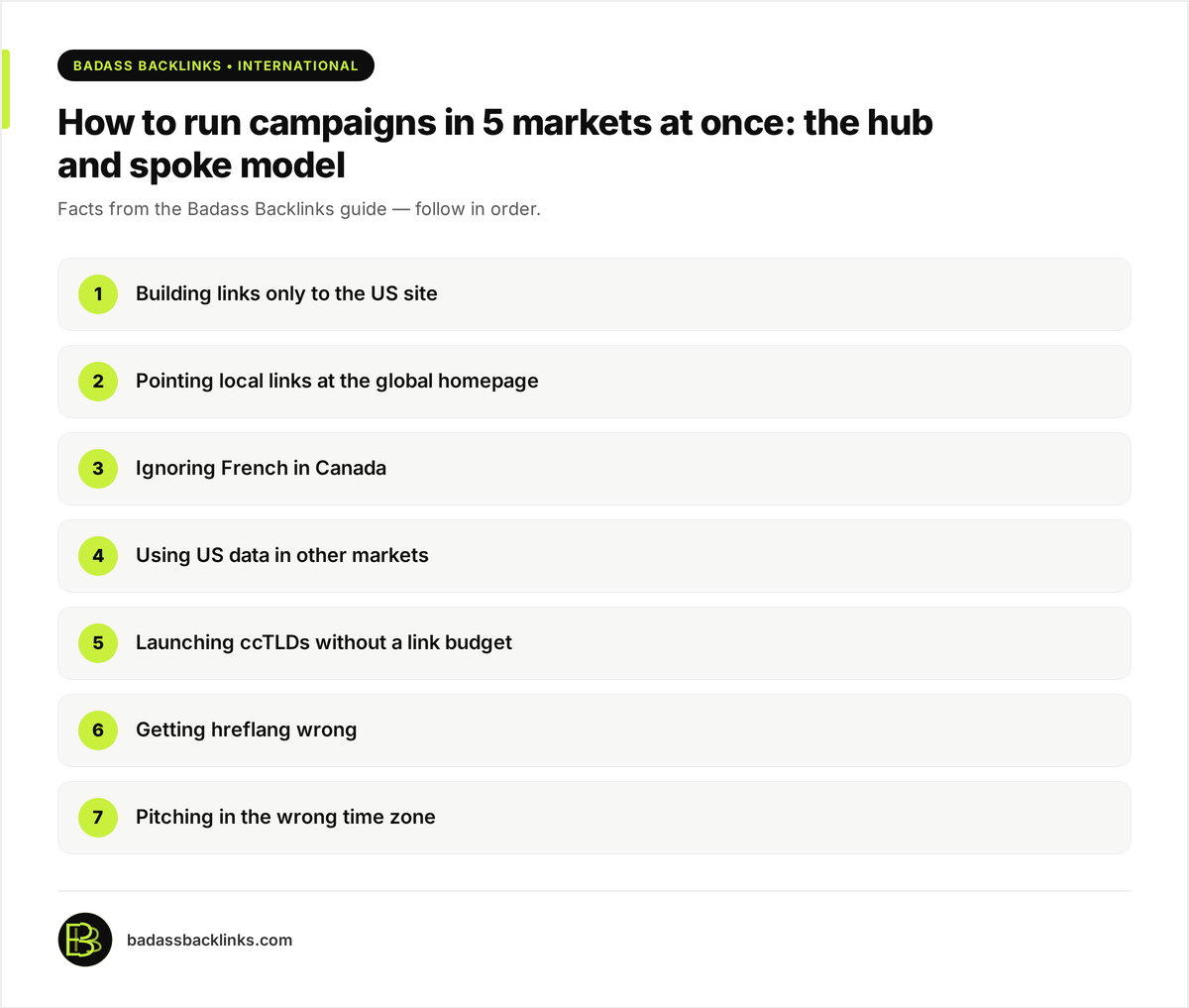
Running five markets at once is an operations problem before it is a link problem. Teams that try to run five separate campaigns burn budget on five sets of research, five assets and five reporting formats. The model that scales is hub and spoke: one central team owns strategy, assets and quality control; a local owner in each market owns the media list, language and relationships.
- Design the asset to split. Choose data that has a country field from the start: public statistics, a survey with quotas per market, or product data you can segment.
- One owner per market. A named person, internal or freelance, who reads the local press and can answer a journalist the same day.
- Shared vetting rules. The same minimum standards for traffic, relevance and editorial quality apply in every market, so a weak market does not drag quality down.
- Shared naming. Tag every link by market, structure (ccTLD or folder) and target page so reporting is comparable.
Reader poll
Your vote is saved in this browser only. No live tally is stored on a server, so results show votes cast on this device.
Launch
A staggered launch calendar for 5 markets
Launching everywhere on the same day rarely works, because news cycles, holidays and time zones differ. We stagger launches across a two-week window instead. The sequence below is a planning template, not a rule.
| Day | Market | Why this order |
|---|---|---|
| Day 1 | United Kingdom | Concentrated national press; early coverage creates momentum and proof for other markets |
| Day 2 to 3 | United States | Larger, more fragmented market; pitch by coast and by vertical |
| Day 4 to 5 | Canada | Can reference US and UK coverage; local data cut essential |
| Day 8 to 9 | Australia | Different week rhythm because of time zone; pitch early morning AEST |
| Day 10 | Singapore | Smaller media market; business and regional titles, English-language first |
Two checks before each launch: confirm there is no national holiday or major scheduled news event that day in that market, and confirm the local spokesperson is available for the first 48 hours.
Markets
UK, US, Canada, Australia and Singapore compared
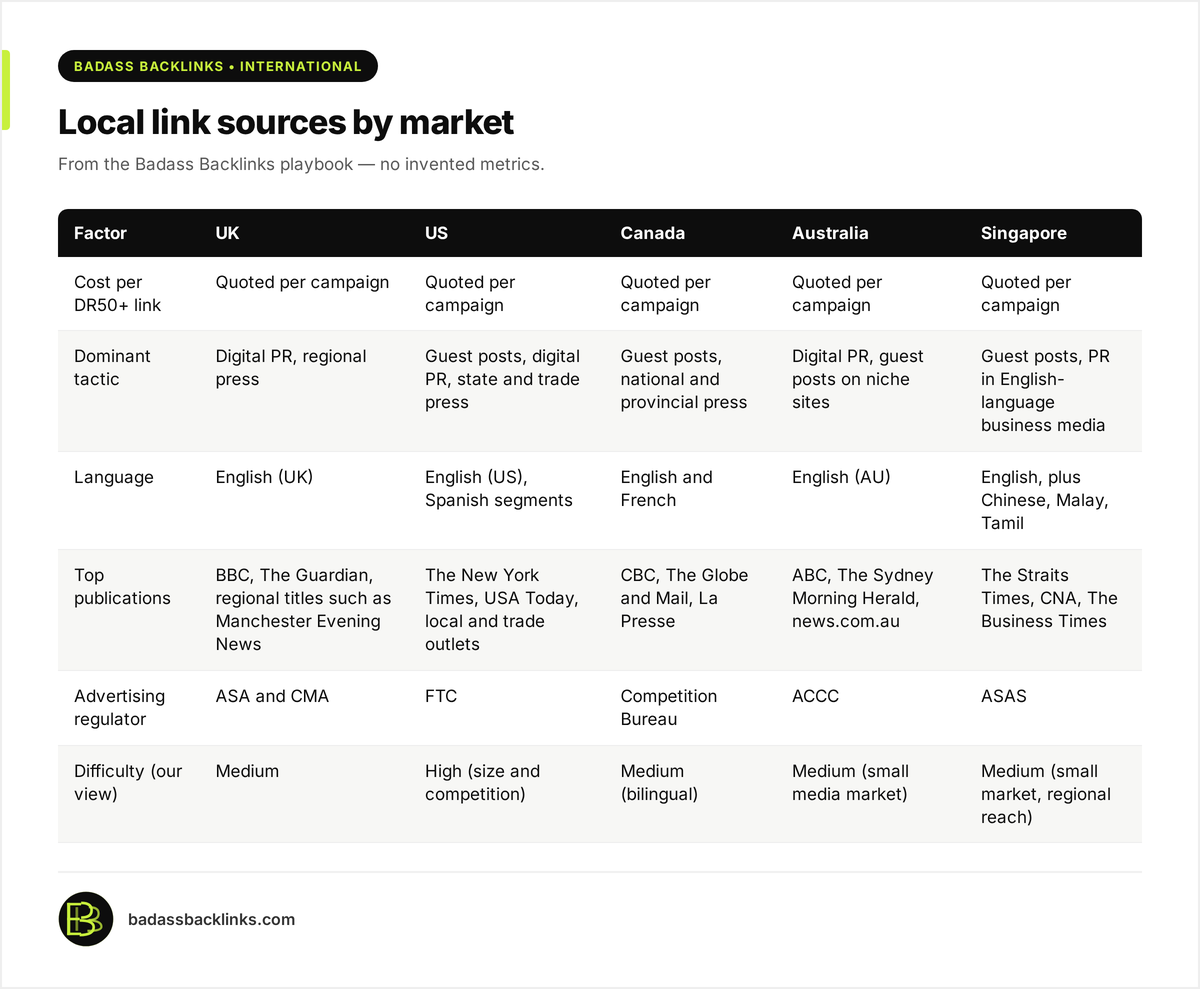
The table below summarises the five markets. Costs are not shown as numbers because we quote them per campaign; published averages are covered in the budget section.
| Factor | UK | US | Canada | Australia | Singapore |
|---|---|---|---|---|---|
| Cost per DR50+ link | Quoted per campaign | Quoted per campaign | Quoted per campaign | Quoted per campaign | Quoted per campaign |
| Dominant tactic | Digital PR, regional press | Guest posts, digital PR, state and trade press | Guest posts, national and provincial press | Digital PR, guest posts on niche sites | Guest posts, PR in English-language business media |
| Language | English (UK) | English (US), Spanish segments | English and French | English (AU) | English, plus Chinese, Malay, Tamil |
| Top publications | BBC, The Guardian, regional titles such as Manchester Evening News | The New York Times, USA Today, local and trade outlets | CBC, The Globe and Mail, La Presse | ABC, The Sydney Morning Herald, news.com.au | The Straits Times, CNA, The Business Times |
| Advertising regulator | ASA and CMA | FTC | Competition Bureau | ACCC | ASAS |
| Difficulty (our view) | Medium | High (size and competition) | Medium (bilingual) | Medium (small media market) | Medium (small market, regional reach) |
Framework
Local or global links? A decision framework
Do you need local links, or will global authority do? Use this framework.
| Signal | Lean global | Lean local |
|---|---|---|
| Search intent | Informational, global topics | Local services, regulated products, prices in local currency |
| Competitors | Global brands rank everywhere | Local brands dominate the SERP |
| Site structure | Subfolders on one domain | Separate ccTLDs |
| Regulation | Unregulated | Finance, legal, health, gambling |
| Audience trust | Brand recognised globally | Brand unknown in the market |
Google’s own documentation on Google Search Central does not say links must be local. But in competitive local SERPs, the pages that win nearly always have links from publications in that country. Check the top five results in each market before you decide.
Briefings
Market briefings
Each market needs its own briefing covering publications, data sources and outreach norms before any pitch goes out.
United Kingdom
The UK is the home of modern digital PR. The national press is concentrated and highly competitive, and strong regional titles give data stories with regional cuts a second life. UK journalists are used to data-led pitches, and Freedom of Information requests are a common source of exclusive data. Financial promotions fall under the Financial Conduct Authority, which matters for any finance campaign.
United States
The US is the largest and most fragmented market. National outlets are very hard to land; state, city and trade media are far more accessible and often link to sources. Rules vary by state for regulated professions such as law. Four mainland time zones affect pitch timing. Guest posting on niche US sites remains common.
Canada
Canada is bilingual. Quebec has its own French-language media, so English-only campaigns miss a large part of the market. National outlets cover both, but provincial press is where most opportunities sit. Canadian audiences and editors notice US-centric data quickly; use Canadian sources such as Statistics Canada.
Australia
Australia has a small, concentrated media market. A handful of groups own many titles, so one pitch can reach several mastheads, and a bad pitch can close several doors at once. Data stories with state-level cuts work well. Niche Australian blogs and publications are fewer than in the US, so vetting matters more.
Singapore
Singapore is an APAC gateway. English is the main business language, and regional business media reach across Southeast Asia. The market is small, so link opportunities are fewer. Many brands combine Singapore placements with regional APAC publications.
| Market | What works | Watch out for |
|---|---|---|
| UK | Data stories with regional cuts; FOI-based exclusives; expert comment on economic news | Very high pitch volume at national desks; FCA rules on financial promotions |
| US | State and city data; trade publications; niche guest posts; local news for local services | Scale makes national coverage rare; state-specific rules for legal and financial services |
| Canada | Provincial angles; French-language versions for Quebec; Canadian data sources | US-centric data and spelling; ignoring French media |
| Australia | State-level data; niche Australian publications; expert commentary | Small number of media owners; fewer niche blogs, so vet harder |
| Singapore | English-language business media; APAC regional comparisons; partnerships | Small market; fewer local link opportunities; combine with regional outreach |
One pattern holds across all five: the closer the story is to the reader’s own city or region, the more outlets can run it. A national figure is one story. The same figure cut by region is a dozen.
Expanding into a new market?
Get a market-by-market link plan.
We audit the competitors in each country, recommend the structure and build local links on publications people in that market read.
Talk to usStructure
ccTLD vs subfolder vs subdomain
Your site structure decides where international links help. Google’s Google Search Central page compares the options.
| Structure | Example | Pros | Cons | Link implication |
|---|---|---|---|---|
| ccTLD | example.co.uk | Clear geotargeting | Expensive, more infrastructure, separate sites | Each ccTLD needs its own links |
| Subdomain | uk.example.com | Easy to set up, separate hosting possible | Users may not recognise geotargeting from the URL alone | Links may be treated more separately |
| Subdirectory | example.com/uk/ | Easy to set up, shares one domain | Single server location | Links to any country folder strengthen the whole domain |
Use Google Search Central to tell Google which page serves which language and region. Hreflang does not pass link equity, but it stops the wrong country page ranking.
Equity
How link equity flows across markets
How link equity flows depends on the structure.
On a subfolder setup, the most efficient plan is usually to build global authority to the root and key guides, plus local links to the country pages that face local competitors. On ccTLDs, every site starts from scratch; budget accordingly.
Localisation
Localising your outreach
Localising your outreach: spelling and vocabulary, local data, currency and units and local spokespeople.
- Spelling and vocabulary. UK and AU English differ from US English. Editors notice “optimize” vs “optimise”.
- Local data. Use ONS for the UK, the Census Bureau for the US, Statistics Canada, the Australian Bureau of Statistics and Singapore’s Department of Statistics.
- Currency and units. Prices in local currency, metric where expected.
- Local spokespeople. A comment from someone based in the market lands better.
- Local link targets. Link to the country page, not the US homepage.
- Regulatory context. Advertising and financial promotion rules differ by country.
Timing
Time zones and pitch timing
Send pitches in the journalist’s local morning and avoid local holidays; the schedule below shows timing for each market.
| Market | Main time zone(s) | Pitching note |
|---|---|---|
| UK | GMT / BST | Pitch early morning UK time |
| US | ET, CT, MT, PT | Stagger sends by coast |
| Canada | Six zones, mostly ET and PT | Separate Quebec timing and language |
| Australia | AEST, ACST, AWST | Pitches sent during UK afternoon arrive overnight |
| Singapore | SGT | Overlaps with Australian business hours |
Budget
How to budget international link building
Budget per market. Published global benchmarks give a floor: PressWhizz reports an average paid placement of $161.25 and a median of $112 across 22,703 placements, and the BuzzStream study found guest posts average $461 through vendors. Digital PR teams most commonly report $300 to $500 per link in the BuzzStream report. These are not country-specific figures.
| Budget line | How to size it |
|---|---|
| Market audit | Competitor referring domains in each country |
| Foundation links | Local directories, associations, partners |
| Outreach | Guest posts and resource pages on local sites |
| Digital PR | One data campaign per quarter per priority market |
| Localisation | Translation or adaptation of assets |
| Reporting | Rankings and links by market |
Prioritise one or two markets at a time. Spreading a single budget across five countries usually produces too few links in each to move rankings.
Sources
Local link sources by market
In all five markets Google is the search engine to plan for. StatCounter Global Stats data put Google at 89.94% of worldwide search and Bing at 5.29% when we checked in October 2026. Bing matters more than its share suggests, though, because several AI assistants draw on web indexes beyond Google, and links help discovery in every index.
| Link source type | UK | US | Canada | Australia | Singapore |
|---|---|---|---|---|---|
| Business directories | Yell, Thomson Local | Yelp, BBB | YellowPages.ca | Yellow Pages, TrueLocal | Yellow Pages Singapore |
| Chambers and federations | British Chambers of Commerce network | US Chamber and local chambers | Canadian Chamber and provincial chambers | ACCI and state chambers | Singapore Business Federation |
| Statistics agency for data PR | ONS | US Census Bureau, BLS | Statistics Canada | Australian Bureau of Statistics | Department of Statistics Singapore |
| Typical press angle | Regional cuts by city | State-level cuts | Province and language cuts | State and capital-city cuts | Regional APAC comparisons |
Directory and chamber links are low in authority individually, but they establish local relevance and consistent business details, which matters for both local rankings and the entity understanding AI systems build. Our {il(“/citation-building-service/”,”citation building service”)} handles them at scale.
Plan
A 90-day plan for each new market
In short: audit, foundation, outreach and PR, with every step explained below.
| Phase | Weeks | Actions |
|---|---|---|
| Audit | 1 to 2 | Pull referring domains for the top 5 local competitors; map which local publications link to them; check hreflang and structure |
| Foundation | 3 to 4 | Local directories, chambers, partners, suppliers and customers in that market |
| Outreach | 5 to 10 | Guest posts and resource links on vetted local sites; localised pitches |
| PR | 8 to 12 | One data story using the national statistics agency, with regional cuts |
| Review | 12 | Rankings by market, links by market, cost per link; decide whether to scale or move to the next market |
Run this cycle in one market, learn from it, then copy what worked to the next. Teams that launch five markets at once usually end up with a handful of links in each and no clear signal about what is working.
Avoid
7 international link building mistakes
The most common international link building mistakes are building links only to the US site, pointing local links at the global homepage, ignoring French in Canada and using US data in other markets. Each one is explained below with the fix.
- Building links only to the US site and expecting the UK pages to rank.
- Pointing local links at the global homepage instead of the country page.
- Ignoring French in Canada.
- Using US data in other markets.
- Launching ccTLDs without a link budget.
- Getting hreflang wrong, so the wrong page ranks.
- Pitching in the wrong time zone.
Expert insight
Expert insight on international link building
The quotes below are verbatim public statements, linked to the original source. We have not interviewed these people; the case study figures are our own client results.
“Google uses links as a signal when determining the relevancy of pages and to find new pages to crawl.”
Google Search Central, Link best practices for Google
“Google’s automated ranking systems are designed to prioritize helpful, reliable information that’s created to benefit people, and not content that’s created to manipulate search engine rankings.”
Google Search Central, Creating helpful, reliable, people-first content
Conclusion
The bottom line on international link building
International link building is several local campaigns run in parallel. Brief each market, localise every pitch and point links at localised pages, and international link building scales without losing relevance.
Quick answers
Quick answers about international link building
Short, direct answers to the questions people ask search engines and AI assistants about international link building.
Do I need local backlinks for each country?
Local backlinks help each country version rank, because links from local publications signal relevance in that market.
Should I translate my outreach emails?
Outreach should be written or reviewed by a native speaker; machine-translated pitches get ignored.
Which pages should international links point to?
International links should point to the localised page for that market, not the global homepage.
How do hreflang and backlinks work together?
Hreflang tells Google which language version to show; backlinks to each version help that version rank.
How long does international link building take per market?
Plan at least 90 days per new market, as the plan on this page shows.
Can one team run link building in several countries?
One team can run several markets with market briefings, native reviewers and pitch timing that respects local time zones.
Questions
Frequently asked questions
Do I need country-specific backlinks?
For competitive local queries, usually yes. Global authority helps, but pages that rank in local SERPs typically have links from publications in that country.
Are local links better than global links?
Not always. Strong global links build domain authority; local links add relevance for a specific market. Most international sites need both.
How do I build links in multiple countries?
Prioritise one or two markets, audit local competitors, localise assets and pitches, use local data and spokespeople, and point local links at the country page.
Can I use the same content for the UK, US and Australia?
You can share core content, but localise spelling, currency, examples, data and regulatory references, and use hreflang to signal the regional versions. Localised pages also earn local links more easily.
Should I use a ccTLD or a subfolder?
Google lists pros and cons for each. Subfolders share one domain’s authority and are easier to manage; ccTLDs give clearer geotargeting but need separate link profiles.
Does hreflang pass link equity between country pages?
No. Hreflang tells Google which language or regional version to show; it does not transfer link equity. Use internal links to share authority between country pages.
Which market should I expand into first?
The one where you already have customers, brand recognition or partners, and where local competitors have beatable link profiles. Audit the top five results before committing budget.
How much does link building cost by country?
There is no reliable published per-country benchmark. Global averages range from a $112 median paid placement (PressWhizz) to $300 to $500 per digital PR link (BuzzStream). We quote per campaign.
References
Sources
Every statistic on this page links back to the original publisher below. Figures were checked on 24 October 2026.
- Google Search Central, Managing multi-regional and multilingual sites: Compares ccTLDs, subdomains and subdirectories: ccTLDs give clear geotargeting but are expensive and need more infrastructure; subdirectories are easy to set up and share the domain. developers.google.com/search/docs/specialty/international/managing-multi-regional-sites
- Google Search Central, Tell Google about localized versions of your page: Use hreflang to tell Google about language and regional variations of your content. developers.google.com/search/docs/specialty/international/localized-versions
- StatCounter Global Stats, Search engine market share (worldwide): Worldwide search engine share at time of access (October 2026): Google 89.94%, Bing 5.29%. gs.statcounter.com/search-engine-market-share
- PressWhizz, Link Building Pricing Report 2026: 22,703 completed placements worth $3.66M; average $161.25, median $112; casino $252, sports $246 and finance $221 among the most expensive niches. presswhizz.com/case-studies/link-building-pricing-report
- BuzzStream, The Cost of Guest Posts, Based on 500k Sites (2026): About 257,000 guest post sites analysed: average vendor price $461, average direct price $295; 96.2% judged low quality; 39.6% had zero organic traffic; only 1.37% high quality; ecommerce niche average $341. www.buzzstream.com/blog/guest-post-costs
- BuzzStream, State of Digital PR 2026: 150+ digital PR practitioners: 95.9% pitch data-led content; about 60% have monthly budgets under $10k; most common cost per link $300 to $500 (19.6%); 39.2% do not know their cost per link; 62.8% cite outdated journalist info; 60.8% say finding journalists is harder; 85.8% call backlinks the most effective outcome; 66.2% cite AI citations. www.buzzstream.com/blog/state-of-digital-pr
- Financial Conduct Authority, Financial promotions and adverts: UK rules requiring financial promotions, including websites, to be clear, fair and not misleading. www.fca.org.uk/firms/financial-promotions-adverts