BadAss Backlinks · Legal SEO · Updated October 2026
Lawyer Link Building: Complete Guide
Lawyer link building is the process of earning backlinks from legal publications, local news, bar associations and trusted directories to a law firm website. Law firms need these links because legal keywords are local, valuable and heavily contested.
TL;DR
- What it is: earning links from legal, local and trusted sites to practice area and city pages.
- Why it matters: 57% of legal consumers search for a lawyer on their own (Clio), and legal topics get Google’s strictest YMYL scrutiny.
- Rules: follow Google’s link spam policies and ABA Model Rule 7.2 (no paying for recommendations). Treat paid placements as disclosed advertising.
- Best sources: local news, bar associations, legal publications, core directories, sponsorships and data studies.
- Cost: typically $1,500 to $5,000 a month; our case study firm went from DR 24 to 39 and +79% traffic in nine months.
On this page
Free link audit
What do you need?
Win PI rankings in your metro
- Legal and local publishers only
- Content reviewed for bar rules
- Specs guaranteed or replaced
Guest posts from $85 and niche edits from $69 per link. Monthly plans optional.
1,200+ links delivered · 95% client retention
Get a free PI link audit
Written by Paul with input from BadAss Backlinks founder SVS, based on our law firm campaigns and a review of the top 10 Google results for “lawyer link building” in October 2026.
The direct answer
What is lawyer link building?
Lawyer link building is the process of earning links from trusted, relevant websites (legal publications, local news, bar associations, community organisations and respected directories) to a law firm’s practice area and location pages, so the firm ranks for searches like “personal injury lawyer near me” or “divorce attorney in [city]”. Because legal topics fall under Google’s YMYL standards and lawyers are bound by professional conduct rules, it needs a stricter approach than ordinary link building.
Legal search is one of the most competitive spaces online. The firms ranking for high-value case types have usually spent years accumulating referring domains, and Google holds legal content to its highest quality bar. Google’s Search Quality Rater Guidelines classify topics that can affect a person’s financial stability, safety or legal rights as “Your Money or Your Life” (YMYL), and Google’s helpful content guidance says trust is the most important part of E-E-A-T for those topics. Links from credible sources are one of the strongest external trust signals a firm can earn.
This guide covers why links matter for law firms, the ethics rules that shape what you can do, the 14 link sources that work best by practice area, how to build a campaign step by step, what it costs and how long it takes, plus data from our own law firm campaign.
The business case
Why backlinks matter so much for law firms
Backlinks matter for law firms because legal keywords are high-value, local and fiercely contested, and Google uses links as evidence of authority when deciding which firm to trust with YMYL queries. A firm with excellent content but weak links usually stalls on page two.
Clients research lawyers online, even when they have a referral
Clio’s Legal Trends Report surveyed 2,000 US consumers and found 59% sought a referral but 57% also searched on their own, and 16% did both. Search engines (17%) and law firm websites (17%) were the most common independent methods. A referral often ends with a Google search for the firm’s name or practice area, and if a competitor dominates that page, the referral can leak.
Content alone rarely breaks page one
Across the web, Ahrefs found 96.55% of pages get no Google traffic, and pages without referring domains almost never rank for competitive terms. In our law firm campaign, the client already had thorough practice area pages, FAQs and clean technical SEO. They were still stuck on pages two and three because they had 23 referring domains while the top five competitors averaged 85 to 140.
Local rankings depend on both links and consistent citations
For “near me” and “[practice area] lawyer [city]” queries, Google blends map pack results with organic listings. Consistent name, address and phone (NAP) data across directories supports the map pack; editorial and local links support both. Our client had nine directories with inconsistent NAP data, an old address live on Yelp and Apple Maps, and no listings on Avvo, FindLaw or Justia. Fixing that came before outreach.
AI answers now shortlist firms
When an AI Overview appears, Ahrefs measured a 34.5% lower click-through rate for the top-ranking page, and a later update put the reduction at 58%. Legal questions such as “how long do I have to file a personal injury claim” are prime AI Overview territory. Ahrefs’ 75,000-brand study found branded web mentions are the factor most correlated with AI Overview visibility. For law firms this means being named, with your practice area and city, on credible local and legal sites.
Compliance first
Where Google’s rules and bar rules meet
Law firms must satisfy two rulebooks: Google’s spam policies on links, and their jurisdiction’s professional conduct rules on advertising and paying for recommendations. Paid placements should be treated as advertising, disclosed, and kept truthful; never pay anyone to “recommend” the firm.
The ABA Model Rule 7.2 problem
ABA Model Rule 7.2(b) says a lawyer shall not compensate, give or promise anything of value to a person for recommending the lawyer’s services, with listed exceptions including the reasonable cost of advertisements. A paid link that reads like an independent endorsement (“the best divorce lawyer in Austin is…”) sits uncomfortably close to that line. A clearly sponsored article, or a directory listing you pay for as advertising, is far easier to defend. State rules vary, and the UK, Canada and Australia have their own regulators, so check with your bar or regulator before any paid activity.
What Google says
Google’s spam policies treat buying links that pass ranking credit, excessive link exchanges and keyword-rich guest posting at scale as link spam. Its outbound link guidance asks for rel=”sponsored” on paid links. Editorial links you earn through expertise, data, sponsorships or relationships do not need special attributes.
| Activity | Google risk | Bar ethics risk | Our view |
|---|---|---|---|
| Earned editorial coverage (expert quotes, data) | Low | Low | Core strategy |
| Local sponsorships and community events | Low | Low if truthful | Strongly recommended |
| Bar association and legal directory profiles | Low | Low (paid listings are advertising) | Recommended, selectively |
| Sponsored guest article, disclosed | Low if marked sponsored | Low if truthful and labelled | Use for brand reach |
| Undisclosed paid “recommendation” links | High | High (Rule 7.2 territory) | Avoid |
| PBNs, link swaps between firms, expired domains | High | Medium | Avoid |
Where the links come from
The 14 best link sources for law firms
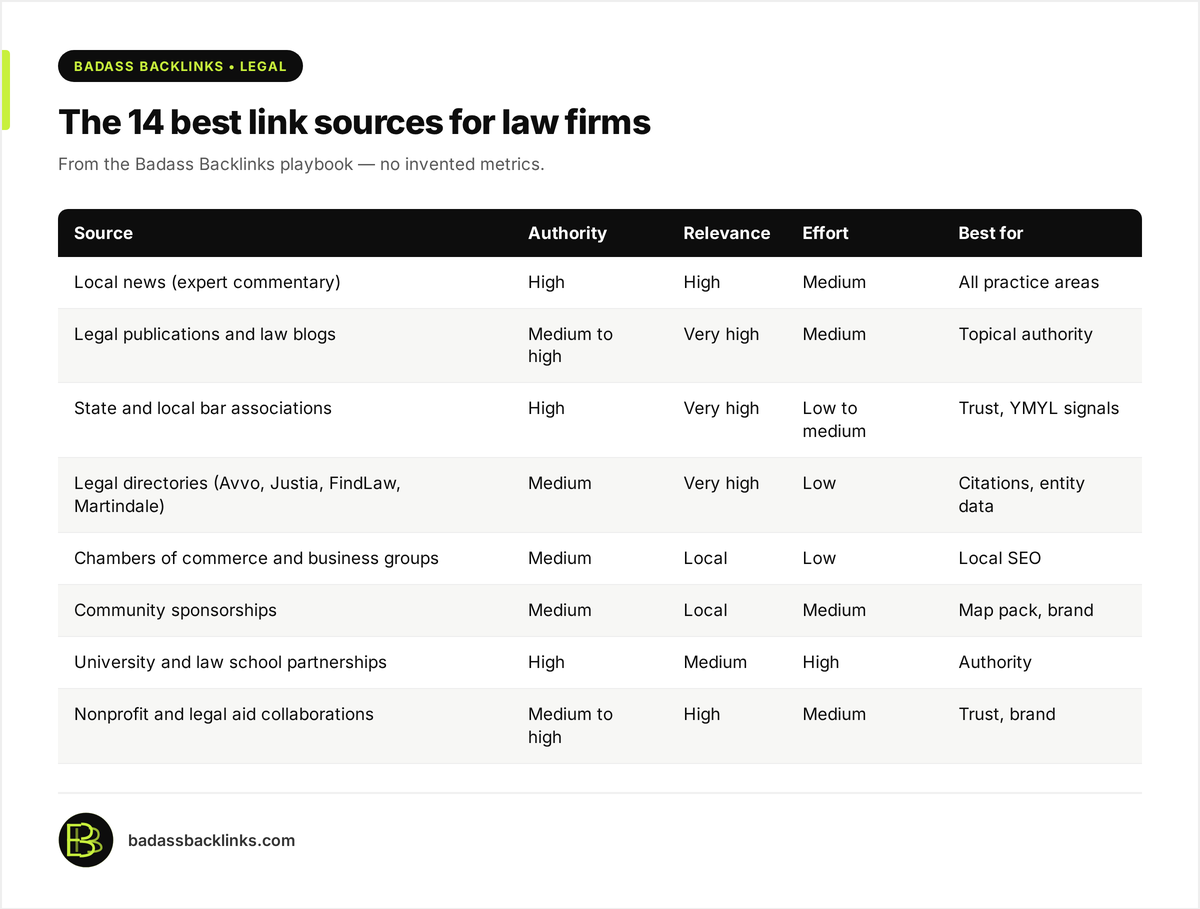
The best link sources for law firms are local news, legal publications, bar associations, reputable legal directories, community sponsorships, university and nonprofit partnerships, podcasts, and data-led content that journalists cite. Here is how each works and what it is worth.
| Source | Authority | Relevance | Effort | Best for |
|---|---|---|---|---|
| Local news (expert commentary) | High | High | Medium | All practice areas |
| Legal publications and law blogs | Medium to high | Very high | Medium | Topical authority |
| State and local bar associations | High | Very high | Low to medium | Trust, YMYL signals |
| Legal directories (Avvo, Justia, FindLaw, Martindale) | Medium | Very high | Low | Citations, entity data |
| Chambers of commerce and business groups | Medium | Local | Low | Local SEO |
| Community sponsorships | Medium | Local | Medium | Map pack, brand |
| University and law school partnerships | High | Medium | High | Authority |
| Nonprofit and legal aid collaborations | Medium to high | High | Medium | Trust, brand |
| Podcasts and webinars | Medium | High | Medium | Brand mentions |
| Original data studies | High | High | High | Digital PR |
| Resource page inclusion | Medium | High | Medium | Guides, checklists |
| Broken link replacement | Varies | High | Medium | Evergreen legal guides |
| Unlinked mentions | Varies | High | Low | Firms already in the news |
| Guest articles on business and niche sites | Medium | Medium to high | Medium | Practice area pages |
1. Local news and expert commentary
Journalists need quotes on new laws, court decisions and seasonal risks (holiday drink driving, storm insurance claims, school year custody). A responsive partner who can comment within hours earns links from local and regional outlets that competitors cannot buy.
2. Legal publications and law blogs
Contributing practical articles to legal trade publications and established law blogs builds topical relevance. Pitch topics that help other lawyers or informed readers, not thinly disguised ads.
3. Bar associations
Member directories, section newsletters, CLE speaking pages and committee pages often link to member firms. They are among the most trusted signals in the legal niche.
4. Legal directories
Avvo, Justia, FindLaw, Martindale-Hubbell, Super Lawyers and practice-specific directories supply citations and entity data. Most links are nofollow or low-weight, so treat them as foundation and trust, not ranking drivers. Paid upgrades are advertising; buy only where the directory sends real enquiries.
5. Chambers of commerce and business associations
Membership pages are simple, local and relevant. They reinforce your firm’s location for map pack queries.
6. Community sponsorships
Youth sports teams, charity runs, school events and local festivals usually list sponsors with links. Pick causes connected to your practice areas: road safety for PI firms, family charities for family law.
7. University and law school partnerships
Guest lectures, clinic support and career events can earn links from .edu pages. Be careful with “scholarship link building”: thousands of firms created token scholarships purely for links, and many universities now strip or nofollow them. Do it only if the scholarship is real and you would fund it anyway.
8. Nonprofit and legal aid collaborations
Pro bono work with legal aid organisations often comes with partner listings and press coverage.
9. Podcasts and webinars
Guesting on business, personal finance, real estate or HR podcasts earns show notes links and brand mentions.
10. Original data studies
Analyse public data (local crash reports, court filing trends, divorce rates by county) and publish it as a clear study. Data stories are what local and national journalists link to.
11. Resource pages
Victim support, small business and senior resource pages link to useful guides. A plain-English “what to do after a car accident in [state]” checklist is a strong asset.
12. Broken link replacement
Find dead links on legal resource pages and offer your up-to-date guide as a replacement.
13. Unlinked mentions
If your firm or attorneys are mentioned in news without a link, a polite request often converts the mention.
14. Guest articles on related business sites
Employment lawyers writing for HR sites, real estate lawyers for property sites, business lawyers for startup sites: relevant audiences, natural links.
Free, no obligation
Find out why competitors outrank your firm
We map the referring domains of the top five firms for your practice areas and city, and show the exact link and citation gaps to close.
Get a free law firm link auditPractice areas
Link building strategy by practice area
Different practice areas attract different linking audiences, so the campaign should follow the client’s journey.
| Practice area | Best link angles | Example assets |
|---|---|---|
| Personal injury | Road safety, local news, medical and insurance sites | Crash hotspot map, accident checklist |
| Family law | Parenting, mental health, financial planning sites | Custody schedule templates, divorce cost guide |
| Criminal defense | Local news, civil rights and community groups | Know-your-rights guides, court process explainers |
| Immigration | Community organisations, diaspora media, universities | Visa timeline tracker, document checklists |
| Employment | HR, recruitment and small business publications | Employee rights guides, policy templates |
| Estate planning | Personal finance, senior care, accountants | Probate timeline, will checklist |
| Business and corporate | Startup, SaaS and finance publications | Contract templates, entity comparison |
| Real estate law | Brokers, mortgage and property sites | Closing cost guide, lease review checklist |
How to run it
How to build links for a law firm: a 9-step campaign
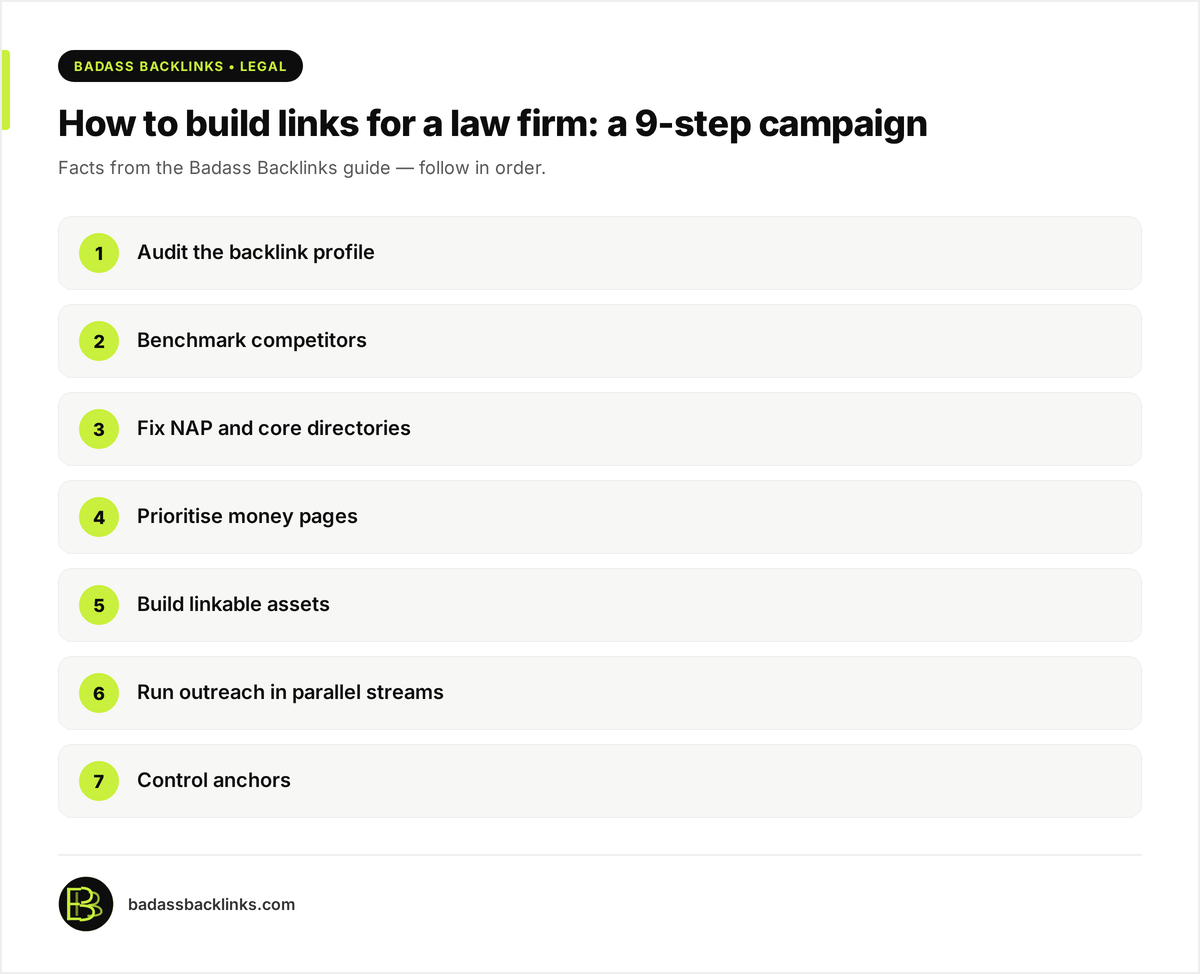
Start with an audit and citation clean-up, choose the pages that drive cases, build linkable assets, then run local, legal and PR outreach at a steady pace while tracking rankings and enquiries.
- Audit the backlink profile. List referring domains, anchors and toxic links. Our law client had 12 low-quality links from a previous VA plus expired domain redirects.
- Benchmark competitors. For each practice area and city, record the referring domains of the top five firms and where their best links come from.
- Fix NAP and core directories. Make name, address and phone identical everywhere; claim Avvo, Justia, FindLaw and your bar directory; complete your Google Business Profile categories.
- Prioritise money pages. Practice area plus city pages usually convert best. Do not send every link to the homepage.
- Build linkable assets. One data study, one checklist and one local resource per priority practice area.
- Run outreach in parallel streams. Local news and PR, legal publications, community and sponsorships, resource and broken link outreach.
- Control anchors. Lead with firm name and natural phrases; keep exact-match anchors rare.
- Interlink. Make sure blog posts that earn links pass equity to the relevant practice area pages.
- Measure monthly. Rankings by practice area and city, map pack positions, calls and form fills, and new referring domains versus competitors.
Case study: page three to page one in nine months
| Metric | Before | After nine months |
|---|---|---|
| Domain rating | 24 | 39 |
| Organic visits per month | 2,850 | 5,100 (+79%) |
| Keywords in top 10 | 4 | 19 |
| Links built | 82 (niche edits and citations) | |
| Penalties | None |
Full details are in our law firm link building case study.
Anchors
Anchor text strategy for law firm links
Lead with your firm name and natural phrases, use partial-match practice area phrases sparingly, and keep exact-match anchors rare. Over-optimised anchors are one of the clearest footprints of paid link schemes.
Google’s spam policy explicitly mentions guest posting campaigns with keyword-rich anchor text links. Law firms are especially exposed because the commercial phrases (“truck accident lawyer Dallas”) are obvious. The safest profile looks like the one a well-known firm earns naturally: mostly its name, its attorneys’ names, its URL and descriptive phrases.
| Anchor type | Example | Suggested share |
|---|---|---|
| Branded | Smith & Lane Law | 35% to 50% |
| Attorney name | Jane Smith, Esq. | 5% to 10% |
| Naked URL | smithlane.com | 10% to 15% |
| Natural or generic | this guide, the firm’s website | 10% to 20% |
| Partial match | Dallas injury attorneys at Smith & Lane | 10% to 15% |
| Exact match | truck accident lawyer Dallas | Under 5% |
These shares are planning guidance from our campaigns, not a Google rule. Compare against the top firms in your market and stay within their natural range. Our anchor text guide explains the method in detail.
Budget
How much does link building cost for lawyers?
Most law firms invest $1,500 to $5,000 a month in link building; competitive markets such as personal injury in large US metros often need more. Individual legal-niche placements typically cost more than general links because quality legal publishers are scarce.
Market-wide, PressWhizz’s analysis of 22,703 orders found an average of $161.25 per placement and a median of $112, while Editorial.Link’s survey found SEOs consider $508.95 an acceptable price for one high-quality link. Legal placements sit in the upper half because of YMYL scrutiny and editorial standards.
| Firm type | Typical monthly links | Typical monthly budget | Time to page one movement |
|---|---|---|---|
| Solo or small firm, smaller city | 4 to 8 | $1,000 to $2,000 | 4 to 6 months |
| Mid-size firm, mid-size metro | 8 to 15 | $2,000 to $4,000 | 5 to 9 months |
| PI or multi-office firm, major metro | 15 to 30+ | $4,000 to $10,000+ | 9 to 18 months |
These are planning ranges from our campaigns, not quotes. The audit sets the real number based on the gap to the firms above you.
Estimate your law firm link budget
Estimated monthly investment:
Uses $250 to $700 per legal-niche editorial link. PR-led campaigns and directory upgrades are priced separately.
Get an exact quoteMap pack
How links support the Google map pack for law firms
Map pack rankings rely on relevance, distance and prominence; links, citations and reviews feed prominence. Locally relevant links from news, chambers, sponsorships and community sites help your Google Business Profile as well as your website.
Google’s own local ranking help page says prominence is based on information Google has about a business from across the web, such as links, articles and directories, and that review count and score factor in. For multi-office firms, each office needs its own location page, consistent citations and local links pointing to that page, not a single “locations” page.
- Create one well-built location page per office, with local proof (court, community, case results where permitted).
- Build citations for each office address separately and keep them identical.
- Earn at least a handful of genuinely local links per office: chamber, sponsorship, local news, local nonprofit.
- Link the Google Business Profile to the matching location page, not the homepage.
- Encourage reviews within your bar’s rules on testimonials.
DIY, in-house or agency?
| Option | Works when | Limits |
|---|---|---|
| Do it yourself | Solo firm with time for PR and community work | Slow; hard to scale outreach |
| Marketing hire | Firm with several offices and a content programme | Needs publisher relationships and tools |
| Specialist agency | Competitive markets, fast catch-up needed | Must vet for link farms and compliance |
Many firms combine all three: attorneys handle community and bar relationships, a marketer manages content, and an agency runs outreach and digital PR. If you want hands-off delivery, see our law firm backlink packages. Related reading: lawyer backlinks explained, digital PR link building and what link building costs.
Buyer guide
How to choose a law firm link building agency
Hire a provider that can show live legal placements, guarantees the traffic, topic and country of every site in writing, understands your bar’s advertising rules, and reports on cases and enquiries rather than link counts.
The legal niche attracts vendors selling “law firm link packages” built on the same low-quality guest post sites they sell to every other niche. Those links are cheap because the sites accept anything, and that is also why they carry risk. Use these questions in every sales call:
- Show me five legal placements from the last 90 days. Open them and ask whether a prospective client or journalist would respect that site.
- Will I know what kind of sites I am getting? You should: ask for the traffic, topic and country each site must meet, guaranteed in writing.
- Who writes the content, and can our attorneys review it? Legal content needs accuracy and must not make claims your rules prohibit, such as guaranteed outcomes or unqualified “specialist” language.
- How do you handle paid placements? Look for an answer that covers Google’s rel=”sponsored” guidance and ABA Model Rule 7.2, not a claim that paid links are invisible.
- What anchor mix will you use? It should be led by the firm name and natural phrases.
- Which pages will links target, and why? A good provider ties each link to a practice area and city page with a ranking goal.
- What happens if a link disappears? Expect a written replacement policy covering at least six months.
- How will you report results? Rankings, map pack visibility and enquiries, alongside live URLs.
Also check contract terms. Month-to-month or short initial terms let you judge quality before committing. Be wary of anyone guaranteeing first-page rankings for competitive terms like “personal injury lawyer” in a large city; nobody controls Google, and such guarantees usually come with conditions that make them meaningless.
Finally, ask how the provider will coordinate with your other marketing. Link building works best when it supports a plan: the practice area pages are strong, the Google Business Profile is complete, intake is ready to answer calls, and the firm’s attorneys are available for occasional media quotes. If you want those pieces handled together, our SEO for lawyers service covers on-page, local and links in one programme.
Avoid these
Eight link building mistakes law firms make
The most common lawyer link building mistakes are buying cheap directory bundles, overusing exact-match anchors and ignoring bar advertising rules. Each mistake below includes the fix we apply.
- Buying “lawyer guest post” packages from link farms. If a site publishes casino, CBD and law content side by side for a fee, it adds risk, not trust.
- Exact-match anchors everywhere. “Best car accident lawyer Houston” fifty times is a footprint.
- Directory overload. Hundreds of low-quality directories add nothing after the core legal and local ones.
- Fake scholarships. Many universities nofollow or remove them, and they invite scrutiny.
- Link exchanges between firms. Excessive exchanges are named in Google’s spam policy.
- Ignoring compliance. Testimonials, results claims and “specialist” language can breach advertising rules; review content before it is published.
- Sending every link to the homepage. Practice area pages win cases.
- Quitting at month three. Legal SEO compounds; most gains come later.
Need help beyond links? See our full-service SEO for lawyers and link building for lawyers service page.
Reporting
How to measure law firm link building
Measure cases, not links: track signed cases and qualified enquiries from organic search first, then the leading indicators that predict them.
| Metric | Why it matters | How often |
|---|---|---|
| Signed cases and consultations from organic and map pack | The only metric partners care about | Monthly |
| Calls and form fills on practice area pages | Early revenue signal | Monthly |
| Rankings per practice area and city | Shows where links are working | Weekly or monthly |
| Map pack position across a city grid | Local visibility by neighbourhood | Monthly |
| Referring domains vs top five competitors | Closes the authority gap | Monthly |
| Brand mentions and AI answer inclusion | Visibility beyond blue links | Quarterly |
Use call tracking with dynamic numbers on the website, tag Google Business Profile links with UTM parameters, and ask intake staff to record how each client found the firm. Attribution in legal marketing is messy because clients often research on mobile and then call. A steady upward trend in practice area rankings, calls and consultations over six to twelve months is the signal you are looking for.
Linkable asset ideas that work for law firms
- Local crash and injury data: map public police or transportation data to show the most dangerous roads and intersections in your city.
- Statute of limitations tables: a clear, sourced table by claim type for your state, updated each year.
- Cost guides: “how much does a divorce cost in [state]” with real ranges and what drives them.
- Process explainers: visual timelines of a criminal case, probate or a visa application.
- Templates and checklists: evidence checklists after an accident, documents to bring to a first consultation.
- Annual surveys: commission a small public survey on a legal topic that local media will cover.
Each asset should live on your site, be reviewed by an attorney, carry the date it was last updated, and link internally to the relevant practice area page so the authority it earns flows to the pages that sign cases.
Expert insight
Expert insight on lawyer link building
The quotes below are verbatim public statements, linked to the original source. We have not interviewed these people; the case study figures are our own client results.
“Google uses links as a signal when determining the relevancy of pages and to find new pages to crawl.”
Google Search Central, Link best practices for Google
“Mark links that are advertisements or paid placements (commonly called paid links) with the sponsored value.”
Google Search Central, Qualify your outbound links
From our case study data
Law firm case study: 82 links over nine months took a regional US firm from DR 24 to DR 39, organic traffic from 2,850 to 5,100 visits a month (+79%) and keywords in the top 10 from 4 to 19. Read the full case study
Conclusion
The bottom line on lawyer link building
Lawyer link building works when every link would make sense to a prospective client: local press, legal publications and community organisations. Combine that relevance with clean anchor text and bar-compliant tactics and lawyer link building compounds over time.
Quick answers
Quick answers about lawyer link building
Short, direct answers to the questions people ask search engines and AI assistants about lawyer link building.
How do law firms get backlinks?
Law firms get backlinks from local news coverage, bar association pages, legal directories, scholarships, guest articles on legal publications and expert commentary for journalists.
Is it ethical for a lawyer to pay for links?
Lawyers should check their state bar rules on paying for recommendations before paying for any placement. Paid placements should also carry rel=”sponsored” under Google guidelines.
How many backlinks does a law firm website need?
The number of backlinks a law firm needs depends on the firms already ranking for its target keywords. Compare referring domains for the top three local results and close the gap with relevant links.
Do legal directories still help law firm SEO?
Established legal directories still help with citations and some referral traffic, but they rarely move rankings on their own.
How long does lawyer link building take to work?
In our law firm case study, measurable growth came over a nine-month campaign of 82 links.
What is the best link for a personal injury lawyer?
The best link for a personal injury lawyer is usually an editorial mention from a local news site or a respected legal publication that covers the firm’s practice area.
Questions
Frequently asked questions
Does link building work for law firms?
Yes. Legal keywords are competitive and YMYL, so links from trusted legal and local sites are one of the strongest signals separating firms on page one from those on page two. Our regional law firm client moved from DR 24 to DR 39 and grew organic traffic 79% in nine months.
How many backlinks does a law firm need?
Enough to match the firms ranking above you for each practice area and city. In our case study the top competitors had 85 to 140 referring domains while the client had 23. Benchmark your top five competitors to set a target.
Is buying links ethical for lawyers?
Paying someone to recommend your services conflicts with ABA Model Rule 7.2(b). Disclosed advertising, such as a labelled sponsored article or a paid directory listing, is generally treated differently. Rules vary by jurisdiction, so confirm with your bar.
Are legal directories worth it?
Core directories such as Avvo, Justia, FindLaw, Martindale and your bar directory are worth it for citations and trust. Beyond those, extra directories add little ranking value.
How long does link building take for a law firm?
Expect early movement in three to four months and solid page one gains in six to twelve months, longer for personal injury in major metros.
How much does law firm link building cost?
Most firms invest $1,500 to $5,000 a month; competitive PI firms in large cities often spend $4,000 to $10,000+.
Are scholarship links still worth it?
Only if the scholarship is genuine. Many universities now remove or nofollow scholarship links created purely for SEO.
Do backlinks help law firms appear in AI answers?
Yes, indirectly. Ahrefs found branded web mentions correlate most strongly with AI Overview visibility, so being named on credible local and legal sites helps.
References
Sources
Every statistic on this page links back to the original publisher below. Figures were checked on 24 October 2026.
- Clio, 2019 Legal Trends Report: Survey of 2,000 US consumers: 57% searched for a lawyer on their own; 17% used a search engine and 17% visited a lawyer’s website. www.clio.com/wp-content/uploads/2019/10/2019-Legal-Trends-Report.pdf
- Google Search Quality Rater Guidelines: Defines YMYL topics, including financial and legal topics, and applies the highest Page Quality standards to them. static.googleusercontent.com/media/guidelines.raterhub.com/en/en/searchqualityevaluatorgui
- American Bar Association, Model Rule 7.2: A lawyer shall not give anything of value to a person for recommending the lawyer’s services, except listed exceptions such as the reasonable cost of advertisements. www.americanbar.org/groups/professional_responsibility/publications/model_rules_of_profess
- Google Search Central, Spam policies for Google web search: Defines link spam, including buying or selling links that pass ranking credit, excessive link exchanges and large-scale guest posting campaigns with keyword-rich anchors. developers.google.com/search/docs/essentials/spam-policies
- BadAss Backlinks, Law firm link building case study: Regional US law firm: DR 24 to DR 39, organic traffic 2,850 to 5,100 per month, 82 links over nine months. badassbacklinks.com/backlink-case-studies/law-firm-link-building-case-study
- Ahrefs, AI Overview brand visibility factors (75K brands): Branded web mentions had a 0.664 correlation with AI Overview visibility, branded anchors 0.527, backlinks 0.218. ahrefs.com/blog/ai-overview-brand-correlation
- Ahrefs, AI Overviews reduce clicks by 34.5%: 300,000 keywords; position-one CTR was 34.5% lower when an AI Overview appeared (March 2025 data). ahrefs.com/blog/ai-overviews-reduce-clicks
- Google Search Central, Creating helpful, reliable, people-first content: Explains E-E-A-T and that trust is weighted most heavily for YMYL topics. developers.google.com/search/docs/fundamentals/creating-helpful-content
- Ahrefs, Search Traffic Study (2023 update): 96.55% of roughly 14 billion pages get zero Google traffic; only 2,997 of about 20 million pages with no referring domains get 1,000+ monthly visits. ahrefs.com/blog/search-traffic-study
- Google Search Central, Qualify your outbound links: rel=”sponsored” for paid or sponsored links, rel=”ugc” for user-generated content, rel=”nofollow” otherwise. developers.google.com/search/docs/crawling-indexing/qualify-outbound-links
- Ahrefs, Update: AI Overviews reduce clicks by 58%: Follow-up using December 2025 data found the CTR reduction had grown to 58%. ahrefs.com/blog/ai-overviews-reduce-clicks-update
- PressWhizz, Link Building Pricing Report 2026: 22,703 completed placements worth $3.66M; average $161.25, median $112; casino $252, sports $246 and finance $221 among the most expensive niches. presswhizz.com/case-studies/link-building-pricing-report
- Editorial.Link, Link Building Statistics survey: 518 SEO professionals surveyed; $508.95 average acceptable price for one high-quality link; 80.9% expect costs to rise. editorial.link/link-building-statistics
- Google Business Profile Help: local ranking: Relevance, distance and prominence; prominence uses links, articles, directories and reviews.. support.google.com/business/answer/7091