BadAss Backlinks · Real Estate SEO · Updated October 2026
How to Get Backlinks for a Real Estate Website (2026 Playbook)
The best way to get backlinks for a real estate website is through local sources: news, community organisations, market reports, neighbourhood guides and partner businesses. Those local links help an agent rank for area searches that portals do not fully own.
TL;DR
- Real estate link building is earning links to an agent, brokerage or property site’s area and listing pages from local and property websites.
- Buyers start online: in NAR data, 46% of buyers’ first step was looking online for properties and 52% found the home they bought online.
- Big portals such as Zillow, Realtor.com, Rightmove and Domain.com.au dominate listing searches, so independent sites win on neighbourhood expertise.
- Local links (chambers, sponsorships, home service partners, local news) beat generic real estate guest posts.
On this page
Real estate link building
What do you need?
Local and property links for agents, brokerages and property sites.
- Local and community links
- Property and home publications
- Area pages that rank
Guest posts from $85 and niche edits from $69 per link. Monthly plans optional.
See real estate link building
Real estate SEO is a fight against portals. Zillow, Realtor.com, Rightmove and Domain.com.au own most listing searches, with link profiles no agent will match. The way through is local: neighbourhood expertise, community relationships and local media. That is also where the best links are.
This playbook covers the link sources that work in property, the steps we use and how to measure results. For done-for-you campaigns, see our real estate backlinks service.
Definition
What is real estate link building?
Real estate link building is the process of earning links from local, community and property websites to an agent’s, brokerage’s or property business’s website, so its area pages, listings and agent profiles rank in local search.
The audience is online first. The National Association of Realtors found 46% of buyers’ first step was looking online for properties, 52% found the home they bought online, and the typical search lasted 10 weeks. That is ten weeks of searches like “best neighbourhoods in [city] for families” where an expert local site can win.
Context
Why link building is different in real estate
Link building is different in real estate because portals dominate broad searches, so agents win with local links and neighbourhood pages rather than national volume.
Three things make property different. First, portals dominate listing queries, so independent sites should target area and advice queries the portals serve poorly. Second, everything is local: a link from a city lifestyle blog beats a national real estate blog for a local agent. Third, the industry is relationship-driven, and those relationships (lenders, inspectors, movers, builders) are natural link partners.
Real estate also touches YMYL territory: buying a home is one of the largest financial decisions most people make. Google’s guidance on helpful, reliable content applies, and trust signals such as licences, reviews and named agents matter.
Reader poll
Your vote is saved in this browser only. No live tally is stored on a server, so results show votes cast on this device.
Link sources
Link sources that only work in real estate
Link sources that only work in real estate: property portals, MLS and broker networks, REALTOR and agent associations and home service partners.
| Source | Examples | Notes |
|---|---|---|
| Property portals | Zillow, Realtor.com (US); Rightmove (UK); Domain.com.au (AU) | Profiles, reviews and leads; links often nofollow |
| MLS and broker networks | MLS member pages, franchise office directories | Access depends on membership |
| REALTOR and agent associations | Local REALTOR association directories, state associations | Trusted, local, relevant |
| Home service partners | Mortgage brokers, inspectors, movers, stagers, builders | Natural reciprocal relevance; avoid link-swap schemes |
| Neighbourhood and community sites | HOA sites, community associations, local event pages | Hyper-local relevance |
| Local news property sections | Market updates, new development coverage | Expert comment and data |
| Relocation resources | Employer relocation pages, university housing pages | Strong local authority |
Priorities
The best links for real estate, in priority order
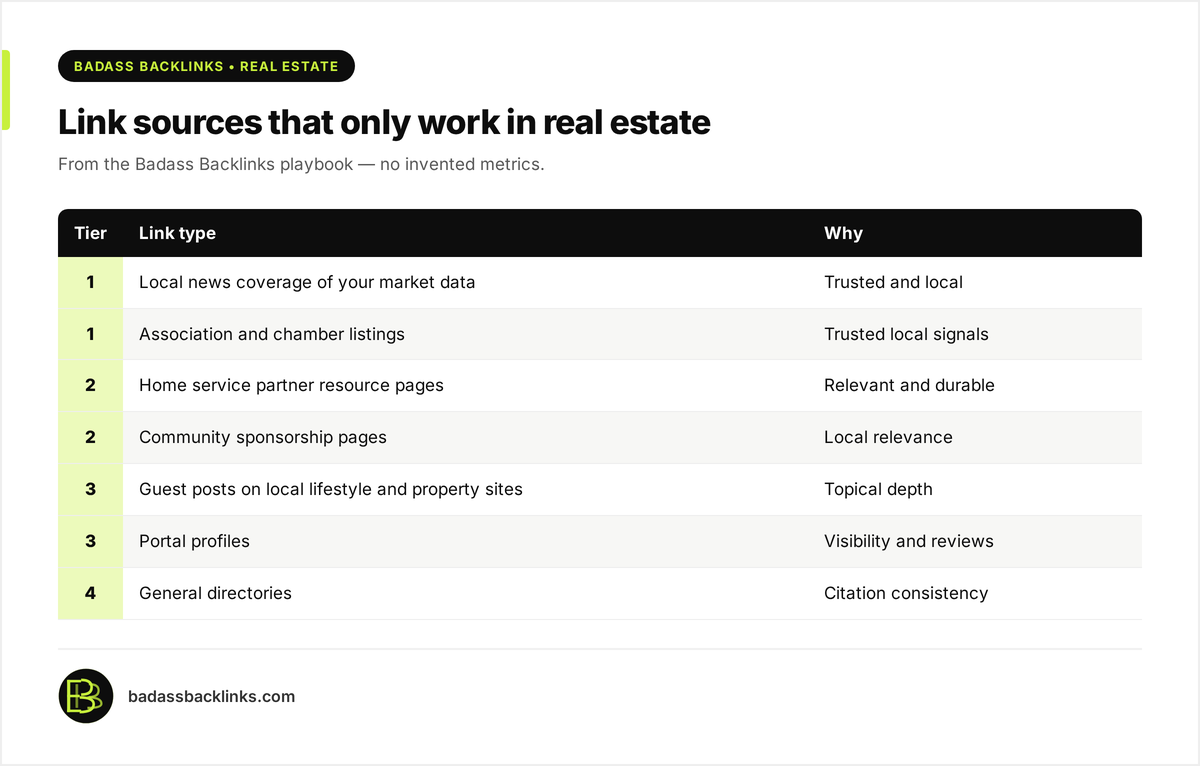
The best links for real estate, in priority order: local news coverage of your market data, association and chamber listings, home service partner resource pages and community sponsorship pages.
| Tier | Link type | Why |
|---|---|---|
| 1 | Local news coverage of your market data | Trusted and local |
| 1 | Association and chamber listings | Trusted local signals |
| 2 | Home service partner resource pages | Relevant and durable |
| 2 | Community sponsorship pages | Local relevance |
| 3 | Guest posts on local lifestyle and property sites | Topical depth |
| 3 | Portal profiles | Visibility and reviews |
| 4 | General directories | Citation consistency |
How to
How to get backlinks for a real estate website: 7 steps
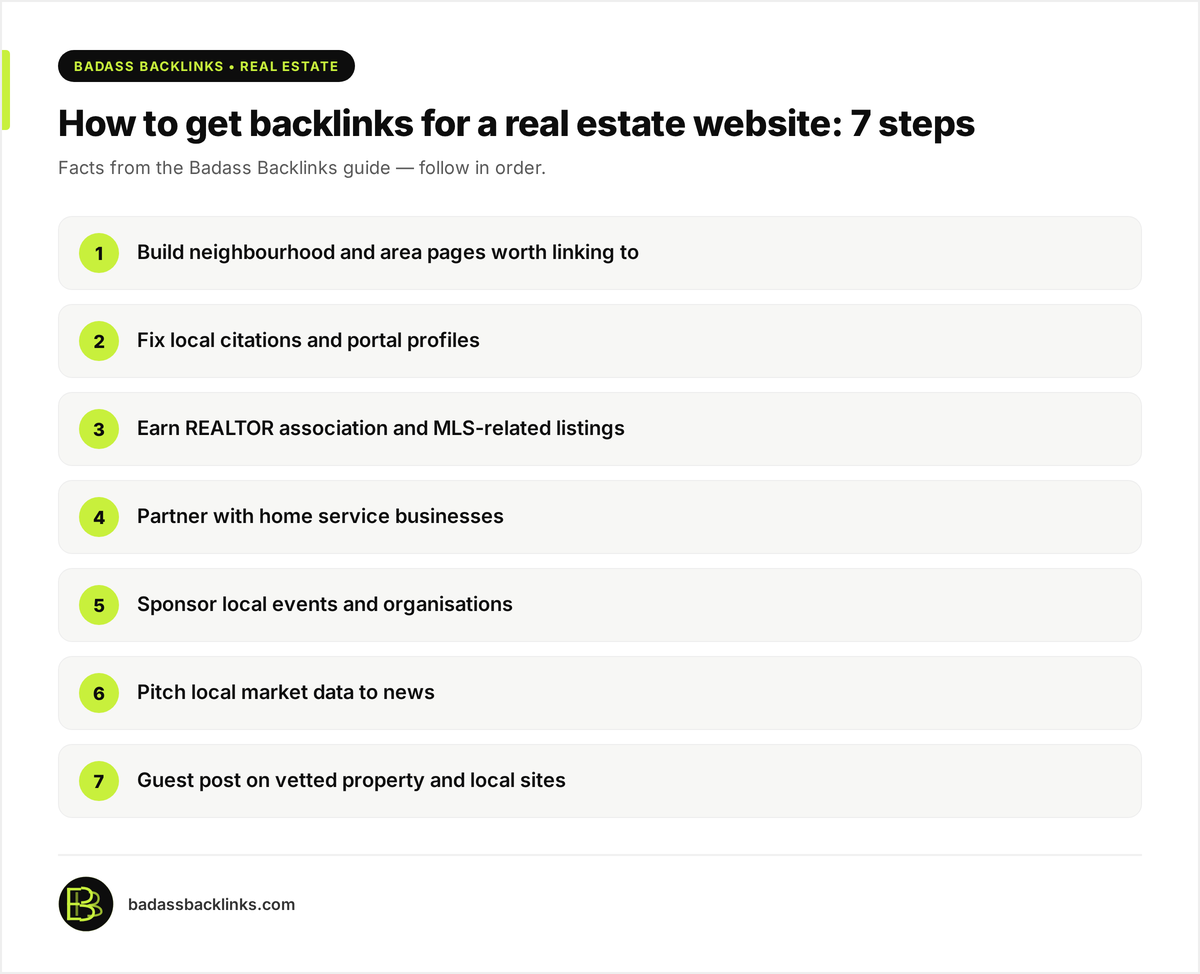
In short: build neighbourhood and area pages worth linking to, fix local citations and portal profiles, earn REALTOR association and MLS-related listings and partner with home service businesses, with every step explained below.
- Build neighbourhood and area pages worth linking to. Schools, commute times, amenities, price trends and photos. These are the pages other sites link to.
- Fix local citations and portal profiles. Consistent name, address and phone across Google Business Profile, portals and directories.
- Earn REALTOR association and MLS-related listings. List with local REALTOR associations, broker networks and franchise directories.
- Partner with home service businesses. Create a genuine “trusted local partners” resource and ask partners to do the same where it helps their clients.
- Sponsor local events and organisations. Little leagues, school fairs, charity events. Choose causes you support.
- Pitch local market data to news. Quarterly price, rent or days-on-market analysis by neighbourhood. Journalists want local data: 42% in the Muck Rack survey want original data or research.
- Guest post on vetted property and local sites. Use the filter in our guest posting guide; BuzzStream found 96.2% of guest post sites are low quality.
Real estate link building
Want local links that win area searches?
We build community, partner and editorial links for agents, brokerages and property businesses, pointed at the pages that bring in clients.
See real estate backlinksAssets
Content that earns links in real estate
Content that earns links in real estate: neighbourhood guides, local market reports, buyer and seller tools and relocation guides.
| Asset | Example | Links from |
|---|---|---|
| Neighbourhood guides | Living in [area]: schools, commute, prices | Relocation pages, community sites |
| Local market reports | Quarterly prices and days on market by area | Local news, bloggers |
| Buyer and seller tools | Affordability calculator, moving checklist | Resource pages |
| Relocation guides | Moving to [city] for work | Employers, universities |
| New development trackers | What is being built where | Local news, community groups |
Use public data where you can, and say where it came from. Neighbourhood statistics from census and local government sources are credible and free.
Deep dive
A monthly link checklist for agents and brokerages
Most real estate link building fails because it is treated as a project rather than a habit. Agents already meet the people who can link to them: lenders, inspectors, builders, schools, charities and local reporters. The checklist below turns those relationships into links without extra budget.
- Use public data. Local planning applications, school catchment changes and public sales records make reliable story hooks. Always cite the source.
- Credit the people you work with. Featuring a builder, designer or stager on your site often leads them to link back to the feature.
- Keep listings off the target list. Individual listing pages expire. Point links at neighbourhood, buying and selling guides that last.
- Brokerage sites. Agent profile pages on a brokerage site should link to the agent’s own site where policy allows, and vice versa.
Four small actions a month adds up to dozens of relevant local links a year, and every one is a link a competitor cannot simply buy.
Deep dive
Portals vs your own site: where links help
Links help most on your own site, because portals own the broad listing searches while your area pages can win neighbourhood searches and keep the leads.
| Portals (Zillow, Realtor.com, Rightmove, Domain.com.au) | Your own site | |
|---|---|---|
| Strength | Listing searches, huge authority | Neighbourhood expertise, agent trust |
| Links you can earn | Profile links, often nofollow | Editorial and local links |
| What to rank for | Not worth competing on raw listings | Area guides, market updates, agent and office pages |
| Lead ownership | Portal-controlled | Yours |
Use portals for visibility and reviews, but point your link building at the pages you own. Every link to your neighbourhood guide builds an asset the portal cannot take back.
Deep dive
Link building for new developments and commercial property
Developers and commercial agents face a different problem from residential agents: fewer transactions, larger budgets and a B2B audience. The best link sources follow from that.
- Planning and regeneration coverage. Local and trade press cover large schemes. Give them renders, timelines and a named spokesperson.
- Architects, contractors and consultants. Project pages on their sites usually link to the developer or agent. Ask for it at handover.
- Trade publications. Commercial property and construction titles publish market commentary from named experts.
- Investor and market reports. A short quarterly report on local rents, yields or vacancy, built on cited public data, gives journalists a reason to come back.
Keep the same rule as residential: point links at evergreen pages such as the development hub or area guide, not short-lived unit listings.
Compliance
Rules and risks for real estate links
The main rules and risks to respect are paid links, link-swap schemes with partners, anchor text and fair housing and advertising rules.
- Paid links. Google’s Google Search Central cover links bought to pass ranking credit; paid placements should be rel=”sponsored” per Google Search Central.
- Link-swap schemes with partners. Genuine partner resource pages are fine; excessive reciprocal exchanges are a listed spam pattern.
- Anchor text. “[City] real estate agent” on every link is an over-optimisation signal. The Ahrefs study found the median exact-match share among top-20 pages was 0%.
- Fair housing and advertising rules. Content about neighbourhoods must avoid steering language; check local fair housing and advertising rules.
- Duplicate listing content. IDX listing pages rarely earn links; do not build links to them at the expense of area pages.
First-hand
First-hand example: a local home services campaign
We have not yet published a real estate case study, so here is the closest first-hand example: a local home services brand competing in local SERPs, published as our home service brand case study.
The same principles apply to property: relevant local links, aged editorial placements and anchors kept natural. Results in real estate will depend on market competition and portal dominance in your area.
Budget
What real estate link building costs
There is no reliable public price list for niche link building, but several large datasets give useful benchmarks.
Published link cost benchmarks (USD)
Sources: Editorial.Link survey of 518 SEOs; BuzzStream guest post study of about 257,000 sites; Ahrefs outreach test; PressWhizz 2026 report on 22,703 placements.In our experience, local real estate links are often cheaper in cash and more expensive in time, because the best ones come from relationships rather than vendors. Digital PR teams most commonly report a cost per link of $300 to $500 in the BuzzStream report, and the Editorial.Link survey found 80.9% of SEOs expect link costs to rise. Cheap links are usually cheap because the site has no traffic: BuzzStream found 39.6% of guest post sites had zero organic traffic. Our pricing page explains how we scope campaigns.
Choosing help
Real estate link building agency vs in-house
Hire an agency when you need volume, vetted publisher relationships and speed; keep real estate link building in-house when you have writers, time and deep niche knowledge. The comparison below shows the trade-offs.
| Task | Best owner |
|---|---|
| Community sponsorships and partners | Agent or brokerage |
| Citations and portal profiles | In-house or agency |
| Local data PR | Agency with local media contacts |
| Guest posting | Agency |
| Neighbourhood content | Agents plus writer |
Agents know the neighbourhoods; agencies know outreach. The best campaigns use both. Check any agency’s Clutch reviews and ask for local placement examples.
Reporting
How to measure real estate link building
Measure real estate link building by rankings, organic traffic and conversions on the pages that receive links, not by link count alone. These are the metrics to track: rankings for area and neighbourhood keywords, local pack visibility, referring domains to area pages and leads from organic and referral.
| Metric | Why |
|---|---|
| Rankings for area and neighbourhood keywords | Where independent sites win |
| Local pack visibility | Calls and direction requests |
| Referring domains to area pages | Authority where it counts |
| Leads from organic and referral | The outcome |
| Citation consistency | Supports local rankings |
Avoid
7 real estate link building mistakes
The most common real estate link building mistakes are competing with portals on listing searches, neglecting neighbourhood pages, inconsistent citations across portals and directories and exact-match city anchors on every link. Each one is explained below with the fix.
- Competing with portals on listing searches.
- Buying national real estate guest posts with no local relevance.
- Neglecting neighbourhood pages.
- Inconsistent citations across portals and directories.
- Exact-match city anchors on every link.
- Excessive link swaps with partners.
- Measuring links instead of leads.
Expert insight
Expert insight on backlinks for a real estate website
The quotes below are verbatim public statements, linked to the original source. We have not interviewed these people; the case study figures are our own client results.
“Google uses links as a signal when determining the relevancy of pages and to find new pages to crawl.”
Google Search Central, Link best practices for Google
“Google’s automated ranking systems are designed to prioritize helpful, reliable information that’s created to benefit people, and not content that’s created to manipulate search engine rankings.”
Google Search Central, Creating helpful, reliable, people-first content
From our case study data
Home service brand case study: A 90-day local campaign built 84 links, lifted organic traffic from 3,100 to 9,680 visits a month and grew page-1 keywords from 7 to 26. Read the full case study
Conclusion
The bottom line on backlinks for a real estate website
Backlinks for a real estate website come from being part of the local community online. Publish local data, partner with local businesses and backlinks for a real estate website follow.
Quick answers
Quick answers about backlinks for a real estate website
Short, direct answers to the questions people ask search engines and AI assistants about backlinks for a real estate website.
What are the easiest backlinks for a real estate agent?
The easiest backlinks for a real estate agent come from local sponsorships, chamber of commerce listings, partner businesses and community groups.
Do links on Zillow or Realtor.com profiles help SEO?
Portal profile links help referral traffic and citations but pass limited ranking value to your own site.
What real estate content gets links?
Local market reports, neighbourhood guides and price or rent data get the most links in real estate.
Should a brokerage build links to agent pages?
A brokerage should build most links to area and listing-hub pages and link internally to agent pages.
How do I measure real estate link building?
Measure real estate link building by local rankings, organic leads and traffic to area pages.
Are paid real estate directories worth it?
Most paid real estate directories add little; keep the few that real buyers use.
Questions
Frequently asked questions
What is real estate link building?
Earning links from local and property websites to an agent, brokerage or property site’s pages, especially neighbourhood guides, area pages and agent profiles, so they rank for local searches.
How does real estate link building work?
Agents and brokerages combine local citations, association and portal profiles, community sponsorships, home service partnerships, local market data PR and vetted guest posts, then link internally to the pages that win clients.
Should I hire a real estate link building agency?
If you want consistent local and property links without spending agent time on outreach, yes. Vet any agency on the local sites it uses and check its Clutch reviews.
What do real estate link building services include?
Citation cleanup, local link building, neighbourhood content, data-led local PR, guest posting on property sites and reporting on local rankings and leads.
How do I get backlinks for real estate?
Publish neighbourhood guides, fix citations and portal profiles, join local associations and chambers, partner with home service businesses, sponsor community events and pitch local market data to journalists.
Do Zillow and Realtor.com profile links help SEO?
Portal profiles mainly help visibility, reviews and leads; many profile links are nofollow. They are worth maintaining, but local editorial links usually do more for rankings.
References
Sources
Every statistic on this page links back to the original publisher below. Figures were checked on 24 October 2026.
- National Association of Realtors, 2025 Profile of Home Buyers and Sellers (highlights): 46% of buyers’ first step was looking online for properties; 52% found the home they bought online; median search 10 weeks. www.nar.realtor/sites/default/files/2025-11/2025-profile-of-home-buyers-and-sellers-highli
- BadAss Backlinks, Home Service Brand Case Study: 90-day local campaign: 84 links live and indexed; organic traffic 3,100 to 9,680 visits a month (+212%); page-1 keywords 7 to 26; average position 22.4 to 13.8. badassbacklinks.com/backlink-case-studies/home-service-brand-case-study
- Ahrefs, Anchor Text study (384,614 pages): 384,614 pages ranking in the top 20 for 19,840 keywords; median share of exact-match anchors was 0% at every position; average Spearman correlation between exact-match anchors and rank 0.1436 (weak); notes most SEOs recommend about 1% to 5% exact match; Penguin affected about 3.1% of queries. ahrefs.com/blog/anchor-text
- Google Search Central, Spam policies for Google web search: Defines link spam, including buying or selling links that pass ranking credit, excessive link exchanges and large-scale guest posting campaigns with keyword-rich anchors. developers.google.com/search/docs/essentials/spam-policies
- Google Search Central, Qualify your outbound links: rel=”sponsored” for paid or sponsored links, rel=”ugc” for user-generated content, rel=”nofollow” otherwise. developers.google.com/search/docs/crawling-indexing/qualify-outbound-links
- BuzzStream, The Cost of Guest Posts, Based on 500k Sites (2026): About 257,000 guest post sites analysed: average vendor price $461, average direct price $295; 96.2% judged low quality; 39.6% had zero organic traffic; only 1.37% high quality; ecommerce niche average $341. www.buzzstream.com/blog/guest-post-costs
- Muck Rack, State of Journalism 2025: Survey of 1,515 journalists: 84% say at least some stories originate from pitches; 86% disregard irrelevant pitches; 42% want original data or research; 77% use AI tools. media.muckrack.com/documents/6.9.2025_state_of_journalism.pdf
- Google Search Central, Creating helpful, reliable, people-first content: Explains E-E-A-T and that trust is weighted most heavily for YMYL topics. developers.google.com/search/docs/fundamentals/creating-helpful-content
- Editorial.Link, Link Building Statistics survey: 518 SEO professionals surveyed; $508.95 average acceptable price for one high-quality link; 80.9% expect costs to rise. editorial.link/link-building-statistics
- Ahrefs, Should You Buy Backlinks: Average quoted price for a paid link insertion $361.44 (450 sites, nine niches); paid guest posts $77.80; only 12.6% of sites agreed to sell; cites Authority Hacker’s $83 average. ahrefs.com/blog/buy-backlinks
- PressWhizz, Link Building Pricing Report 2026: 22,703 completed placements worth $3.66M; average $161.25, median $112; casino $252, sports $246 and finance $221 among the most expensive niches. presswhizz.com/case-studies/link-building-pricing-report
- BuzzStream, State of Digital PR 2026: 150+ digital PR practitioners: 95.9% pitch data-led content; about 60% have monthly budgets under $10k; most common cost per link $300 to $500 (19.6%); 39.2% do not know their cost per link; 62.8% cite outdated journalist info; 60.8% say finding journalists is harder; 85.8% call backlinks the most effective outcome; 66.2% cite AI citations. www.buzzstream.com/blog/state-of-digital-pr