BadAss Backlinks · SaaS SEO · Updated October 2026
SaaS Link Building: Complete Guide
SaaS link building is earning backlinks from software review sites, integration partners, tech publications and comparison content to a software company website. SaaS brands need these links to rank product, feature and comparison pages against well-funded competitors.
TL;DR
- What it is: earning links and mentions to comparison, use case, feature and integration pages.
- Why now: buyers spend only 17% of buying time with suppliers (Gartner) and 29% start research with AI more than Google (G2).
- Top tactics: roundup inclusion, integration links, product-led tools, data PR, industry guest posts.
- Cost: typically $2,000 to $8,000 a month; judge it on pipeline, not link counts.
- Proof: our CRM client grew organic traffic 340% in six months with 128 links.
On this page
Free link audit
What do you need?
First authority for a new product
- Industry publications your buyers read
- Roundup and AI visibility focus
- Specs guaranteed or replaced
Guest posts from $85 and niche edits from $69 per link. Monthly plans optional.
1,200+ links delivered · 95% client retention
Get a free startup link audit
Written by Paul with input from BadAss Backlinks founder SVS, drawing on SaaS campaigns we have run and a review of the top 10 Google results for “SaaS link building” in October 2026.
The direct answer
What is SaaS link building?
SaaS link building is earning links and brand mentions from relevant software, business and industry websites to the pages that create pipeline: feature, use case, comparison, alternatives, integration and pricing pages, plus the guides that support them. It differs from general link building because SaaS buyers research across review sites, roundups and AI assistants, and links have to put your product in those conversations.
Software buying has moved online and self-directed. Gartner’s research on the B2B buying journey found buyers spend only 17% of their buying time meeting potential suppliers. The rest is independent research, much of it on search engines, review sites and now AI assistants. G2’s 2025 Buyer Behavior Report (1,169 B2B decision makers) found 79% say AI search has changed how they research, 29% start research with AI search more often than Google, and generative AI chatbots were the top source influencing vendor shortlists at 17.1%, ahead of software review sites at 15.1%.
That changes what a link is for. A SaaS link campaign in 2026 must do three jobs: lift rankings for high-intent pages, place the product in the “best X software” lists buyers and AI systems read, and earn the branded mentions that Ahrefs found correlate most with AI Overview visibility. This guide shows how, with data from our B2B SaaS CRM campaign.
The business case
Why SaaS companies need link building
SaaS keywords are dominated by well-funded competitors and review platforms with huge link profiles; without links, even excellent product pages rarely rank for commercial terms.
The SERP is crowded with high-authority players
For terms like “CRM for small business” or “project management software”, page one usually includes G2, Capterra, Forbes Advisor-style roundups and the category leaders. Your feature page competes with domains holding tens of thousands of referring domains. Backlinko’s study found the number one result had 3.8 times more backlinks than positions two to ten.
Content without links stays invisible
Many SaaS teams publish hundreds of blog posts and see little traffic. Ahrefs found 96.55% of pages get no Google traffic, with a lack of backlinks a leading reason. Our CRM client had good content but a link profile from a previous agency with 62 links, 36 of them toxic, 14 from PBNs, and 41% exact-match anchors.
Organic compounds; paid does not
Paid acquisition costs rise with competition, while ranking pages keep producing trials without per-click costs. A strong page that ranks for “[competitor] alternatives” can feed sales for years.
AI answers shortlist vendors
When buyers ask an assistant for the best tools in a category, the answer is assembled from pages that already rank and from roundups and reviews that mention brands. If you are missing from those sources, you are missing from the shortlist.
Targeting
Which SaaS pages should you build links to?
Prioritise pages closest to revenue: comparison and alternatives pages, use case and industry pages, core feature pages, then integration pages; support them with guides and free tools that earn links naturally and pass equity internally.
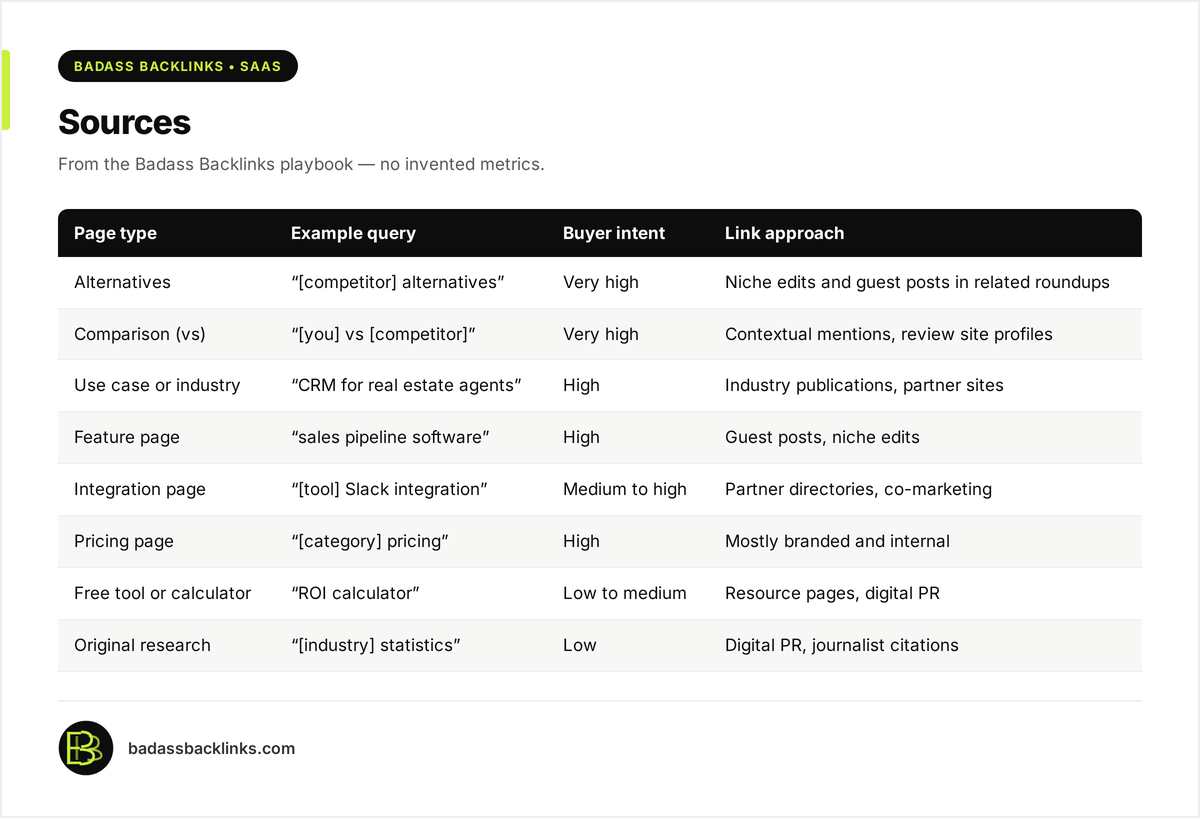
| Page type | Example query | Buyer intent | Link approach |
|---|---|---|---|
| Alternatives | “[competitor] alternatives” | Very high | Niche edits and guest posts in related roundups |
| Comparison (vs) | “[you] vs [competitor]” | Very high | Contextual mentions, review site profiles |
| Use case or industry | “CRM for real estate agents” | High | Industry publications, partner sites |
| Feature page | “sales pipeline software” | High | Guest posts, niche edits |
| Integration page | “[tool] Slack integration” | Medium to high | Partner directories, co-marketing |
| Pricing page | “[category] pricing” | High | Mostly branded and internal |
| Free tool or calculator | “ROI calculator” | Low to medium | Resource pages, digital PR |
| Original research | “[industry] statistics” | Low | Digital PR, journalist citations |
Free tools and research act as link magnets. They attract links that would never point at a feature page, and internal links pass that authority to the commercial pages. Map every linkable asset to two or three money pages it will link to.
Tactics
12 SaaS link building tactics that work in 2026
The highest-impact SaaS tactics are roundup inclusion, integration and partner links, product-led assets, data-led digital PR, founder and expert thought leadership, and targeted guest posts on industry publications.
1. Get included in “best [category] software” roundups
These pages rank for the highest-intent category terms and are heavily used by AI assistants. Contact the authors, offer a demo account, accurate feature and pricing details and screenshots. Where a listicle is a paid placement, it should be disclosed and its link marked as Google’s outbound link guidance asks.
2. Integration and marketplace listings
Every integration is a potential link: the partner’s marketplace listing, their docs, and co-written announcement posts. These are highly relevant and hard for competitors to copy.
3. Co-marketing with complementary tools
Joint webinars, reports and templates with non-competing tools in your buyers’ stack create links and mentions on both sides without a link exchange scheme.
4. Product-led assets
Free calculators, graders, template galleries and generators earn links from blogs and resource pages for years. The best ones solve a small job your product solves at scale.
5. Original data and benchmark reports
SaaS products sit on aggregated, anonymised usage data. Benchmarks such as “average response time by industry” are exactly what journalists and bloggers cite.
6. Founder and expert commentary
Journalists need expert quotes on trends in your category. Fast, specific commentary earns tier-one mentions.
7. Guest posts on industry publications
Write for the publications your buyers read, not generic tech blogs. A CRM should write for sales, real estate and agency publications. This was the core of our CRM campaign: 42 high-authority guest posts in sales and business publications.
8. Niche edits in existing roundups and guides
Adding a relevant mention to an already-ranking article about your use case shows impact quickly.
9. Podcast tours
Founders and product leaders on industry podcasts earn show notes links and branded mentions.
10. Customer stories on customer sites
Customers who publish case studies or “our stack” pages often link to tools they use.
11. Review platform profiles
G2, Capterra and similar profiles rarely pass much link equity, but they are among the most cited sources in AI answers and comparisons. Keep them complete and current.
12. Unlinked mentions and competitor gaps
Reclaim mentions of your brand without links, and study which sites link to two or more competitors but not you. Those are the warmest prospects.
Free, no obligation
See which roundups and sites link to your competitors
We build a competitor link gap report for your category: roundups you are missing from, integration partners linking to rivals, and publications covering your space.
Get a free SaaS link gap auditAssets
SaaS linkable assets: what earns links without paying for them
The SaaS assets that earn the most links are free tools, original benchmark data, templates, definitive glossaries, and honest comparison resources. Each should solve a real problem for your buyer and link internally to a commercial page.
Free tools and calculators
A small, focused tool often out-earns hundreds of blog posts. Think of an email subject line tester for an email platform, a payroll cost calculator for HR software, or a cap table simulator for equity management. Bloggers link to tools because they make their own articles more useful. Build the tool on its own URL, give it a short explanation and FAQ, and include a clear path to the full product.
Benchmark and state-of-industry reports
Aggregated, anonymised product data is the most defensible linkable asset a SaaS company owns because nobody else has it. Publish a headline number, a few charts, a methodology section and a downloadable summary. Pitch the findings to trade journalists and newsletter writers in your category. Refresh annually so the asset keeps earning links each year rather than going stale.
Templates and swipe files
Sales scripts, onboarding checklists, OKR templates, contract templates and project plans attract links from resource pages and “best templates” roundups. Gate the advanced version if you like, but keep a useful preview open so people can link to it.
Glossaries and definitive guides
Category glossaries earn links from writers who need a definition to point to. They also build topical authority that supports every commercial page in the cluster.
Statistics pages
Curated, sourced statistics pages on your category are cited constantly by bloggers and journalists. Keep sources primary, dates visible and numbers current; outdated stats pages lose links to fresher competitors. Our own link building statistics page follows this model.
Honest comparison resources
Fair comparison pages, including ones where a competitor wins for some use cases, get cited more than self-serving ones. They also rank better for “vs” and “alternatives” queries because they match what searchers want: an honest answer.
GEO
How link building gets your SaaS into AI answers
To appear when buyers ask ChatGPT, Perplexity, Gemini or Google AI Mode for the best tools, your product needs consistent, contextual mentions on the pages those systems draw from: ranking roundups, comparison articles, review platforms, documentation of partners and trusted industry media.
Ahrefs’ study of 75,000 brands found branded web mentions had a 0.664 correlation with AI Overview visibility, branded anchors 0.527 and plain backlinks 0.218. It is a correlation, but it fits what we see: assistants recommend brands that are described consistently across many credible sources. For SaaS, that means each placement should state who you are, what category you belong to and who you are best for, in plain language, close to your brand name.
Practical steps
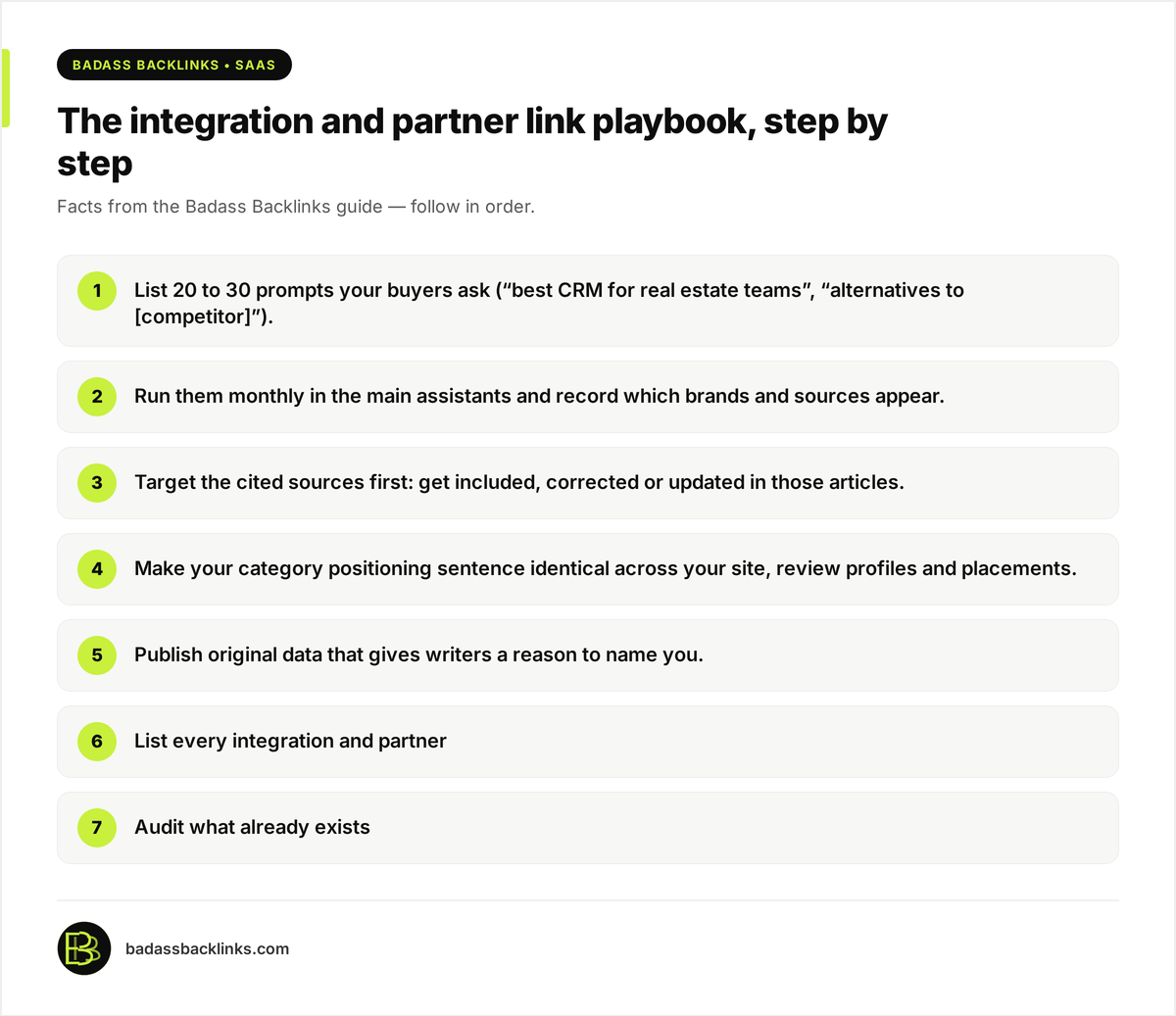
- List 20 to 30 prompts your buyers ask (“best CRM for real estate teams”, “alternatives to [competitor]”).
- Run them monthly in the main assistants and record which brands and sources appear.
- Target the cited sources first: get included, corrected or updated in those articles.
- Make your category positioning sentence identical across your site, review profiles and placements.
- Publish original data that gives writers a reason to name you.
Clicks from classic search are also shrinking for informational queries: Ahrefs measured a 34.5% lower click-through rate for the top result when an AI Overview appeared. Commercial pages and brand searches hold up better, which is one more reason to aim links at bottom-funnel pages.
How to vet a SaaS publisher in five minutes
- Organic traffic is real and stable or growing over 12 months, and comes from countries you sell in.
- The site covers your buyers’ topics, not everything from crypto to recipes.
- Recent articles have named authors and real editorial quality.
- Outbound links in recent posts are mostly to genuine resources, not a stream of casinos and essay mills.
- The site ranks for some keywords your buyers search.
- There is no “sponsored post price list” for every niche on the homepage.
If a site fails two or more of these checks, skip it whatever its domain rating. One relevant link from a publication your buyers actually read is worth more than five from generic tech blogs.
Partnerships
The integration and partner link playbook, step by step
Integration partners are the most relevant and most overlooked SaaS link source: every integration can produce a marketplace listing, a docs page, a co-written announcement and joint content, all from sites your buyers already trust.
Unlike paid placements, partner links are earned through a real business relationship, which places them clearly outside the link schemes described in Google’s spam policies, as long as you avoid systematic “you link to me, I link to you” arrangements with no user value. Here is the process we use.
- List every integration and partner. Include native integrations, Zapier or Make connectors, API partners, agencies and resellers, and technology alliances.
- Audit what already exists. For each partner, check whether their marketplace, docs, partner directory and blog mention and link to you. Many SaaS companies find half their integrations have no listing or an outdated one.
- Fix the listings. Submit complete listings with current descriptions, screenshots and a link to your dedicated integration page, not your homepage.
- Build a strong integration page on your site. Explain what the integration does, setup steps, use cases and FAQs. This is the page partners and users will link to, and it can rank for “[partner] [your category] integration” searches.
- Co-create launch content. A joint announcement, a how-to guide or a webinar recording earns links from both blogs and often from newsletters that cover the partner ecosystem.
- Run one deeper co-marketing project per quarter. A joint report, template pack or benchmark combining both companies’ data produces press-worthy material.
- Add partners to your outreach calendar. When either side publishes something relevant, cross-promote it where it genuinely helps readers.
International SaaS: localised pages need local links
If you sell in several countries, localised pages (for example a UK pricing page or a German-language product page) compete with local vendors and local review sites. Links from publications in that market and language signal relevance far better than more links from US tech blogs. Prioritise markets by revenue potential, localise the commercial pages properly, then build a small number of links from local industry media, local partners and local review platforms to each market’s key pages. We cover country-specific campaigns for the UK, US and other markets on request.
Stage
SaaS link building strategy by growth stage
Early-stage SaaS needs foundational authority on a few commercial pages; growth-stage SaaS needs scale across use cases and comparisons; enterprise SaaS needs brand-led PR and category ownership.
| Stage | Typical DR | Links per month | Focus |
|---|---|---|---|
| Pre-seed to seed | Under 20 | 5 to 10 | Homepage, 2 to 3 feature pages, review profiles, launch coverage |
| Series A to B | 20 to 50 | 10 to 25 | Alternatives, comparisons, use cases, roundup inclusion |
| Series C+ | 50+ | 20 to 40+ | Category terms, digital PR, research, international pages |
Our packages follow the same logic: sites under DR 30 usually start with a few per-link guest posts and niche edits a month, and DR 30+ sites with a managed plan of 8 or more links a month. Details are on our SaaS link building agency page.
Proof
Case study: B2B SaaS CRM, +340% organic traffic in six months
By cleaning up a toxic profile and building 128 relevant links, including 42 high-authority guest posts, a B2B CRM grew from 4,200 to 18,500 monthly organic visits and from one to eleven top-three rankings in six months.
| Metric | Before | After six months |
|---|---|---|
| Organic visits per month | 4,200 | 18,500 (+340%) |
| Top-three keyword rankings | 1 | 11 |
| Monthly organic pipeline | $14.2K | |
| Links built | 62 inherited (36 toxic, 14 PBN) | 128 new, incl. 42 high-authority guest posts |
| Exact-match anchor share | 41% | Rebalanced toward branded and natural |
What we did
- Audited the inherited 62 links and disavowed the toxic and PBN links.
- Mapped competitor link gaps for comparison and use case pages.
- Pitched sales, real estate and agency publications with practical guides.
- Secured roundup mentions and niche edits on ranking articles.
- Rebuilt internal links from blog posts to commercial pages.
Read the full SaaS CRM link building case study.
Budget
How much does SaaS link building cost, and what is the ROI?
Most SaaS companies spend $2,000 to $8,000 a month on link building; quality SaaS placements typically cost $200 to $800 each, with digital PR priced higher.
Across all niches, PressWhizz’s 22,703-order dataset found an average of $161.25 and a median of $112 per placement, with guest posts making up 64% of orders. Editorial.Link’s 2025 survey found 80.9% of SEOs expect link costs to keep rising and reported an average budget of $8,406 a month in highly competitive niches. SaaS sits in the competitive group because tech publications are heavily pitched.
A simple ROI model
Estimate the organic visits a target page can win, multiply by visit-to-trial and trial-to-paid rates, then by average contract value. For example, 2,000 extra monthly visits to comparison pages at a 2% trial rate and 20% trial-to-paid rate is 8 new customers a month; at $1,200 annual contract value that is $9,600 in new ARR each month. Swap in your own numbers; the point is to judge link spend against pipeline, not against link counts.
Estimate your SaaS link budget
Estimated monthly investment:
Uses $250 to $700 per SaaS editorial link, typical for relevant industry publications. Digital PR and roundup inclusion are priced separately.
Get an exact quotePlan
A 90-day SaaS link building plan
Month one is audit and quick wins, month two is assets and outreach at pace, month three is scaling what works and reporting on pipeline.
Days 1 to 30: audit and foundations
- Audit existing links and anchors; disavow clear PBN and spam links only after review.
- Run a competitor link gap analysis for your top 20 commercial keywords.
- Choose 5 to 10 target pages: alternatives, comparisons, two use cases, two features.
- Complete G2, Capterra and integration marketplace profiles.
- Secure the first niche edits on ranking roundups and guides for fast signals.
Days 31 to 60: assets and outreach
- Publish one linkable asset (tool, benchmark or template pack).
- Start guest post outreach to the publications your buyers read.
- Pitch roundup authors with demo access and current pricing.
- Launch one co-marketing project with an integration partner.
- Fix internal links from the blog to target pages.
Days 61 to 90: scale and report
- Review which pages are moving and double the link pace there.
- Pitch your benchmark data to trade journalists.
- Book founder podcast appearances.
- Report rankings, referring domains, organic trials and pipeline.
- Plan the next quarter around the pages that responded.
Agency, freelancer or in-house?
Early-stage teams rarely justify a full-time link builder; a specialist agency or freelancer gives access to existing publisher relationships from week one. As organic becomes a core channel, many SaaS companies hire an in-house content or SEO lead who owns strategy and assets while the agency handles outreach volume. What matters most is that whoever does the work understands your product well enough to pitch it credibly; generic outreach gets ignored by the tech publications that matter.
Safety
Anchor text and risk management for SaaS
Keep anchors mostly branded and descriptive, avoid PBNs and bulk “tech guest post” lists, and audit inherited links before building new ones.
Google’s spam policies name keyword-rich guest posting campaigns, PBN-style link schemes and excessive exchanges. Tech is full of “write for us” sites that accept anything; their traffic often collapses after updates. The March 2024 update targeted scaled content, expired domain and site reputation abuse, and these patterns are common on low-quality tech blogs.
- Branded and product name anchors should lead.
- Use descriptive partial matches (“open-source CRM for agencies”) for feature and use case pages.
- Exact match for head terms should be rare.
- Check each publisher’s organic traffic trend over the last 12 months.
- Avoid sites where most outbound links are commercial and unrelated.
More on anchor ratios in our anchor text guide, and on vetted publishers in the best SaaS guest post sites.
Reporting
How to measure SaaS link building
Measure trials, demos and pipeline from organic first, then rankings for commercial pages, referring domains versus competitors, and inclusion in roundups and AI answers.
| Metric | Tool or method |
|---|---|
| Organic sign-ups, demos and pipeline | Product analytics and CRM attribution |
| Rankings for comparison, alternative and use case pages | Rank tracker |
| Referring domains to each target page vs competitors | Ahrefs, Semrush or similar |
| Roundup inclusion for category queries | Manual SERP checks |
| Brand presence in AI answers | Regular prompt testing in ChatGPT, Perplexity and Google |
| Branded search volume | Search Console |
Related: SaaS backlinks explained, guest posting strategy, digital PR link building and SaaS backlink packages.
Avoid these
Nine SaaS link building mistakes
The biggest SaaS link building mistakes are pointing every link at the homepage, inheriting exact-match anchors and buying links from irrelevant sites. The list below shows each mistake and the fix.
- Building links only to the blog. Traffic grows but trials do not. Point links at commercial pages or make sure assets pass equity to them.
- Buying from generic “tech” guest post lists. Many publish anything for a fee and lose traffic after updates.
- Over-optimised anchors. Our CRM client inherited 41% exact-match anchors; rebalancing was part of the recovery.
- Ignoring roundups. “Best X software” pages influence buyers and AI answers more than most blog links.
- Neglecting integration partners. The most relevant links in SaaS are often one partnership email away.
- No product-led assets. Without something worth linking to, every link has to be negotiated.
- Measuring DR instead of pipeline. Domain rating is a vanity metric if trials do not follow.
- Stopping after a launch spike. Launch coverage fades; steady monthly links compound.
- Forgetting international pages. If you sell in the UK, Germany or Australia, local publications and local links help localised pages rank.
The common thread: link building in SaaS works best when it is treated as part of product marketing, not a separate SEO task. The teams that win connect product data, partnerships, PR and content into one programme, and use outreach to amplify assets that deserve links.
Expert insight
Expert insight on SaaS link building
The quotes below are verbatim public statements, linked to the original source. We have not interviewed these people; the case study figures are our own client results.
“Google uses links as a signal when determining the relevancy of pages and to find new pages to crawl.”
Google Search Central, Link best practices for Google
“There are no additional requirements to appear in AI Overviews or AI Mode, nor other special optimizations necessary.”
Google Search Central, AI features and your website
“The web has TRILLIONS of links. Google ignores most by default. Links are not equal.”
Cyrus Shepard (@CyrusShepard), on X, 20 October 2026
From our case study data
B2B SaaS CRM case study: 128 links took organic traffic from 4,200 to 18,500 visits a month in six months, after a previous vendor had left 41% exact-match anchors. Read the full case study
Conclusion
The bottom line on SaaS link building
SaaS link building pays off when links point at the pages that sell: features, integrations and comparisons. Keep anchors natural, measure pipeline as well as rankings, and SaaS link building becomes a growth channel rather than a cost.
Quick answers
Quick answers about SaaS link building
Short, direct answers to the questions people ask search engines and AI assistants about SaaS link building.
What is the fastest way to build links for a SaaS startup?
The fastest SaaS links usually come from integration partners, software directories, customer case studies and founder podcast appearances, because those sites already link to tools.
Which pages should SaaS link building target?
SaaS link building should target feature, comparison, integration and use-case pages, not only the homepage.
How many backlinks does a SaaS company need?
The number of backlinks a SaaS company needs depends on the gap between its pages and the pages ranking for the same keywords.
Do review sites like G2 and Capterra help SaaS SEO?
Profiles on review sites like G2 and Capterra help brand searches and referral traffic and often rank for comparison queries themselves.
What anchor text is safe for SaaS backlinks?
Branded and natural anchors should make up most of a SaaS link profile. Our CRM client arrived with 41% exact-match anchors from a previous vendor, which we had to dilute.
Does SaaS link building help with AI search visibility?
SaaS link building builds the brand mentions and citations that AI answers draw from, and Google says AI features follow the same SEO best practices as Search.
Questions
Frequently asked questions
What is SaaS link building?
SaaS link building is earning links and brand mentions from relevant software, business and industry sites to SaaS pages that drive pipeline, such as comparison, alternatives, use case, feature and integration pages.
How many backlinks does a SaaS company need?
The number of backlinks a SaaS company needs depends on the gap to competitors for each target page. Early-stage products often start with 5 to 10 quality links a month; growth-stage companies build 10 to 25.
What is the best link building strategy for SaaS?
Combine roundup inclusion, integration and partner links, product-led assets, data-led PR and guest posts on the industry publications your buyers read, pointed at commercial pages.
How much does SaaS link building cost?
Most SaaS companies spend $2,000 to $8,000 a month. Individual placements on relevant SaaS and business sites typically cost $200 to $800.
How long does SaaS link building take?
Expect early movement in two to three months and significant gains in four to six months; our CRM client grew 340% in six months.
Should SaaS companies buy listicle placements?
Paid listicle placements can drive visibility but should be disclosed and the links marked sponsored. Earned inclusion through outreach to roundup authors is safer and often cheaper.
Do backlinks help SaaS products appear in ChatGPT answers?
Yes, indirectly. AI assistants draw on ranking pages, roundups and brand mentions. G2 found AI chatbots are now the top shortlist influence for software buyers.
Should we link build to the blog or product pages?
Both, deliberately. Build links to product, comparison and use case pages, and to linkable blog assets that pass equity to them via internal links.
Are G2 and Capterra links worth it for SEO?
Their direct link value is limited, but review profiles appear constantly in comparison searches and AI answers, and G2’s 2025 research shows review sites still influence 15.1% of shortlists. Keep profiles complete, current and well reviewed.
Should SaaS companies use niche edits or guest posts?
Both. Niche edits on already-ranking roundups and guides show impact faster; guest posts on industry publications build topical authority and brand mentions at scale. Most of our SaaS campaigns mix the two and add digital PR as the domain matures.
References
Sources
Every statistic on this page links back to the original publisher below. Figures were checked on 24 October 2026.
- Ahrefs, AI Overviews reduce clicks by 34.5%: 300,000 keywords; position-one CTR was 34.5% lower when an AI Overview appeared (March 2025 data). ahrefs.com/blog/ai-overviews-reduce-clicks
- Gartner, The B2B buying journey: B2B buyers spend only 17% of total buying time meeting potential suppliers. www.gartner.com/en/sales/insights/b2b-buying-journey
- G2, 2025 Buyer Behavior Report: 1,169 B2B software decision-makers; 79% say AI search changed how they research software; 29% start research with AI search more often than Google. learn.g2.com/hubfs/G2-2025-Buyer-Behavior-Report-AI-Always-Included.pdf
- Ahrefs, AI Overview brand visibility factors (75K brands): Branded web mentions had a 0.664 correlation with AI Overview visibility, branded anchors 0.527, backlinks 0.218. ahrefs.com/blog/ai-overview-brand-correlation
- Backlinko, Search Engine Ranking Study (2020): 11.8 million Google results analysed with Ahrefs data; the #1 result had 3.8x more backlinks than positions 2 to 10; about 95% of pages had zero backlinks. backlinko.com/search-engine-ranking
- Ahrefs, Search Traffic Study (2023 update): 96.55% of roughly 14 billion pages get zero Google traffic; only 2,997 of about 20 million pages with no referring domains get 1,000+ monthly visits. ahrefs.com/blog/search-traffic-study
- Google Search Central, Qualify your outbound links: rel=”sponsored” for paid or sponsored links, rel=”ugc” for user-generated content, rel=”nofollow” otherwise. developers.google.com/search/docs/crawling-indexing/qualify-outbound-links
- PressWhizz, Link Building Pricing Report 2026: 22,703 completed placements worth $3.66M; average $161.25, median $112; casino $252, sports $246 and finance $221 among the most expensive niches. presswhizz.com/case-studies/link-building-pricing-report
- Editorial.Link, Link Building Statistics survey: 518 SEO professionals surveyed; $508.95 average acceptable price for one high-quality link; 80.9% expect costs to rise. editorial.link/link-building-statistics
- Google Search Central, Spam policies for Google web search: Defines link spam, including buying or selling links that pass ranking credit, excessive link exchanges and large-scale guest posting campaigns with keyword-rich anchors. developers.google.com/search/docs/essentials/spam-policies
- Google, March 2024 core update and spam policies: New policies on expired domain abuse, scaled content abuse and site reputation abuse. developers.google.com/search/blog/2024/03/core-update-spam-policies
- BadAss Backlinks, B2B SaaS CRM case study: Organic traffic 4,200 to 18,500 per month in six months; 128 links; previous vendor left 41% exact-match anchors. badassbacklinks.com/backlink-case-studies/b2b-saas-crm-case-study